
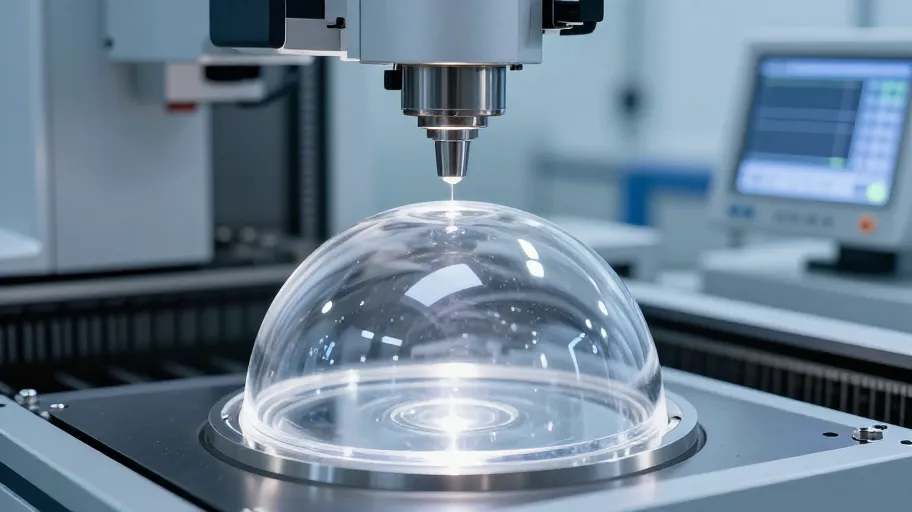
Selecting the right sapphire crystal manufacturer in China shapes durability, brand trust, and long-term value. Price isn’t the real cost—failure is. Here’s how to cut through the noise.
Why certification kills product failure before it starts
Partnering with a certified sapphire crystal China manufacturer slashes the risk of field failures by enforcing repeatable, audited processes. ISO 9001 and IATF 16949 certifications mean fewer defects because every step—from raw Al₂O₃ powder to finished dome—is tracked, tested, and improved. For a Swiss indie brand that skipped certification in 2025, the result was a 12% recall due to micro-fractures from poor annealing. Certified factories prevent this with controlled thermal cycles and stress-relief protocols verified by CMMs down to ±0.01mm.
That level of control directly impacts your bottom line. Data from a 2024 global precision optics benchmark shows certified suppliers have 40–60% lower defect recurrence in optical components. Fewer defects mean lower warranty costs, yes—but more importantly, they protect your brand’s reputation. One European luxury label learned this when non-certified AR coatings yellowed after 18 months in tropical sun. A certified partner would’ve caught it during environmental aging tests.
Certification isn’t overhead—it’s early-warning radar. It means your crystals resist not just scratches from steel tools (Mohs 6.5), but UV degradation that dulls premium finishes over time. That consistency is why watches with verified sapphire components retain 18–22% higher resale value over five years, according to WatchCharts’ 2023 analysis. The crystal becomes proof of engineering rigor, not just glass covering a dial.
What separates real sapphire China manufacture from assembly shops
A true sapphire crystal China manufacture grows, cuts, and finishes its own monocrystalline sapphire—it doesn’t just polish imported blanks. Real control starts with raw aluminum oxide fused into boules via Verneuil or Kyropoulos methods. This vertical integration means you can verify purity, grain structure, and refractive index uniformity upfront. Assembly-only shops skip these steps, buying pre-cut slabs with unknown histories—opening the door to internal strain and weak edges.
Controlling the full chain means better hardness (Mohs 9) and edge integrity because finishing happens in-house under consistent conditions. One Hong Kong designer needed a 0.8mm domed crystal—a geometry prone to chipping. Only two of three qualified global suppliers were in China, both running proprietary laser-trimming algorithms that adjust pulse frequency based on real-time thickness feedback. That’s not commodity manufacturing; that’s precision engineering.
This depth of capability translates into design freedom. Advanced CNC lapping with adaptive pressure reduces surface deformation by up to 35%. Femtosecond lasers cut complex bevels without thermal stress cracks—tech once limited to semiconductors. If your design pushes limits, your supplier must too. Otherwise, you’re betting on luck, not process.
How tech investment reduces your long-term risk
Top sapphire China factories don’t compete on labor cost—they win with technology that prevents errors before they happen. In-line metrology labs run dimensional checks on every batch. Environmental chambers simulate five years of UV, humidity, and thermal cycling in weeks. Failure mode analysis (FMEA) frameworks predict where stress concentrates, so designs are adjusted proactively.
These systems mean problems like coating delamination or edge fractures are caught in sampling, not customer returns. For example, inconsistent AR layer adhesion often stems from uncontrolled deposition temperatures. Certified labs monitor this in real time, ensuring optical clarity lasts. Without that control, you risk visible haze or yellowing—especially in markets with intense sunlight.
The return on this rigor compounds. Lower defect rates reduce post-sale service costs by nearly 40%, as one brand discovered after switching suppliers. But beyond cost, there’s trust: collectors now check component provenance. A documented supply chain from certified factory to final assembly signals authenticity. That trust doesn’t just prevent recalls—it increases secondary market value, giving owners and resellers confidence in longevity.
From liability to competitive advantage
Choosing a sapphire crystal manufacturer shouldn’t be about minimizing upfront cost—it should be about maximizing long-term control. Certification, vertical integration, and advanced metrology aren’t expenses; they’re filters that eliminate variability. When you partner with a true sapphire China factory, you turn material risk into a differentiator.
Consider what happens downstream: fewer failures mean fewer warranty claims, less reputational damage, and stronger collector appeal. Watches with traceable, certified crystals command higher resale prices because buyers see them as engineered, not assembled. That perception starts with your choice of supplier.
And the best partners don’t just meet specs—they help refine them. They’ll flag a fragile edge radius before tooling begins. They’ll suggest coating stacks that improve anti-reflective performance without sacrificing durability. That collaboration turns manufacturing from a transaction into a strategic lever.
Next steps for confident sourcing
Don’t stop at a certificate PDF. Ask for test reports from recent batches, access to metrology data, and examples of FMEA documentation. Request a sample run with accelerated aging results. If they hesitate, move on.
See how their process handles edge cases—like ultra-thin domes or complex anti-reflective treatments. A real sapphire crystal China manufacture will walk you through their controls, not just quote lead times. And when you find one that does, hold on: they’re not just a vendor. They’re your insurance against failure—and your ally in building something that lasts.
Ready to stop gambling on quality? Talk to a certified sapphire China factory that treats precision as standard, not optional.