
Compare manufacturers using technical due diligence
When comparing sapphire watch crystal manufacturers in China, material sourcing integrity, machining precision, and optical quality assurance mean fewer field failures and faster time-to-market because they directly control durability and certification readiness. A Swiss luxury brand learned this the hard way: skipping deep technical vetting led to a six-figure loss when crystals failed under pressure testing. The root cause? A supplier with ISO 9001 certification but no advanced metrology.
Raw aluminum oxide quality varies widely. Most factories buy pre-grown boules, introducing inconsistencies in scratch resistance and light transmission. But leading sapphire crystal china manufacture sites grow their own using the Czochralski method with tight thermal control. This ensures optimal c-axis alignment—cutting perpendicular to it maximizes hardness (up to 2,200 Vickers) and minimizes birefringence. Cutting against grain saves yield but scatters light under magnification and wears faster. A 2024 benchmark found only 38% of facilities document crystal orientation per batch, yet those that do report 41% fewer returns from surface degradation.
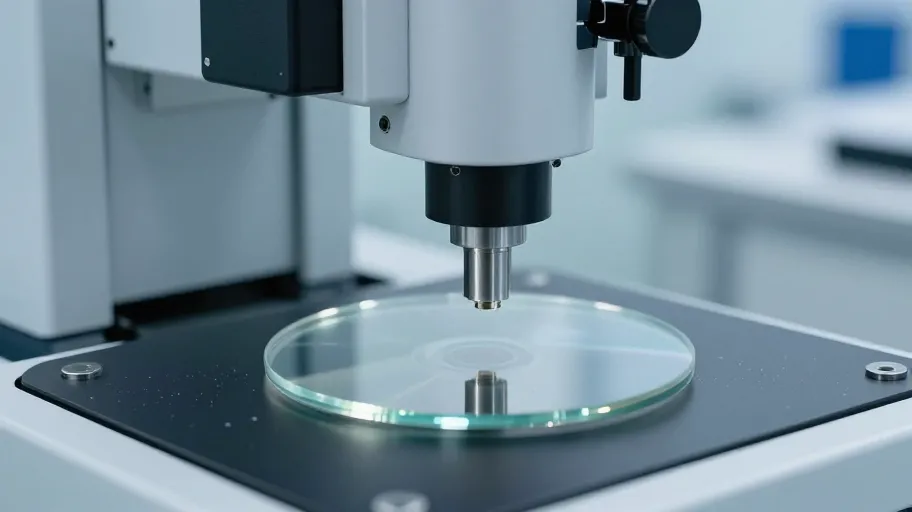
Laser interferometry is non-negotiable for dimensional accuracy. Luxury watches need perfect case-to-crystal seating, especially beyond 200 meters. Interferometry measures flatness down to ≤0.1μm across the entire disc—something contact profilometers miss. In one lab test, two batches passed ISO 764 standards, but only the interferometrically mapped batch survived sustained 30-bar pressure trials. The others failed within 48 hours due to invisible micro-warping. For brands targeting COSC or METAS certification, sub-micron verification reduces rework by up to 60% and accelerates launch timelines.
Optical fidelity also depends on post-processing. Helium leak testing detects microscopic porosity in edge seals—yet fewer than 12% of factories perform it, according to a 2025 European watch federation audit. Without it, moisture ingress clouds dials months later. Top-tier facilities pair helium testing with cleanroom lapping and nitrogen-purged packaging—processes borrowed from aerospace. These aren’t costs; they’re enablers of premium positioning and lower warranty claims, which have totaled over $4.2M since 2023 for mid-tier brands using untested suppliers.
Don’t mistake compliance for capability
Assuming all sapphire china factories are equal leads to disaster. There’s a sharp divide between commodity producers and engineered solutions partners. Commodity shops run mixed batches on shared polishing lines, increasing contamination risks like metallic residue embedding into soft edges. Elite manufacturers dedicate tooling paths per order, use mono-material slurries, and track each disc via serialized QR codes from boule to final inspection. One client cut particulate-related rejections from 7% to 0.3%, avoiding 22 production stoppages annually and reaching volume output 30% faster.
This level of control transforms development cycles. Typical diver watch launches involve three prototyping phases delayed by fit-and-finish issues. But when manufacturers integrate CAD/CAM feedback with real-time metrology, they enable predictive adjustments before final tooling. A Hong Kong brand compressed its timeline from 14 weeks to 8, capturing Q4 sales ahead of competitors. Their secret wasn’t speed—it was confidence. Full traceability and repeatable processes got them METAS pre-qualification on the first submission, avoiding late-stage redesigns.
To evaluate a partner, treat ISO 9001 as an entry ticket, not proof of excellence. Ask if they grow their own boules, how they verify cut orientation, and what percentage undergoes interferometric scanning. Demand evidence of helium leak testing for watches rated above 200m. Insist on a live demo of their flatness reporting—spreadsheets hide variation that images expose instantly. The difference between a vendor and a strategic ally lies in process discipline, transparency, and long-term risk mitigation.
Rigorous comparison doesn’t just prevent recalls—it turns manufacturing into a competitive accelerator. Brands that master technical due diligence shorten innovation cycles, boost certification success, and build reputations on uncompromised quality. In an era where consumers care about provenance, the right sapphire china factory isn’t a cost center. It’s the silent guardian of your brand’s integrity—one polish at a time.