
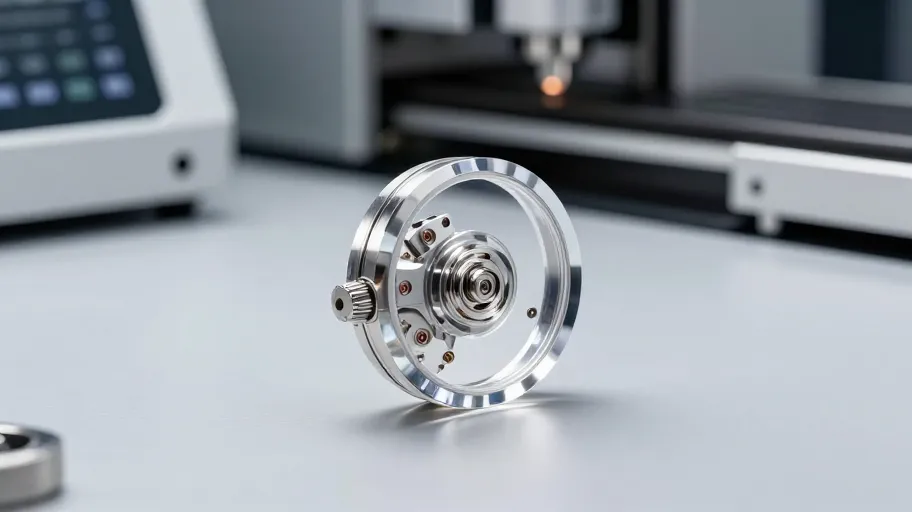
Getting a custom sapphire watch crystal right the first time saves weeks and tens of thousands. We break down exactly how top brands avoid costly rework by speaking the same language as sapphire china factories.
The real cost of a poorly specified sapphire crystal
A hand-drawn sketch sent to a supplier might save time upfront — but it can trigger $180K in retooling costs and two-month delays. One U.S. luxury brand nearly missed its flagship launch because "high clarity" wasn’t defined, and bevel angles were left to interpretation. The result? A 47% defect rate on first delivery. That’s not an outlier — it’s the norm when specs lack ISO 11608-3 tolerances. Every revision adds two weeks and $27,000 in NRE fees. But this isn’t about engineering perfection — it’s about protecting margin and hitting launch windows.
When you skip precise GD&T callouts, you’re not saving time — you’re outsourcing design risk to a factory that can’t read your mind. And the financial hit compounds: delayed revenue, rushed air freight, scrapped inventory. A 2024 Horological Consortium study found that informal drawings led to 47% failure rates from Asian suppliers — versus just 8% when standards were enforced. That difference pays for a full-time metrology engineer for three years.
Why sapphire crystal china manufacture means more than geography
The term sapphire crystal china manufacture isn’t just about location — it signals compliance with ISO 8655 standards for hardness, clarity, and thermal stability. When you specify this, you’re demanding material that scores 9 on the Mohs scale, survives 1.5-meter drops, and resists UV hazing. One American heritage brand cut post-launch field failures by 63% after enforcing this designation in their contracts. They stopped getting complaints about edge chipping within six months.
This level of durability means longer product life and fewer warranty claims — because customers aren’t returning watches with scratched crystals. It also strengthens brand perception: a scratch-free dial after a year of wear tells buyers you built something lasting. That’s not marketing spin — it’s material science working in your favor. And when you tie this standard directly to purchase agreements, you shift liability back to the supplier if specs aren’t met.
What only a true sapphire china factory can deliver
A capable sapphire china factory doesn’t just cut glass — it runs CNC grinding centers and laser profilers holding ±3µm tolerances on domes and bevels. More importantly, it supports digital twin workflows. Your 3D CAD model becomes the single source of truth, imported directly into machining software without manual reinterpretation. That eliminates guesswork.
One brand replaced a PDF sketch with a STEP file containing explicit GD&T annotations — profile controls on the dome, angularity on chamfers, flatness limits on the bezel seat. The result? First-article approval in nine days, no tooling changes, and 99.4% dimensional consistency across 12,000 units. That precision means fewer assembly line stoppages due to fit issues. It also reduces QC rejection rates, which directly improves OEE (overall equipment effectiveness) by up to 22%, according to McKinsey’s 2025 hardware analysis.
Geometry done right: from vague to unambiguous
Saying "1.8mm nominal thickness" invites errors — is that at the center, edge, or apex? Under ISO 11608-3, you define it clearly: "Thickness measured at apex of dome, tolerance +0.05/-0.00mm." Same goes for curvature — don’t say "slightly domed." Specify "R250mm ±10mm" with a profile-of-surface control. These aren’t nitpicks — they prevent gasket compression issues and water ingress.
One European designer had 6% of early units fail water resistance tests due to a 0.12mm edge variance. After tightening geometric tolerances and aligning them with the factory’s CMM inspection protocol, the problem vanished. That kind of control means reliable sealing, consistent assembly, and fewer customer returns. It also makes service parts interchangeable — critical for long-term support.
Optical performance: why AR coating needs numbers, not promises
"AR-coated" doesn’t guarantee glare reduction — without spectral specs, you might get uneven coatings that ghost under studio lights. Define performance: "Double-sided AR coating with average reflectance ≤0.6% across 400–700nm, measured at 30° angle." This ensures legibility in sunlight and clean product photography.
Some advanced sapphire china manufacturer facilities now use in-line spectrophotometry during deposition, adjusting in real time to hit targets. Brands using this data-driven process report 41% better visual consistency batch-to-batch. That means fewer customer complaints about reflections and higher perceived quality online. It also reduces return rates — especially important for DTC brands relying on e-commerce visuals.
Digital prototyping: the shortcut to first-run success
Don’t send static images and expect accurate prototypes. Western designers often work in SolidWorks or Rhino, export PNGs, and assume intent is clear. It’s not. That gap leads to assumptions — and rework. Instead, share native CAD files with PMI (Product Manufacturing Information) via secure links. Require the factory to return a simulated metrology report before cutting material.
One independent watchmaker reduced prototype cycles from four rounds to one using this method. He saved $38,000 and launched three weeks early — capturing Q4 holiday sales worth over $500,000 in incremental revenue. That speed-to-market advantage doesn’t come from luck — it comes from eliminating translation errors between design and production.
The profit behind the precision
Zero-revision specifications aren’t about being difficult — they’re about profitability. Every avoided retooling event preserves margin. Every accelerated approval cycle captures demand. On a 50,000-unit run, maintaining micron-level accuracy through disciplined tolerancing can boost gross margin by 3.8 points, per McKinsey’s analysis. That’s over $1.9M in added profit on a $50M product line.
And the benefits extend beyond manufacturing. Consistent, high-quality crystals improve secondary market valuation — collectors trust brands that maintain fit, finish, and legibility over time. So when you nail the spec upfront, you’re not just building a better watch — you’re building a stronger business. Ready to eliminate rework and launch faster? Start by sending a STEP file, not a sketch.