
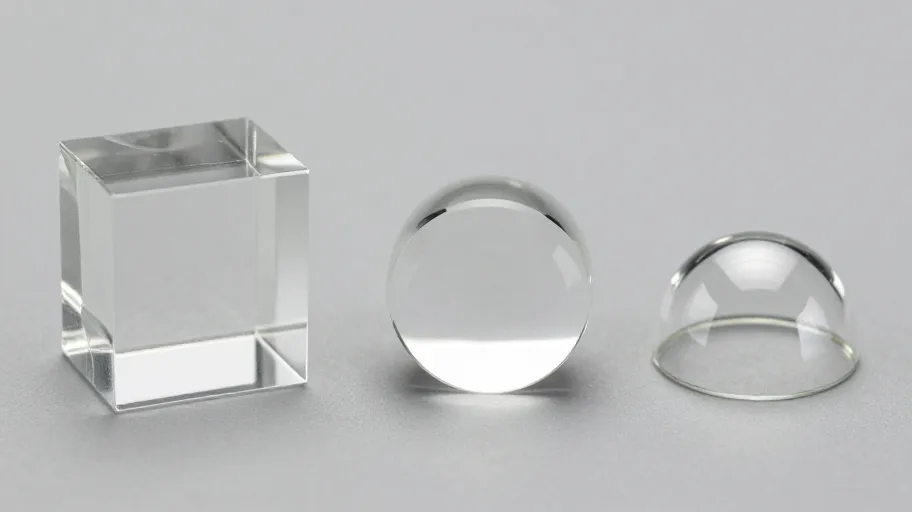
Selecting the right sapphire watch glass types involves balancing the intended aesthetic narrative with the mechanical realities of water resistance and dial legibility. While flat crystals offer the most straightforward path to high compression ratings and minimal distortion, domed and box-type geometries provide the distinctive visual depth and vintage authenticity that modern collectors demand, provided the brand accounts for increased internal volume, light refraction, and hand clearance.
The Geometric Integrity & Sealability Matrix
For product developers and sourcing managers, choosing a crystal geometry is not merely a stylistic decision; it is an engineering constraint that defines the case architecture. We utilize the Geometric Integrity & Sealability Matrix to evaluate these options. This framework weighs three critical variables:
- Sealability: The surface area available for the gasket or compression ring. Flat surfaces offer maximum uniform contact, while complex curves require precise profiling to maintain consistent pressure.
- Internal Volume: The space created inside the case. Higher domes increase the volume of air trapped inside, which can impact compression testing and movement height requirements.
- Optical Distortion: The degree to which the geometry alters light transmission. Curved surfaces act as lenses, potentially magnifying or distorting the dial unless specifically mitigated by coating thickness and placement.
Flat Sapphire: The Utility Standard
Flat sapphire crystal remains the industry benchmark for tool watches, divers, and field watches where legibility and robustness are paramount.
From a sourcing perspective, flat crystals are generally the most efficient to manufacture and finish. They allow for a simple, linear gasket seat that maximizes the seal surface area. This geometry is the preferred choice when the design objective is a compression rating suitable for significant depths without the complexity of calculating variable gasket compression on a curve.
However, the aesthetic is strictly utilitarian. It lacks the visual "pop" and vintage warmth that curved glass provides. For brands focusing on modernist or industrial design languages, the flat crystal is the correct choice. However, designers must ensure that the dial design is sufficiently compelling, as the crystal will not contribute to the visual depth of the face.
Domed Sapphire: Single vs. Double Dome
Domed sapphire is the primary choice for dress watches and contemporary sports watches seeking a softer, organic interface with the wearer.
Single Dome A single dome is curved on the exterior but flat on the interior. This geometry offers a vintage aesthetic while simplifying the movement clearance requirements. Because the interior surface is flat, the hands do not need to be bent to follow the curve of the glass, and there is minimal risk of the seconds hand rubbing against the crystal.
Double Dome The double dome curves on both the exterior and the interior. This is technically demanding to grind and polish, as the wall thickness must remain consistent throughout the curve. The advantage is a slimmer profile at the edges while maintaining a high, magnifying central arch.
The critical sourcing consideration here is refraction. A double dome acts as a strong lens. Without a high-quality internal anti-reflective (AR) coating, the dial can disappear under certain lighting angles. When specifying a double dome, developers must verify the supplier's capability to apply uniform coatings on complex internal curves to prevent "ghosting" or hazing.
Box-Type Sapphire: The Vintage Specialist
Box-type sapphire (often referred to as "high box") is distinct from a standard dome. It features a tall, vertical wall that rises straight up before transitioning into a dome. This mimics the look of vintage acrylic crystals found on mid-century marine chronometers and pilot watches.
This geometry presents the highest challenge for the Geometric Integrity & Sealability Matrix.
- The Vertical Wall: Unlike a gentle curve, the vertical wall requires a case design with a specific step or ledge to support the crystal. The gasket must often sit on a flat surface at the top of this wall, rather than the base.
- Optical distortion: Due to the thickness and abrupt curve transition, box crystals can create significant edge distortion. Sourcing managers must confirm if the "crazy" edge distortion is a desired vintage trait or if they require a "distortion-free" box profile, which requires advanced tooling.
- Clearance: The interior of a box crystal is often cavernous. This increases the total case height and may require longer hand sets or specific dial placement to avoid a hollow look.
Selection Decision Table
| Feature | Flat Sapphire | Domed (Single/Double) | Box-Type Sapphire |
|---|---|---|---|
| Primary Aesthetic | Modern, Industrial, Technical | Elegant, Organic, Retro | Vintage, Historical, Bold |
| Water Resistance Ease | High (Uniform gasket compression) | Moderate (Requires precise seating) | Complex (Requires specialized case step) |
| Internal Volume | Low | Medium to High | Very High |
| Hand Clearance | Standard | Standard (Single) / High (Double) | High |
| AR Coating Criticality | Low (External usually sufficient) | High (Internal essential) | Very High (Internal critical) |
| Ideal Application | Diver watches, Field watches, Chronographs | Dress watches, Pilot watches, Daily drivers | Re-issues, Marine chronometer styles |
Project Verification Checklist
Before initiating a custom run of sapphire crystals, product developers should verify the following parameters with their technical team and manufacturer:
- Case Architecture: Does the case accommodate the specific "sagitta" (height of the curve) of the crystal? Verify that the case back or movement ring does not conflict with the interior curve.
- Hand Clearance: Have you calculated the distance between the highest point of the hands (usually the seconds hand) and the interior crystal surface at full winding or maximum hand stack?
- Gasket Specification: For domed and box types, is the gasket a flat O-ring, a custom profile, or a glue-seal? The geometry dictates the seal method.
- Coating Specification: If selecting a double dome or box type, is the AR coating specified for the interior surface? Have you requested a "hard coat" to prevent scratching during assembly?
- Edge Finish: How will the vertical edge (box) or the bevel (dome) be finished? Polished, matte, or brushed?
Approval Questions for the Supplier
When engaging with a manufacturer for these geometries, avoid asking for "best" or "cheapest." Instead, ask verification questions:
- How do you verify consistent wall thickness on double-domed geometries to prevent optical distortion?
- What is the recommended tolerance for the interior radius to ensure standard hand clearance without modification?
- For box-type crystals, can you provide a cross-section diagram of the recommended case step to ensure a proper compression seal?
- How is the internal AR coating applied to high-curvature interiors to ensure even coverage without pooling?
Frequently Asked Questions
Can a box-type sapphire crystal achieve the same water resistance as a flat crystal? Yes, but the construction method differs. A flat crystal relies on a simple compression ring. A box-type crystal often requires a specially machined case step and a gasket that sits on the flat top of the wall, or a specialized bonding process. The design of the case plays a much larger role in the water resistance of a box crystal than the crystal itself.
Why are double-domed crystals more expensive to source? The cost lies in the grinding and polishing process. To achieve a double dome, the sapphire must be ground to a consistent thickness while following two complex radii. Additionally, applying an internal AR coating on a double dome is technically difficult; the spray application must be perfectly uniform to avoid visual defects, which increases material waste and processing time.
Does the thickness of the sapphire affect the "domed" look? Yes. A thicker blank allows for a higher dome without compromising structural integrity. However, increasing thickness also increases weight and cost. There is an engineering balance between achieving the desired visual height and maintaining a slender profile for wearability.
[Compare crystal geometries]
Download the Sourcing Checklist: 5 Points to Verify Before Ordering Custom Sapphire.