
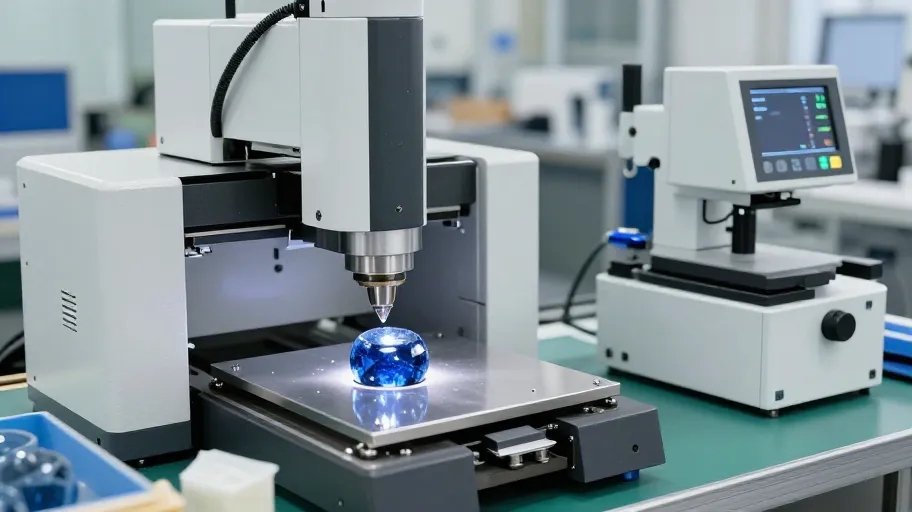
To effectively compare a sapphire watch crystal manufacturer, procurement teams must move beyond unit price and strictly evaluate technical capabilities, material traceability, and quality control protocols. The most reliable way to assess a potential partner is to audit their process controls—from raw boule sourcing to final optical inspection—rather than relying solely on sample aesthetics. By implementing a structured vetting framework, buyers can mitigate the risk of batch inconsistencies and ensure the supplier can meet specific geometric and optical requirements.
The Crystal-Clear Vetting Protocol
Comparing manufacturers of technical components like sapphire crystals requires a shift from vendor shopping to technical auditing. We recommend using the Crystal-Clear Vetting Protocol. This framework divides the evaluation into three distinct pillars: Material Traceability, Process Precision, and Verification Standards. This approach ensures that the supplier you select possesses not just the machinery, but the discipline to deliver consistent results in mass production.
1. Assessing Raw Material Sourcing and Composition
The foundation of any high-quality sapphire component lies in the raw material. While all synthetic sapphire is essentially aluminum oxide (corundum), the growth method and purity levels vary significantly. When evaluating a manufacturer, do not simply ask if they use "sapphire." Ask for the specific origin of their boules and the growth method employed—whether it is Kyropoulos, Czochralski, or EFG.
A transparent sapphire watch crystal manufacturer should be willing to disclose material specifications. Ask to see the material certificates for a recent batch. You want to verify the absence of bubbles or stone lines that could cause structural weakness. If a supplier is vague about their material supply chain or sources from multiple unknown brokers, this represents a significant risk variable. Consistency in the final product is impossible without consistency in the raw input.
Key Questions to Ask:
- Can you provide the material specification sheet for the boules used in this project?
- What is the typical bubble class or inclusion standard for your raw material?
- How do you trace a finished crystal back to a specific boule lot in case of defects?
2. Evaluating Precision Grinding and Polishing Capabilities
Sapphire is an extremely hard material (ranked 9 on the Mohs scale), making it difficult to machine. The difference between a standard component and a premium one often lies in the grinding and polishing stages. When comparing suppliers, scrutinize their equipment and tooling strategies.
Specifically, inquire about their capability to produce your required geometries. If your design involves complex shapes like double-domed crystals, stepped edges, or internal drilling for apertures, the manufacturer needs specialized CNC grinding equipment. Do not assume that a factory producing flat crystals can execute a high-curvature dome with the same precision.
Furthermore, ask about their tooling management. How often do they dress or replace their grinding wheels? Worn tooling can lead to micro-fractures or surface waviness. A supplier who can articulate their tooling maintenance schedule is more likely to maintain dimensional stability throughout a production run.
Key Questions to Ask:
- What is the maximum curvature or dome height your equipment can achieve for my specific dimensions?
- Can you describe your tooling maintenance protocol to ensure consistent surface finish?
- Do you utilize CNC grinding for profile generation, or is manual intervention involved?
3. Analyzing Coating Processes and Optical Clarity
Many modern timepieces require anti-reflective (AR) coatings to enhance legibility. When evaluating a sapphire watch crystal manufacturer, the coating process is a frequent point of failure. Cheap or improperly applied coatings can peel, scratch easily, or degrade over time.
You must differentiate between "dip" coating and vacuum deposition. While specific techniques vary, you should verify if the manufacturer performs coating in-house or outsources it. In-house coating generally allows for better quality control over adhesion and thickness consistency.
Ask for validation of the coating's performance. Do not accept generic claims like "scratch-resistant." Instead, ask for the results of standard adhesion tests, such as cross-hatch tape tests or pencil hardness tests specific to the coated surface. The goal is to ensure the optical performance does not compromise the structural integrity of the crystal.
Key Questions to Ask:
- Is the AR coating applied in-house or by a third-party partner?
- What adhesion tests do you perform to verify coating durability?
- Can you provide spectral transmission data for the proposed coating solution?
4. Quality Control Protocols and Defect Management
A robust Quality Control (QC) system is the primary defense against batch failures. When visiting or auditing a supplier, look for a documented QC process that covers every stage of production, not just the final inspection.
Inquire about the inspection equipment used. Do they utilize automated optical inspection (AOI) systems for surface defects, or is the process entirely manual? While manual inspection by skilled technicians is valuable, automation adds a layer of objectivity for detecting sub-microscopic scratches or chips.
Crucially, ask about their "red bin" process. How do they handle defective units? A reliable manufacturer will have a traceable system for quarantining and analyzing defects to prevent recurrence. If a supplier cannot show you their defect rate data or corrective action reports, they likely lack the process maturity required for high-end watch manufacturing.
Key Questions to Ask:
- What is the ratio of automated to manual inspection in your final QC stage?
- Can you share a summary of defect types and frequencies from a recent similar production run?
- How are out-of-tolerance parts identified and segregated during the production process?
5. Logistics, Commercial Terms, and Communication
Finally, the commercial viability of the partnership must be assessed. While specific numbers depend on your project volume, the flexibility of the manufacturer is a key differentiator.
When discussing Minimum Order Quantities (MOQs), look for a partner willing to support your ramp-up phase. A rigid high MOQ can stall product development. Similarly, understanding their lead time structure is vital. Ask them to break down the lead time: how much is allocated for raw material procurement vs. machining vs. coating? This breakdown helps identify potential bottlenecks.
Communication is often the softest metric with the hardest impact. Evaluate their responsiveness during the quoting phase. Are they answering technical questions with engineering detail, or are they deflecting? The quoting phase is often a preview of production communication. If they are slow to respond now, they will likely be slow to alert you to issues during manufacturing.
Decision Matrix: Comparing Potential Suppliers
| Evaluation Criteria | High-Risk Indicator (Proceed with Caution) | Positive Indicator (Preferred Partner) |
|---|---|---|
| Material Traceability | Cannot link finished part to a specific boule lot. | Provides full material traceability and certificates. |
| Process Control | Vague answers about tooling changes or maintenance. | Documented maintenance schedules and process parameters. |
| Coating Quality | Outsourced coating with no adhesion test data available. | In-house vacuum deposition with verified adhesion test results. |
| Inspection | 100% reliance on visual inspection under standard light. | Combination of automated inspection and controlled lighting visual checks. |
| Defect Management | No data on historical defect rates or "it depends" answers. | Transparent sharing of Pareto charts for defect analysis. |
| Project Support | Rigid MOQs and standard lead times only. | Willingness to discuss ramp-up schedules and engineering support. |
Approval Questions for Your Team
Before signing a contract with a new sapphire watch crystal manufacturer, ensure your sourcing and QA teams can answer "Yes" to the following:
- Has the supplier provided material certification for the specific boules to be used?
- Have we verified their capability to hold the required geometric tolerances for our specific profile?
- Are the coating performance metrics (adhesion, hardness) documented and available for review?
- Is there a clear agreement on the inspection criteria and the acceptable quality limit (AQL)?
- Have we validated their communication flow and emergency escalation protocols?
Frequently Asked Questions
How can I verify if a crystal is genuine sapphire without specialized equipment? While a professional setting requires refractive index testing, a basic field check involves a thermal conductivity test (sapphire feels cold to the touch) or a scratch test against a known material (like quartz). However, for B2B procurement, you should never rely on these physical tests. Instead, require the supplier to provide material chemical composition reports and origin certificates as part of the contract.
What is the typical tolerance range for sapphire crystal dimensions? Tolerances are entirely project-dependent and rely on the geometry of the part. While simple flat crystals might hold tighter tolerances, complex domed shapes introduce more variables. Rather than asking for a "standard" tolerance, provide your supplier with your assembly requirements and ask them to confirm if their process can consistently achieve that specific range.
Do I need to worry about color variations in sapphire? Synthetic sapphire is typically colorless. However, impurities in the growth process can sometimes introduce a slight tint. If your watch design requires absolute color neutrality, you must specify this as a critical requirement. Ask the manufacturer how they measure color consistency—usually using a spectrophotometer—to ensure there is no batch-to-batch variation.
Ready to audit your supply chain?
Don't leave your watch quality to chance. Use our comprehensive Supplier Evidence Checklist to standardize your vetting process and ensure you partner with a manufacturer who meets your technical standards.
[Download the Supplier Evidence Checklist]
Still defining your technical specifications? Contact our engineering team for a preliminary design review.
[Start a Technical Discussion]