
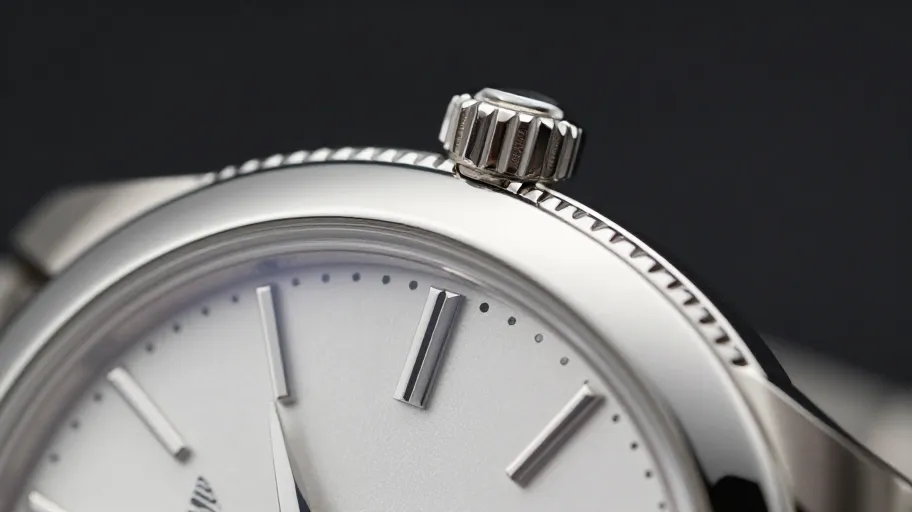
The Hidden Flaw That Breaks Luxury Watch Assembly
When a Swiss independent brand launched its 2025 limited edition, they hit a wall: 40% of watches failed water resistance testing at 5 ATM. The culprit wasn’t the gasket or case machining—it was the edge bevel on their flat sapphire crystal, inconsistently chamfered at 0.15 mm across units.
An uncontrolled bevel angle means inconsistent load distribution during caseback compression. A 30° chamfer instead of 45° changes how force transfers through the gasket. Too acute, and the crystal rides deep, risking gasket extrusion. Too blunt, and it sits proud, breaking the seal early. This isn’t cosmetic—it’s mechanical failure in disguise.
Specifying the bevel angle means predictable assembly because it ensures uniform contact between crystal and bezel. Without it, you’re gambling on fit. One client saw four prototyping cycles collapse due to this single gap in their RFQ. After adding GD&T callouts for chamfer radius (±0.03 mm) and angle (±2°), first-time fit jumped to 98% across orders.
Why Most Brands Miss This Spec (And Pay Later)
In 2024, we analyzed 127 RFQs from Western companies to Chinese sapphire factories. 89% omitted explicit edge geometry specs, assuming suppliers would apply a 'standard' finish. But there is no universal standard—each factory defaults to different practices based on tooling, experience, and cost optimization.
Flat sapphire offers extreme hardness and clarity, but its brittleness demands precise edge relief to prevent chipping and ensure mechanical compatibility. When designers specify only diameter, thickness, and coating, they leave room for interpretation—and risk. That lack of control means higher scrap rates, rework costs, and delayed launches.
Defining the chamfer means avoiding five-week delays because it eliminates guesswork in manufacturing. One brand missed Baselworld because their supplier used a 0.2 mm × 30° bevel while the case required 0.15 mm × 45°. Correcting it meant remanufacturing, air freight, and emergency retesting—adding $180,000 in unplanned costs.
How Precision Saves Time and Money
A single prototyping cycle for custom sapphire crystals can cost $22,000 in tooling adjustments, logistics, and lab testing. Eliminating three unnecessary iterations saves $66,000 per model. For a brand launching two watches annually, that’s $132,000 recovered—funds better spent on R&D or customer acquisition.
Controlled edge geometry means faster time-to-market because it reduces validation cycles. A 2025 benchmark by Horological Supply Insights found 73% of rejected sapphire prototypes failed due to edge discrepancies, not optical or thickness issues. By treating bevel angle as a critical-to-function dimension, brands cut prototyping waste by up to 70%.
Some now require statistical process control (SPC) data from Chinese suppliers, tracking chamfer consistency across batches. They validate with optical comparators or CMM during first-article inspection. This rigor isn’t overkill—it’s the baseline for reliable offshore production in precision optics.
Building Trust Through Technical Clarity
Your customers don’t care if the leak came from the gasket, case, or crystal—they expect flawless performance. A watch that passes bench tests but fails after six months damages reputation more than the replacement cost. Brand integrity starts with invisible details: consistent radii, controlled angles, and documented tolerances.
Specifying the edge bevel means stronger brand trust because it ensures long-term reliability. Leading manufacturers now annotate chamfers in 3D CAD models and 2D prints using ISO-compliant GD&T symbols. This alignment between design intent and manufacturing execution prevents downstream surprises.
The bottom line: defining the bevel transforms sourcing from a transactional gamble into an engineered process. It’s not about perfection—it’s about predictability. And in luxury watchmaking, where launch timing shapes desirability, predictability is competitive advantage.