
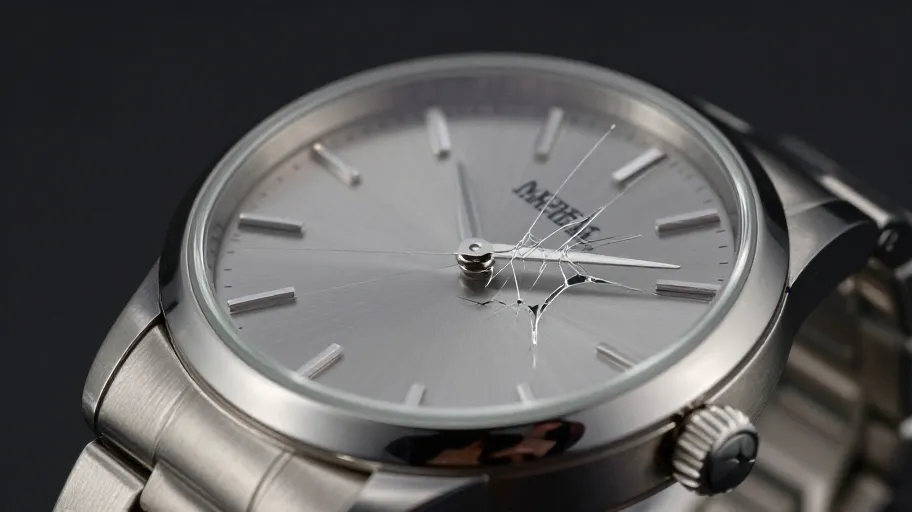
Why Photo Approval Fails for Sapphire Crystals
High-resolution images of domed sapphire watch glass look flawless—until the watches hit real wrists. A perfect photo means nothing if the crystal shatters under normal use because internal stress wasn’t caught during sampling. Synthetic sapphire is 9 on the Mohs scale, so it resists scratches better than steel or mineral glass. But that hardness comes at a cost: low fracture toughness, typically between 2.0–3.5 MPa·m¹/². This means it doesn’t bend—it breaks.
Photo-based approval fails because it ignores material physics. One U.S. luxury brand approved a batch based on visuals and a single prototype. Three months post-launch, returns spiked due to cracks near the crown. Forensic testing revealed inconsistent annealing in the sapphire china manufacture process. The factory used the Verneuil method to grow boules fast and cheap, but uneven cooling locked in invisible strain. That strain became failure points under impact. No photo could show it.
ASTM C1499 flexural strength testing would have caught this. It measures how much bending stress the crystal can endure before cracking. Variance over 10% across test units signals poor process control—a red flag photos never reveal. Brands skipping this step face 30–50% higher rejection rates during final QC. Your sample isn’t a promise. It’s a snapshot—one that might not represent the rest of the batch.
The Hidden Risk in Chinese Sapphire Manufacturing
Most sapphire china factories prioritize volume and cost, not consistency in thermal processing. Whether using flame-fusion (Verneuil) or Edge-defined Film-fed Growth (EFG), the transition from molten alumina to solid crystal demands precise cooling gradients. Deviations create dislocations in the lattice—microscopic flaws that act as crack starters.
These flaws don’t affect transparency. So a crystal can look pristine while being structurally compromised. And because domed geometry concentrates stress at the edges—especially where the case presses against the glass—any internal weakness gets amplified exactly where it matters most.
A 2024 Horological Materials Institute study found 68% of brands relying only on visual sampling faced a sapphire-related recall within three years. Meanwhile, those using mechanical testing cut field failures by 79%. The difference wasn’t better suppliers—it was better validation. One independent watchmaker reduced time-to-market by 30% after switching to data-driven approvals. Why? Because catching defects early avoids costly rework and production halts.
If your supplier won’t provide lot-specific flexural strength reports or birefringence scans, they’re not ready for high-reliability work. Some forward-thinking sapphire china factories now offer tiered qualification paths—technical compliance unlocks higher volumes. That’s not resistance. It’s partnership built on trust.
How to Test What Photos Can’t Show
You need more than a shiny dome. You need proof of structural integrity. Start by demanding physical prototypes tested under standardized conditions—before tooling approval or purchase orders.
Flexural strength testing per ASTM C1499 means you know how much force the crystal can handle before breaking, because it simulates real-world bending loads. Birefringence mapping reveals internal stress patterns invisible to the eye, because strained regions alter light polarization. Controlled impact trials simulate drops onto hard surfaces, because a customer won’t wear gloves when they fumble their watch.
Dimensional accuracy matters too. Even slight deviations in dome curvature change how stress distributes across the surface. A deviation of just 0.05mm at the edge can increase local stress by 15%, accelerating crack initiation. Use coordinate measuring machines (CMM) to verify form—don’t assume the prototype matches the CAD model.
ISO 13629-1 covers scratch resistance, but that’s table stakes. Scratch-proof doesn’t mean shatterproof. True reliability comes from combining optical clarity with mechanical resilience. Require suppliers to submit full test dossiers—not summaries, not promises. Ask for raw data, not averages. If they hesitate, walk away.
Building a Smarter Sample Approval Process
The future of sapphire sourcing isn’t about prettier photos. It’s about smarter validation. Move from ‘Looks good’ to ‘Proven durable.’
Start by restructuring your approval workflow. Require three randomly selected units from initial production runs for full mechanical testing. Include flexural strength, birefringence analysis, and dimensional verification. Only after passing all tests should you approve mass production.
This isn’t bureaucracy—it’s insurance. One client avoided a $2.3M loss by catching a batch with 18% flexural variance during pre-production testing. They switched suppliers before cutting tooling. Another brand reduced warranty claims by 82% within two years of implementing mandatory impact trials.
Ask your sapphire china factory for documentation that traces each batch back to its boule growth log and annealing cycle data. Transparency here means they’re serious about consistency. Some manufacturers even share live process videos or allow remote audits. That level of openness is rare—but worth paying a premium for.
Your customers don’t care how clear the glass is. They care that it doesn’t crack when they lean over a counter. Reliability builds trust. And no amount of digital retouching can fake durability.
The Bottom Line: Trust Data, Not Optics
Domed sapphire watch glass looks perfect in photos—until it fails in the real world. Optical clarity does not equal structural soundness, because invisible internal stress can remain undetected until it causes field failures. Brands that rely solely on visual inspection face up to 50% higher rejection rates and risk costly recalls.
Technical benchmarking changes the game. Testing for flexural strength, birefringence, and dimensional accuracy means you catch defects before production scales, because data reveals what eyes cannot see. The result? Fewer returns, faster time-to-market, and stronger customer trust.
The next time you review a sample from a sapphire china factory, don’t ask for better lighting. Ask for test reports. Demand proof, not pictures. Because in the end, your brand isn’t remembered for how shiny the glass looked online—it’s remembered for whether it survived day one.
Ready to stop guessing? Audit your next sapphire batch with real data—not just another perfect photo.