
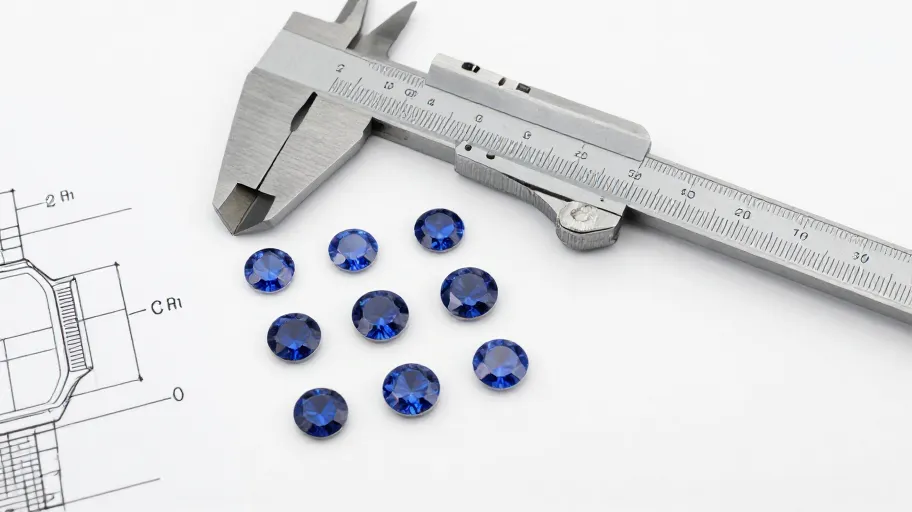
Comparing custom sapphire watch crystal samples requires physical, documented evaluation, not photographs. Use a Three-Point Sample Gate: verify dimensions against your drawing under controlled measurement, inspect optical and surface qualities under standardised lighting, and record written approval criteria before releasing production. Confirm every policy question — sample terms, tolerances, coatings, lead arrangements — directly with the supplier.
Why photographs mislead even experienced buyers
A sapphire crystal is, by design, an object that manipulates light. Photographs of one are therefore doubly mediated: the crystal interacts with the photographer's lighting, and the camera then compresses what remains. Three failure modes follow.
First, geometry disappears. A photo cannot tell you whether a dome's curvature matches your case, whether a date window is positioned to your drawing, or whether an edge chamfer is consistent across a batch. Slight barrel distortion in a lens can make a correct crystal look wrong and a wrong crystal look acceptable.
Second, coatings render unpredictably. Anti-reflective coatings shift in appearance depending on angle, white balance and ambient light. Two identical crystals can photograph differently; two differently coated crystals can photograph alike. Reflection colour is a poor proxy for coating specification.
Third, surface defects hide. Fine scratches, polish marks, inclusions near the edge and inner-face blemishes vanish at casual focal lengths. Photos select what the photographer chooses to show — and even honest photographers cannot show what the camera cannot resolve.
None of this means suppliers' photos are dishonest. It means photos are a screening tool for gross errors, not an approval instrument. Approval belongs to your bench, your instruments and your documentation.
The Three-Point Sample Gate
The Three-Point Sample Gate is a repeatable sequence for turning sample comparison into a defensible procurement decision.
Gate 1 — Dimensional verification. Every sample is measured against your drawing, not against each other. Whichever instruments your workshop trusts — callipers, micrometers, height gauges, optical measurement — the point is that the reference is your dimension sheet. Record each measured feature, the nominal value, and your acceptance decision. Ask the supplier what dimensional inspection they perform on their side and whether inspection reports accompany samples; do not assume reports are included, and confirm what documentation is available before you need it.
Gate 2 — Optical and surface inspection. Inspect each crystal under conditions you define: a fixed light source, a fixed viewing angle, and a fixed background. Check inner and outer faces separately. Look at edge polish, hole positioning, coating consistency across the face, and any visible inclusions or blemishes. Score each attribute rather than forming a single impression — single impressions drift between reviewers.
Gate 3 — Written approval criteria. Before any sample is approved, write down what "approved" means: which features must pass, which deviations are acceptable, and who signs. This record protects both sides. It gives the supplier an unambiguous reference for production, and it gives your team an internal paper trail if questions arise later.
A sample that passes Gate 1 but fails Gate 3 is not approved. A sample that looks beautiful but has no dimensional record has not been evaluated at all — it has been admired.
Sample comparison decision table
Score each sample per attribute. Adapt attributes and weighting to your project; the table is a starting structure, not a verdict.
| Evaluation attribute | What to check | Reference standard | Score (0–2) | Notes |
|---|---|---|---|---|
| Outer diameter / case fit | Measurement against drawing | Your dimension sheet | ||
| Thickness and dome profile | Cross-section measurement at defined points | Your drawing | ||
| Date/window aperture position | Position and edge quality of any cut-out | Your drawing | ||
| Edge finish and chamfer | Consistency around full circumference | Approved reference or written criterion | ||
| Outer-face polish | Uniformity under defined lighting | Your written criterion | ||
| Inner-face quality | Blemishes, marks, coating evenness | Your written criterion | ||
| Coating behaviour | Reflection character at fixed angles | Supplier's stated coating specification | ||
| Documentation received | Inspection report, material confirmation | Your request list | ||
| Fit trial in case | Assembly test on your movement/dial | Your assembly checklist |
Two samples compared through this table produce a traceable record; two samples compared by eye produce an argument.
Inspection conditions to standardise
Mixed lighting, mixed reviewers and mixed sequence will produce mixed verdicts. Before samples arrive, fix:
- Lighting: one defined light source and position, used for every sample and every reviewer.
- Sequence: inspect in the same order every time — dimensions, outer face, inner face, edges, coating — so nothing is skipped when time is short.
- Handling: finger cots or gloves; sapphire survives handling that coatings may not.
- Records: one sheet per sample, filled in during inspection, not reconstructed afterwards.
- Reviewers: the same people evaluate all samples in a comparison round.
Concrete approval questions to send the supplier
Send these before or alongside your sample request. Every answer should be written, not verbal.
- What dimensional inspections do you perform on custom sapphire watch crystal samples, and what documentation accompanies them?
- Can samples be produced against our drawing or dimension sheet, and what do you need from us to quote and sample — drawing format, tolerances, finish specification, coating details?
- What anti-reflective or other coating options do you offer, and how do you specify them so we can verify the sample against the specification rather than by appearance?
- What is your current sample policy — terms, quantities, costs, shipping arrangements and timing? We will confirm the current terms directly with you before proceeding.
- How are production pieces verified against the approved sample, and what inspection records ship with production lots?
- If a production lot deviates from the approved sample, what is your correction process?
- What information do you need about our case and movement to confirm fit before sampling?
These questions are not adversarial. A supplier who answers them precisely is easier to work with, and the answers become part of your approval record.
Building the internal approval record
Once gates one and two are complete, assemble a short approval pack: your dimension sheet, the completed scoring table, the supplier's written answers, photographs taken under your standardised conditions (your photos, for your record — not the supplier's), and the signature of whoever owns the decision. Keep the pack with the project file. When production crystals arrive six months later, or when a design revision changes the drawing, the record answers questions no one remembers asking.
FAQ
Can I compare sapphire crystal samples from different suppliers fairly? Only if all samples are evaluated against the same drawing, under the same inspection conditions, with the same scoring sheet. Otherwise you are comparing photographs and impressions, which is where evaluation errors begin.
What matters more: how the sample looks or its dimensions? Dimensions gate everything. A visually flawless crystal that does not fit the case is scrap; a crystal with correct geometry invites discussion about finish. Measure first, admire second.
How do I evaluate an anti-reflective coating without lab equipment? Define a fixed light source and viewing angle, compare reflection behaviour across the full face, and — most importantly — evaluate the sample against the supplier's written coating specification. Ask them to state the specification so you can verify rather than guess.
Should I request inspection reports with samples? Ask, in writing, what inspection documentation is available and confirm current policy directly with the supplier. Do not assume reports are included or excluded; make documentation part of your sample request.
How many samples should I evaluate before approving production? That depends on your project's risk profile and the supplier's sampling terms — confirm what sample quantities the supplier can provide, then evaluate enough pieces to check consistency between samples, not just the quality of one. A single sample tells you nothing about variation.
Next step: submit a drawing or dimension sheet
The fastest way to start a rigorous comparison is to give the supplier something precise to work from. Submit your drawing or dimension sheet to JadeZone Sapphire, and ask the questions above alongside it. A concrete drawing converts a vague enquiry into an evaluable sample.
Not ready to send a drawing? Use the low-friction option instead: download and complete the sample-evaluation checklist below, and send it with your enquiry so both sides agree on what will be measured before anything is shipped.
Sample evaluation checklist (copy into your enquiry):
- Drawing or dimension sheet attached, with revision number and date
- Critical dimensions marked as critical
- Finish specification stated (polish, edge treatment)
- Coating specification stated or requested
- Fitting context described (case, movement, dial)
- Required documentation listed (inspection report, material confirmation)
- Sample policy questions sent in writing
- Internal inspection conditions defined (lighting, sequence, reviewers)
- Approval sign-off owner named