
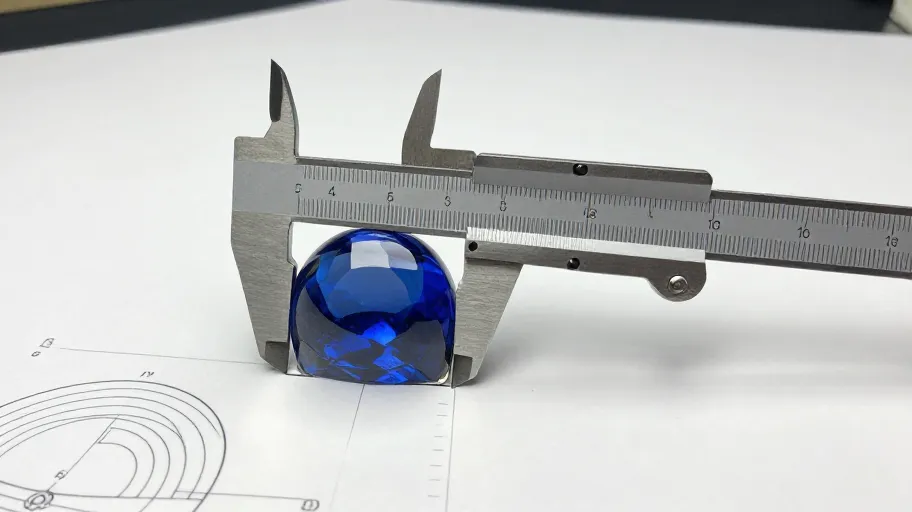
A first brief for domed sapphire watch glass fails when it defines only diameter and thickness. A curved surface needs its height, radius or curvature profile, the reference plane it rises from, and the edge treatment specified together — otherwise every later decision, from gasket seat to hand clearance, is ambiguous. Send these measurements up front and a supplier can quote against a defined part instead of a set of assumptions.
Why curved crystals break flat-glass habits
Flat crystal enquiries survive on diameter, thickness and edge finish. A dome adds geometry that those three numbers cannot describe. When the curvature is undefined, the supplier must guess: guess the height, guess whether the top surface meets the side wall with a step or a curve, guess where the gasket lands. Each guess is a revision cycle.
The purpose of this article is not to sell a profile. It is to give you a comparison structure — the CURVE Framework — so that your first brief for domed sapphire watch glass contains the measurements that determine whether the finished part fits the case, clears the hands and reads cleanly.
The CURVE Framework
C — Case geometry. The crystal does not exist alone. Document the case opening diameter, the seat type (bezel-retained, gasket-compression or glued) and the available depth from the seat to the top of the hands. For a domed part, the height the dome can occupy is set by this stack, not by aesthetics alone.
U — Under-dial clearance. The underside of a dome can dip below where a flat crystal would sit. Define the minimum vertical gap to the highest hand or rehaut point in every hand position, including date-change travel if relevant. This is one of the measurements most frequently absent from first briefs — and one of the few that can force a redesign late in the project.
R — Radius definition. "Domed" is not a dimension. Specify the curvature as a radius value, a sagitta (dome height at centre relative to the edge), or a coordinate profile — and state which. Two drawings that both say "domed, 4 mm thick" can describe very different parts. Also state the reference plane the height is measured from: the gasket seat, the lower edge, or the visual top of the bezel.
V — Verification method. Agree how the curvature will be measured at inspection: profile projector, contour scan, gauge points, or sample comparison. If the buyer and supplier verify with different methods, an acceptable part can still be rejected. Write the method and the measurement points into the drawing or specification sheet.
E — Edge finish. Define the edge profile — flat polished, bevelled, stepped (box-dome), or curved transition — and the surface finish on both the edge and both faces. For AR coating, if any, specify which face(s) and reference the coating by the supplier's documented specification rather than a shorthand term, then confirm the coating's properties in writing before approval.
Decision table: choosing a dome profile
| Criterion | Box-dome (flat top with raised edge) | Full dome | Hybrid / custom profile |
|---|---|---|---|
| Best suited to | Designs needing a flat top surface for logo printing or a specific reflection pattern | Vintage-inspired or depth-emphasising designs | Cases with unusual seats or clearance constraints |
| Measurement burden | Height plus step dimensions; radius of the raised edge | Radius or sagitta plus reference plane | Full coordinate profile; highest documentation effort |
| Clearance risk point | Step corner near the gasket | Lowest point of the dome above the hands | Depends on profile; must be checked point by point |
| Brief failure mode | Underside of the raised edge left undefined | Reference plane for height unstated | Profile defined visually but not dimensionally |
| What to verify with the supplier | Which dimensions they control vs. derive | Their measurement method for curvature | Whether they can produce the profile at all, and how it is inspected |
This table is a prompt for questions, not a ranking. The right profile is a design decision; the right brief is a documentation decision.
Approval questions to send before approving any quotation
- Which dimensions on our drawing do you treat as controlled, and which do you derive from others?
- How will you measure the curvature at inspection, and can we align our acceptance method with yours?
- What is the minimum under-dial clearance you recommend for our hand stack, and what is your basis for that figure?
- Which edge profiles can you produce in this geometry, and what finish options apply to each face?
- If AR coating is specified, what coating specification do you quote against, and how is it verified?
- What do you need from us — drawings, samples, a case, a reference crystal — before you can confirm fit?
- What are your current MOQ, sampling, pricing and lead-time policies for this part? (These are project-specific and must be confirmed directly; no figures are stated here.)
Document the answers. A supplier that answers precisely is demonstrating process control, whatever the final numbers turn out to be.
Checklist: the complete first brief
- Case opening diameter and seat type
- Total crystal height, with reference plane stated
- Curvature definition: radius, sagitta or coordinate profile
- Minimum under-dial clearance in all hand positions
- Edge profile and finish for all faces
- Coating, if any, specified by documented specification
- Inspection method and measurement points agreed
- Tolerances proposed as discussion items, not assumptions
- Supplier's current sample, price, MOQ and lead-time policies confirmed in writing
FAQ
Is a sagitta or a radius the better way to specify a dome? Neither is universally better. A radius suits a simple spherical segment; a sagitta is clearer when the visual height is the design driver; a coordinate profile suits non-spherical shapes. Choose one, state it, and confirm the supplier reads it the same way.
How do I know if my dome will clear the hands? You cannot know from the crystal drawing alone. Model the full stack — movement, hands, dial, rehaut, crystal — and send the worst-case clearance figure to the supplier as a design requirement to verify, not a hope.
What causes most fit problems with domed sapphire watch glass? From a briefing perspective, undefined reference planes and unstated under-dial clearance cause more revisions than curvature itself. A dome that is dimensionally correct but referenced to the wrong plane still does not fit.
Should I send a physical sample with my enquiry? Ask the supplier what they need. Some projects are quotable from a complete drawing; others benefit from a case or reference crystal. Confirm their current intake process directly rather than assuming.
Do coatings change the measurements I need to specify? A coating has thickness and is applied to defined faces, so specify which faces and how the coating boundary relates to the gasket seat. Confirm the coating specification and its verification method with the supplier in writing.
Send your curvature for review
If you have a drawing — even a rough one — for a domed sapphire watch glass project, request a curvature review. JadeZone Sapphire will review the geometry you have, flag the measurements still missing, and tell you what to define before a quotation can be meaningful. Confirm current sample, pricing, MOQ and lead-time policies directly with the team during that conversation.
Request a curvature review.
Or start smaller: use the checklist above to audit your current brief first, and bring the gaps to the review. Either way, the first exchange should be about geometry, not guesswork.