
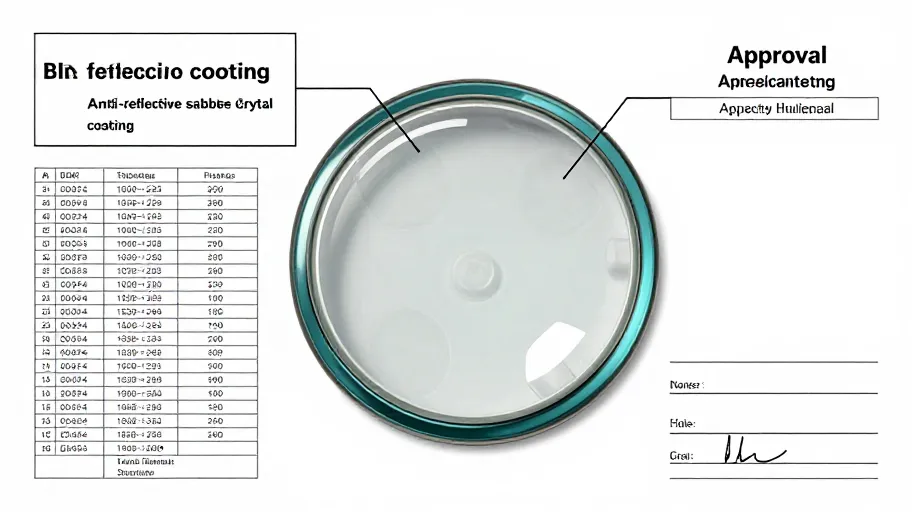
An anti reflective sapphire crystal coating specification belongs in three separate documents, each with a distinct job. The engineering drawing should carry the physical and optical definition: which surface receives coating, coating type, and inspection zones. The BOM should carry the commercial shorthand that purchasing and planning systems read. Approval notes should carry the acceptance language you and the supplier both sign. The most reliable way to keep these aligned is a simple discipline we can call DRAW-BOM-GATE: define on the drawing, lock in the BOM, gate through written approval.
Why coating specifications drift between documents
When a watch brand sources custom sapphire crystals, the coating is where documentation friction concentrates. The crystal blank is defined by measurable geometry; the coating is defined by intent. Words like "AR coated" travel between drawing, BOM and email without anyone recording which surface, which variant, or which acceptance test the words refer to. By the time first articles arrive, two teams can hold different readings of the same specification.
The DRAW-BOM-GATE framework exists to remove that ambiguity. It assigns each detail to the single document where it carries authority, so nothing depends on memory or an email thread.
D — Drawing: the physical and optical definition
The drawing is the engineering authority. Details that belong here include:
- Coated surface designation. State explicitly whether the anti reflective coating applies to the top (outer) surface, the bottom (inner) surface, or both. Use unambiguous notation tied to the view, not free-text notes.
- Coating construction reference. If your design intent is a specific layer count or construction approach, reference it as a callout or a referenced spec block, and agree the interpretation with the supplier in writing.
- Optical acceptance intent. If you will judge reflectance or colour visually, define the viewing condition on the drawing or its referenced inspection standard: light source type, geometry, and background.
- Cosmetic zones. Define which regions of the crystal face are cosmetic-critical and which are not, so coating appearance is judged where it matters.
- Excluded areas. If any zone must remain uncoated — for example, areas masked for assembly reasons — show them dimensionally.
Geometric tolerances, lead times and dimensional acceptance limits are project-specific. Do not carry assumptions forward; agree and document each one with the supplier. Confirm the current policy directly.
R-A-W — BOM: the commercial shorthand
The BOM is what planning and purchasing systems read, so it should be a faithful compression of the drawing, never a second opinion. A BOM line for a coated crystal should:
- Reference the drawing number and revision level, so the BOM can never outlive the drawing it points to.
- Carry a short, standardised description that names the coating variant and the coated surface, using the same vocabulary as the drawing.
- Include a revision-controlled internal part number so coating changes are traceable across projects.
- Avoid embedding engineering detail that belongs on the drawing. If the BOM starts redefining the coating, the two documents will diverge.
Price, minimum order quantity, sample terms and delivery commitments do not belong in the BOM as assumptions. Confirm the current policy directly.
G-A-T-E — Approval notes: the acceptance contract
Approval notes are where you and the supplier agree what "approved" means. They should convert intent into testable questions. Concrete approval questions to include:
- Which surface(s) carry the anti reflective sapphire crystal coating, and does the approval sample match the drawing callout exactly?
- Under what lighting and viewing geometry will colour and reflectance be judged, and has the supplier confirmed they can evaluate against that condition?
- What visual inspection method and magnification will be used for coating defects, and what acceptance language describes reject conditions?
- How will coating adhesion and abrasion resistance be verified, and which test method has been agreed and documented in writing?
- What happens to approval status if the crystal geometry, coating construction or substrate polishing process changes — does approval reset?
- Where do retained approval samples live, on which side of the relationship, and how are they labelled and referenced?
None of these should be resolved verbally. The answers belong in the approval note itself, dated and referenced to the drawing revision.
Where each detail belongs: decision table
| Detail | Drawing | BOM | Approval notes |
|---|---|---|---|
| Coated surface (top / bottom / both) | Primary authority | Referenced shorthand | Acceptance confirmation |
| Coating construction or layer reference | Callout | Part of description code | Verified against approval sample |
| Reflectance / colour judgement conditions | Referenced inspection standard | — | Agreed viewing protocol |
| Cosmetic and exclusion zones | Dimensionally shown | — | Noted if disputed |
| Adhesion / abrasion test method | Referenced if engineering-driven | — | Primary home: agreed and signed |
| Drawing number and revision | Native | Must reference | Must reference |
| Commercial terms, samples, delivery | — | — | Confirm the current policy directly |
| Change-control trigger | Revision block | Revision sync | Re-approval rule |
Pre-release checklist
Before releasing a coated crystal to production, verify:
- Drawing states coated surface(s) unambiguously.
- Drawing references an agreed inspection condition for appearance.
- BOM line references the drawing number and current revision.
- BOM description uses the same coating vocabulary as the drawing.
- Approval note contains written, agreed test methods for adhesion and appearance.
- Change-control rule defines when approval resets.
- Retained approval samples are identified and located.
- All commercial terms confirmed in writing. Confirm the current policy directly.
FAQs
Does the anti reflective coating go on the inside or outside of a watch crystal? Both placements exist in watch design, and each has trade-offs in appearance and exposure to wear. That decision is yours as the designer; what matters commercially is that the chosen surface is stated explicitly on the drawing, compressed accurately in the BOM, and confirmed in the approval note. Never let the supplier infer it.
Should the BOM repeat the drawing's coating details? The BOM should reference and compress, not redefine. A short description with the coating variant and coated surface, tied to the drawing revision, is sufficient. Duplicating full engineering detail in the BOM creates a second source of truth that will eventually contradict the drawing.
What causes most coating approval disputes? Ambiguous acceptance language: judging reflectance or colour under undefined lighting, or applying an adhesion test nobody documented. Writing the viewing conditions and test methods into the approval note before first articles removes most of this risk.
How do we handle a coating change after approval? Treat any change to coating construction, coated surface or substrate finishing as a reset trigger. Update the drawing revision, sync the BOM, and issue a new approval note. A written change-control rule agreed up front makes this mechanical rather than negotiable.
What should we send a supplier to start a coating specification conversation? A drawing with the coated surface marked, your intended inspection conditions, and a draft list of approval questions. JadeZone Sapphire can then review the specification, flag what needs definition, and help you complete the DRAW-BOM-GATE documentation before anything is released.
Confirm a coating specification. Send your drawing and coating intent to JadeZone Sapphire, and we will review which details need definition before release.
Low-friction option: Download or copy the pre-release checklist above and run it against your current coating drawing before your next supplier call.