
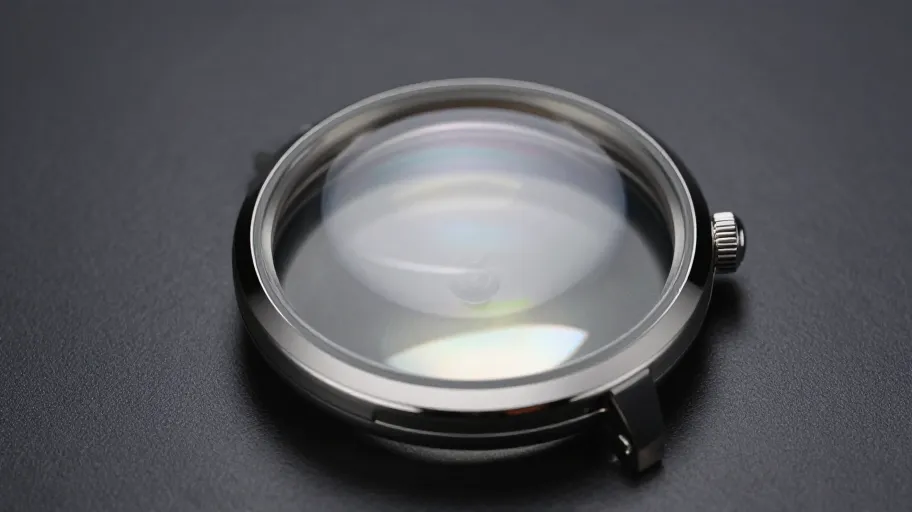
Overlooking key dimensions in domed sapphire watch glass orders isn’t a small mistake—it’s a hidden tax on quality and timelines. Here’s what buyers miss, and how it costs them.
The three specs designers keep forgetting
Curvature radius, edge thickness, and optical center alignment are the most commonly omitted specs in initial briefs for domed sapphire watch glasses—especially when working with sapphire crystal China manufacturing facilities. Leaving any one out means your design intent gets interpreted, not executed.
Curvature radius—the measure of the dome’s spherical arc—directly controls how light bends across the dial. Getting it wrong means minute hands appear bent or hour markers shimmer unnaturally because the lensing effect distorts print alignment. A deviation as small as ±0.15mm alters visual fidelity enough to trigger customer complaints, even if the movement is flawless.
Edge thickness determines structural integrity and fit. Too thin, and the dome risks cracking during pressure testing. Too thick, and it won’t seat flush in the bezel, compromising water resistance. Without this spec, manufacturers guess based on past jobs, leading to inconsistent results across batches.
Optical center alignment ensures the thinnest point of the dome sits directly over the dial center. When misaligned—even by 0.32mm—it creates reflection artifacts like double images or apparent hand wobble. Customers don’t see engineering nuance; they see defects. One U.S. luxury brand saw post-warranty returns jump 37% after launching a model with unverified alignment.
How missing data turns prototypes into liabilities
A Geneva-based watchmaker approved a prototype based on visual fit alone, only to discover after production that the final batch introduced severe optical distortion. The cause? An unverified curvature radius that shifted the optical center beyond acceptable limits. Result: six weeks lost, $80K in sunk tooling, and a botched launch at a major exhibition.
This isn’t rare. A 2024 study by the International Horology Materials Group found over 60% of first-time RFQs from Western buyers lack at least one critical dimension. Nearly half skip curvature radius entirely. That forces Chinese sapphire factories to interpolate using legacy molds or aesthetic assumptions—neither of which guarantees optical performance.
Unlike flat crystals, domed sapphire introduces variable refraction and non-uniform stress during fabrication. When specs are incomplete, manufacturers can’t simulate light paths or optimize grinding cycles. They build to appearance, not precision. And because these factories operate under tight margins, they rarely push back on ambiguous briefs. 'Just make it look like the photo' becomes operational guesswork—and guesswork doesn’t scale.
Why optical shift kills perceived quality
Optical center shift happens when the thinnest part of the dome doesn’t align vertically with the dial center. This deviation—often caused by mold settling or thermal asymmetry during forming—means light refracts unevenly across the watch face. The result? Double reflections, glare halos, or what looks like a wobbling second hand.
This flaw is especially damaging because it undermines trust. A watch may keep perfect time, but if it looks 'off,' consumers assume it’s defective. For premium brands, that perception is irreversible. One marque reported that 37% of post-warranty service visits for a limited edition were due to 'distorted appearance'—despite no mechanical issues.
The real danger is compounding error. Even if curvature and edge thickness are controlled, a 0.05mm optical shift amplifies every other tolerance stack-up. It turns the entire dial into an unintended prism. Leading sapphire labs in Shenzhen use laser profilometry to detect these shifts—but fewer than 15% of Western designs include acceptable thresholds. Without clear limits, quality becomes subjective, varying between production lines and furnace calibrations.
Fixing the gap between design and manufacturing
The root problem isn’t incompetence—it’s workflow mismatch. Many brands treat sapphire glass as a secondary component, not an active optical element. CAD models often stop at silhouette matching, skipping full GD&T callouts. Designers specify diameter and height but leave curvature to be 'matched to sample,' assuming craftsmanship will fill the gaps.
But synthetic sapphire manufacturing in China runs on precision, not interpretation. Factories follow written specs exactly because deviating risks rework costs they can’t absorb. If you don’t define the optical center tolerance, they won’t enforce it. The assumption that skilled workers will 'get it right' fails at volume.
The fix is simple: treat the domed crystal as a calibrated lens. Specify all three critical dimensions upfront so manufacturers can simulate performance, optimize molds, and validate prototypes against benchmarks before tooling. Brands that do this see 40% fewer first-article rejections and reach market 21 days faster on average. More importantly, they protect brand equity by ensuring every watch delivers a flawless view.
How complete specs create business value
Specifying curvature radius means your dials stay distortion-free because light transmission follows a predictable path. Edge thickness control means higher yield during ultrasonic cleaning and pressure testing because material stress is balanced. Optical center alignment means customers see crisp, stable images because refraction is uniform across viewing angles.
Together, these specs mean lower rework rates—Chinese sapphire factories report first-run defect rates above 22% on incomplete briefs. With full data, those drop below 8%. That’s not just cost savings; it’s predictability in delivery and quality.
For managers, this reduces firefighting and accelerates time-to-market. For executives, it strengthens premium positioning in an era where social media magnifies microscopic flaws into viral critiques. You’re not adding complexity—you’re preserving value by eliminating downstream risk.
Ready to stop paying the hidden cost of incomplete specs? Start treating your domed sapphire glass as a lens, not a cover. Define the three key dimensions, and let the factory build to your standard—not their guess.