
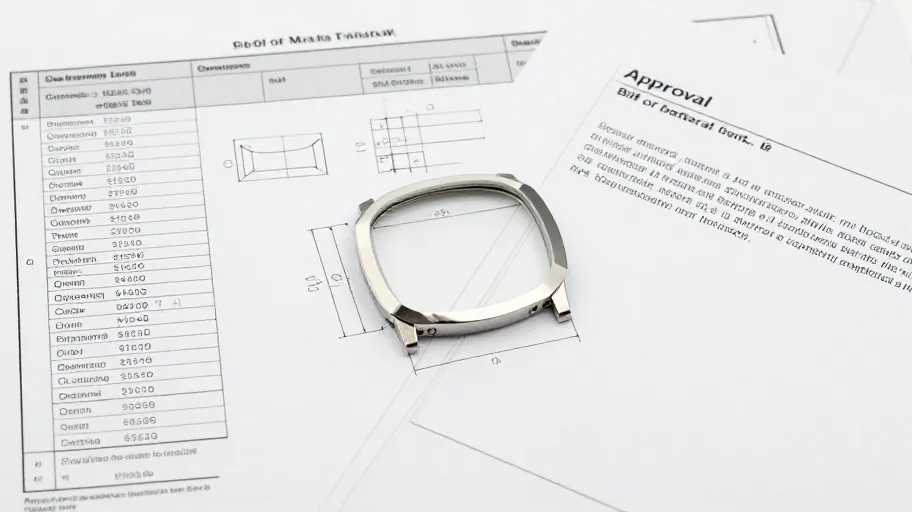
When you order a custom sapphire watch crystal, three documents carry the specification: the drawing defines geometry and finish, the BOM defines material and commercial line items, and the approval notes define what "accepted" means. Buyers who separate these documents cleanly avoid most rework. The DBA completeness framework — Drawing, BOM, Approval — gives each detail one unambiguous home and one owner before anything is quoted or sampled.
Why document separation matters
A custom sapphire watch crystal is a precision component, not a catalogue part. Every project brings its own case geometry, finish expectation and assembly method. When a detail lives in an email thread rather than on the drawing, it disappears at revision time. When it lives on the drawing but not in the approval notes, nobody inspects it. The DBA framework forces you to answer three questions per detail:
- Drawing: Is this a geometric or finish characteristic a machinist must hit?
- BOM: Is this a material, coating or line-item choice a buyer must order against?
- Approval: Is this a criterion a quality reviewer must verify before sign-off?
Most details belong to exactly one of the three. Ambiguity between them is where disputes begin.
What belongs on the drawing
The drawing is the geometry authority. For a custom sapphire watch crystal, the drawing should communicate at minimum:
- Overall form: diameter, thickness profile, and whether the crystal is flat, domed, or has compound curvature. Domed crystals deserve a section view, not just a plan view.
- Critical dimensions and their tolerances: each project needs its own tolerance values, agreed with the supplier against their process capability. Do not carry over values from an unrelated project; ask the supplier which dimensions they can hold and document the agreed figures.
- Edge treatment: the edge shape and any chamfer or step that interacts with the gasket or bezel. Edge geometry drives water resistance and retention, so define it explicitly.
- Surface specification: which face is polished, to what finish criterion, and whether the criterion is visual, dimensional or both.
- Coating callout: if an anti-reflective or other coating is required, the drawing should reference the coating specification rather than describe it in prose.
- Datum and measurement references: how thickness and concentricity are measured, so incoming inspection and supplier inspection use the same method.
One practical discipline: every dimension on the drawing should have either a tolerance or a note saying it is non-critical. Untoleranced dimensions are interpreted, not measured.
What belongs in the BOM
The BOM is the procurement authority. It answers "what exactly am I ordering" without requiring anyone to open CAD. A complete sapphire crystal BOM line includes:
- Part number and drawing revision reference, so the BOM and drawing cannot drift apart.
- Material description, stated to the grade or specification you and the supplier have agreed.
- Coating specification and which faces it applies to, if any.
- Quantity breakdown per variant if you are ordering multiple case sizes in one program.
- Marking or logo requirements, if any, and where they appear.
- Packaging or handling requirements that affect incoming quality, if applicable.
Commercial terms — pricing, minimum order quantities, sampling arrangements and delivery terms — are conversation items with the supplier, not BOM technical fields. Confirm the current policy directly.
What belongs in the approval notes
Approval notes define the acceptance gate between sampling and production. Without them, "the sample looks fine" becomes the entire quality plan. Strong approval notes for a custom sapphire watch crystal cover:
- Golden sample: whether a retained physical sample serves as the visual and dimensional reference, and who holds it.
- Inspection criteria: which drawing dimensions are inspected at incoming, by what method, and with what acceptance outcome documented.
- Visual standard: how surface appearance is judged — under what lighting, at what viewing distance, by whom.
- Revision control: how a drawing change restarts approval, and which revision is valid for production.
- Escalation path: who at your company and at the supplier signs the approval, in writing.
Decision table: where each detail belongs
| Detail | Drawing | BOM | Approval notes | Notes |
|---|---|---|---|---|
| Diameter and thickness profile | Yes | Reference | — | Geometry authority lives here |
| Tolerances per dimension | Yes | — | Inspected subset | Agree values with supplier |
| Dome curvature / section | Yes | — | — | Include a section view |
| Edge and chamfer geometry | Yes | — | Yes | Drives gasket interface |
| Surface finish criterion | Yes | — | Yes | Tie to inspection method |
| Coating type and faces | Callout | Specification line | Verification | Keep one source spec |
| Material grade | — | Yes | Reference | Agreed specification |
| Part number / revision | Reference | Yes | Yes | Prevents drift |
| Marking or logo | Position note | Yes | Visual check | Define placement |
| Golden sample retention | — | — | Yes | Who holds it, in writing |
| Inspection method per dimension | Reference | — | Yes | Same method both sides |
| Pricing, MOQ, sampling, delivery | — | — | — | Confirm the current policy directly |
Concrete approval questions to put to the supplier
Before you release a drawing for sampling, ask and record answers to:
- Which dimensions on this drawing can you hold, and which would you like to renegotiate tolerances on?
- What measuring method will you use for thickness and concentricity, and can our incoming inspection mirror it?
- How do you propose we define the visual standard for surface appearance, and can we retain a golden sample?
- What coating specification do you recommend for this application, and how is it verified?
- How is a drawing revision handled between approval and production?
- What is your process for documenting approval sign-off, and who signs on each side?
- What are your current terms for sampling, quantities and delivery? Confirm the current policy directly.
These questions convert unknowns into documented agreements, which is the entire point of the DBA framework.
Frequently asked questions
Should tolerances be tighter for a domed crystal than a flat one? Not automatically. Tolerance values should follow the function of each dimension — gasket interface dimensions deserve closer control than aesthetic curvature — and be agreed with the supplier against their process. Ask which dimensions they can hold and document the answer per project.
Who owns the coating specification, buyer or supplier? Either can draft it, but one document must be authoritative. A workable split: the supplier proposes the coating spec and performance description, and your approval notes record how conformance is verified. Do not assume coating performance; verify what the supplier states for your specific application.
Do I need a golden sample if the drawing is complete? A drawing cannot fully encode visual appearance. A retained golden sample, referenced in the approval notes, removes interpretation from future production batches. Confirm with the supplier who retains it and how disputes against it are resolved.
How detailed should a first inquiry be if I only have a dimension sketch? Send what you have. A dimension sheet with key measurements, edge intent and target case reference is enough for a supplier to ask the right questions. Perfection at inquiry stage matters less than clarity about which details are fixed and which are open.
Can I use one BOM across multiple crystal sizes? Yes, if each size links to its own drawing and revision, and variant differences are explicit line items. The failure mode is a BOM that references a superseded revision — which is why revision linkage belongs in all three documents.
Checklist before you submit a drawing
- Every dimension has a tolerance or a non-critical note
- Section view included for any domed geometry
- Edge and chamfer treatment drawn, not described in words
- Surface finish criterion defined with a measurement or visual method
- Coating referenced by specification, not prose
- Part number and revision on drawing, BOM and approval notes
- Approval sign-off owner named on both sides
- Commercial terms raised separately with the supplier — confirm the current policy directly
Submit your drawing or dimension sheet
Ready to specify a custom sapphire watch crystal? Submit a drawing or dimension sheet to JadeZone Sapphire for review. Our team will examine your geometry, finish intent and approval requirements, then come back with the questions that matter before anything is quoted or sampled.
Start smaller if you prefer: download the pre-submission checklist above, walk your current drawing against it, and mark which DBA elements are missing. Either way, the more complete your documents, the fewer surprises downstream.