
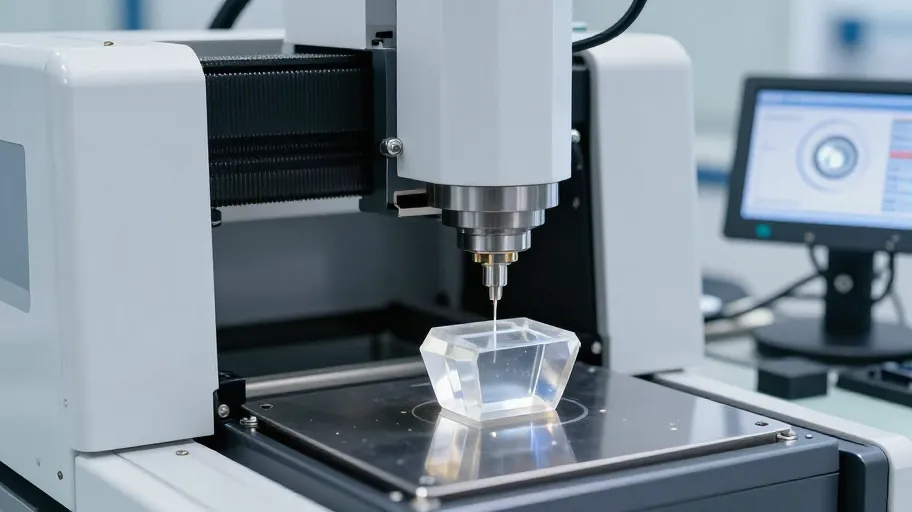
Turning a flawless sapphire watch crystal prototype into mass production in China shouldn’t mean gambling on quality. A structured handoff cuts rework by up to 70%, protects your launch date, and keeps your brand’s reputation intact.
Lock in perfection before scaling
Getting from a perfect prototype to consistent mass production of custom sapphire crystals in China comes down to control — not hope. The difference between success and failure is a formal Specification Transfer Protocol that locks in optical clarity, micron-level tolerances, and surface quality benchmarks directly from your approved sample. For a Swiss watchmaker launching 50,000 units in Q4, even a 0.1mm variance in edge chamfer or a 3% drop in AR coating adhesion during thermal cycling doesn’t just mean rework — it risks delayed shipments and customer complaints.
One luxury brand faced a 22% QC rejection rate because the factory used a different ultrasonic polishing cycle than the one applied to the approved prototype. The sapphire looked fine under office lights but showed micro-hazing under UV — a defect invisible until final inspection. This wasn’t a materials flaw. It was a communication breakdown. Without a binding transfer process, subtle manufacturing variables drift. That’s where the sapphire crystal china manufacture ecosystem reveals both its risk and its potential. Precision hubs like Dongguan and Kunshan now match Swiss-tier tooling — sub-micron CNC grinding, ion-beam finishing — but only if process parameters are enforced from prototype to production lot.
Turn specs into auditable commitments
The shift from suggestion to standard starts with ISO 2859-1 sampling plans — but most brands stop at Level II, allowing up to 4% defects. That’s unacceptable for sapphire crystals where visual perfection is non-negotiable. Leading manufacturers now use tightened inspection (Level S-1 or S-2) plus 100% automated optical inspection (AOI) for critical traits like bevel symmetry and coating uniformity. One European brand cut post-production sorting labor by 65% and reduced customer-reported defects by 89% after linking AOI feedback directly to the original prototype’s digital twin. Better machines didn’t drive this improvement — better data discipline did.
At the core is the production handoff audit trail: a living document that logs every spec, test result, and approval across design, QA, and factory teams. Think of it as a blockchain for precision manufacturing — immutable, timestamped, accessible. When edge radii vary between batches, the audit trail doesn’t ask “who’s to blame?” It shows “where did the spec diverge?” Was it the diamond wheel grit? Dwell time in the tempering oven? Argon-to-nitrogen ratio in the PVD chamber? With full traceability, root cause analysis drops from days to hours. More importantly, it creates shared accountability. Designers can’t assume CAD files speak for themselves. Factories can’t claim “close enough.” Everyone works from the same source: the approved physical sample, digitized and locked down.
Avoid the hidden costs of loose handoffs
Treating the prototype-to-production shift as a checkpoint instead of a controlled process creates hidden costs that compound in Phase 3:
- NRE creep: Unplanned tooling adjustments add $18,000–$42,000 per revision when sapphire molds must be re-etched due to dimensional drift.
- Yield shock: A prototype may hit 98% pass rate, but without controls, volume lots often fall to 70–75%, forcing emergency capacity buys.
- Time-to-market penalties: A 2024 supply chain benchmark found brands without formal handoff protocols averaged 37 extra days in pre-launch validation — missing holiday windows and losing first-mover advantage.
One independent watchmaker traced AR coating delamination not to the coating, but to residual stress in the blank from asymmetric grinding. The prototype was hand-finished on a low-throughput rig; the production line used a high-speed multi-spindle machine that induced uneven strain. Only after comparing polarimetric stress maps — captured in the audit trail — was the root cause found. The fix? A revised feed-rate algorithm and a 15-minute annealing step added to the SOP. Result: adhesion passed 1,000-hour thermal cycling (MIL-STD-810G), and yield jumped to 94% in the next batch.
Make precision your competitive edge
This is where sapphire china factory capabilities stop being a cost play and become strategic leverage. Chinese partners aren’t just order-takers — they’re co-developers in high-precision optics. But unlocking that value means shifting from managing suppliers to orchestrating ecosystems. Embed your engineering team early. Require Cp/Cpk reports for each critical dimension before moving beyond pilot lots. Treat the prototype not as a one-off, but as the DNA of every future unit.
When done right, benefits compound. A streamlined handoff protocol doesn’t just prevent deviations — it accelerates learning. Each run generates feedback that refines the next. Coating adhesion data informs substrate prep. Chamfer metrics improve fixture design. Over time, you build a proprietary library of process knowledge competitors can’t replicate through specs alone. This is the real ROI: predictable quality becomes a scalable advantage, not a recurring firefight.
The proof? On-time delivery and lower NRE costs in Phase 3. Brands using structured handoffs report 40% fewer engineering change orders during volume production and a 30% faster transition from pilot to full run-rate. That’s not just efficiency — it’s market agility. In a world where consumers expect perfection and launch windows are razor-thin, flawless scaling isn’t a backend detail. It’s the foundation of your brand promise. And in luxury timepieces, where one flawed crystal can undermine years of craftsmanship, zero deviation isn’t an aspiration. It’s the only acceptable outcome.