
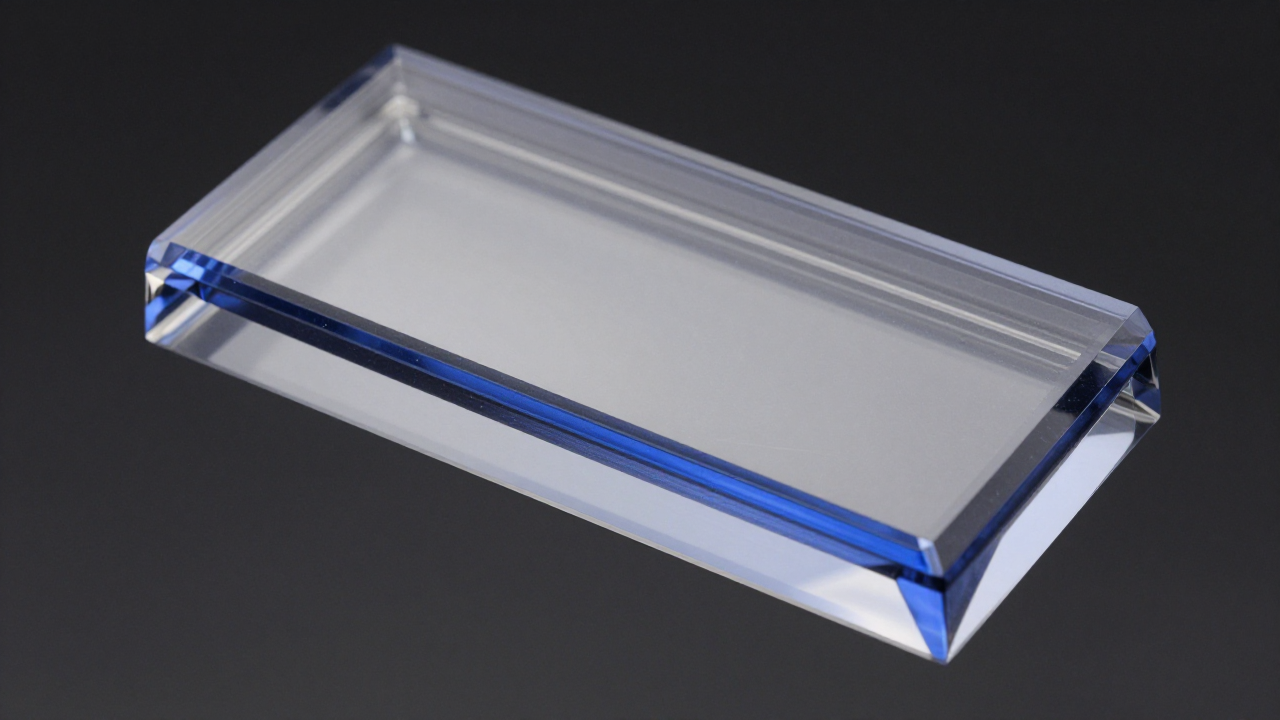
In March 2022, a microbrand out of Bend, Oregon shipped 1,800 dive watches, each fitted with a 1.1 mm flat crystal sourced through a trading house in Kowloon.…
By the first week of June, 71 had come back. Every one was chipped at the edge. Not a single one had cracked across the face. The brand spent six weeks blaming its sapphire supplier. It had a polishing problem.
A sapphire watch crystal is a lens machined from a single crystal of synthetic aluminum oxide (α-Al₂O₃) grown at roughly 2,050 °C, then diamond-ground and polished until no surface flaw exceeds about one micron. The Mohs 9 rating gets the headlines. The one-micron flaw budget is what actually keeps the glass on your wrist.What a Sapphire Watch Crystal Actually Is
Sapphire crystals are grown, not mined. Gem-grade natural corundum is far too small, too included, and too expensive to slice into 32 mm lenses at volume. The watch industry runs on boules pulled by the Kyropoulos method — a tungsten crucible of high-purity Al₂O₃ powder melted at 2,050 °C, a seed crystal dipped in, and roughly 8 to 14 days of slow withdrawal. A production boule for optical use typically lands between 20 and 40 kg with a usable diameter of 100 to 200 mm.
Here is the part that surprises most brand owners: watch sapphire shares a supply chain with LED substrates and smartphone camera covers. When LED fab demand tightens in Asia, boule allocation for watch blanks tightens with it. In the second half of 2021, lead times on 2-inch optical boules stretched from six weeks to over four months, and several American microbrands discovered their "Swiss crystal" was a Hong Kong-traded blank with a European invoice.
The boule is cored or sawn into discs, then the discs go through blanking, CNC curve generation, lapping, and finally chemical-mechanical polishing with colloidal silica. That last step is where the strength lives or dies.
Why Sapphire Is Hard but Not Unbreakable
Hardness and toughness are unrelated properties, and confusing them is the single most expensive mistake in this category. Sapphire resists plastic deformation because its aluminum and oxygen ions sit in a tightly packed corundum lattice with strong directional bonding and no active slip system at room temperature. Scratch resistance follows directly from that. Fracture resistance does not.
Sapphire's fracture toughness, K₁c, sits around 2.0 to 2.5 MPa·m^0.5. Soda-lime glass runs about 0.75. So sapphire is roughly three times tougher than window glass — real, but nowhere near "unbreakable." The strength of a finished crystal comes almost entirely from how few and how small its surface flaws are. That relationship is captured by the Griffith criterion:
σ_f = sqrt( (2 × E × γ) / (π × a) )Run the numbers. A flaw of 5 micrometers gives a predicted fracture stress near 310 MPa. Shrink that flaw to 1 micrometer and the predicted stress climbs past 690 MPa. You did not change the material. You changed the polish.
That is why a $40 crystal and a $400 crystal can come off the same boule.
Reading the Spec Sheet on a Sapphire Watch Crystal
That 8.2% per surface figure matters more than people expect. An uncoated crystal loses 15.7% of incoming light across two faces. A dial that reads crisp under a coated crystal reads dull under an uncoated one, and no amount of dial printing fixes it.
The Edge Problem Nobody Prints on the Data Sheet
Edge geometry drives more field failures than thickness, coating, or case design combined — and no watch standard specifies it.
ISO 22810:2010 governs water resistance classification and ISO 6425:2018 governs dive watches. Neither document says a word about the chamfer radius on a crystal, or about subsurface damage depth. Here is what actually happens on the shop floor: a 15-micrometer diamond grinding wheel leaves a microcrack zone extending roughly 1.5 to 3 times the grit size below the surface. Fifteen microns of grit means 25 to 45 micrometers of damaged crystal that has to be removed before you reach sound material.
Most failure investigations stall at this point. When the Bend, Oregon brand finally sent us three of the 71 returned crystals in August 2022, the chamfer showed a continuous 0.12 mm band of what looked like surface abrasion. It was not abrasion. It was a subsurface damage zone that had propagated to the surface under normal bezel torque. That brand's polisher had shortened the 3-micrometer diamond stage to save 90 seconds per part. Seventy-one watches later, the savings were gone.
We run a 15 → 6 → 3 → 1 micrometer diamond progression at Jadezone with a mandatory 4:1 removal ratio against grit size, and we inspect chamfers under 30x dark-field before coating. It costs cycle time. It also means the edge does not fail.
Choosing and Caring for Sapphire in the Real World
Pressure resistance is a geometry problem you can estimate before you buy. For a clamped circular crystal under external pressure:
σ_max = 0.75 × P × (r / t)²Take a 30 mm aperture, so r = 0.015 m. At 1.0 mm thick, r/t = 15 and the squared ratio is 225. At 100 m depth (1.0 MPa), σ_max ≈ 169 MPa. At 200 m, ≈ 338 MPa. At 300 m, ≈ 507 MPa.
Now swap in a 1.2 mm crystal. r/t drops to 12.5, and at 200 m the stress falls to about 234 MPa — a 31% reduction from a 0.2 mm change. This is why dive watches jump thickness before they jump case size.
Our own experience is that this estimate is conservative by 15 to 25% on domed crystals, because the dome behaves partly as an arch and carries load in compression rather than bending. Against that, a domed crystal concentrates point impact at the apex. Flat crystals win on impact. Domed crystals win on depth rating. There is no version that wins both.
For care, three rules cover 95% of cases. Rinse with warm water and mild soap rather than wiping a dry crystal, because dry wiping drags quartz dust across the AR layer. Skip the ultrasonic jewelry cleaner — cavitation under the bezel gasket can chip coating at the chamfer, and we have seen it happen on a 2019 Seiko after a single 3-minute cycle. And accept that the AR coating, at roughly 400 to 500 HV, will scratch long before the sapphire underneath does.
Is a Sapphire Watch Crystal Really Scratch-Proof?
No. Sapphire watch crystal resists everything at or below Mohs 7 — sand, steel, concrete dust, keys, coins. It scratches against materials at Mohs 9 or above: diamond, silicon carbide, tungsten carbide, and other sapphire. Emery boards and some abrasive papers contain corundum and will mark it.
The more common complaint is not a scratch at all. When a customer says "my sapphire scratched," what usually failed is the anti-reflective coating, which is a soft oxide stack sitting on top of the hardest material in the watch. Coating damage shows up as a faint purple or blue haze under raking light. Sapphire damage shows up as a bright line that catches a fingernail. Test it that way before you accept a repair quote.
Two other myths worth burying. Thicker is not always better — past about 1.6 mm you are adding mass and parallax without meaningfully raising burst pressure, because the flaw population, not the cross-section, is setting the ceiling. And not all sapphire is the same grade: optical-grade blanks with controlled bubble density and off-axis orientation commands a real premium, and the $12 crystals on a marketplace listing are not that.
The category is moving downmarket fast. When Casio's leaked GMW-B5000SB-1A2 dealer catalog shot circulated in September 2026 showing sapphire across the G-Shock line, it signaled that sapphire had stopped being a luxury marker and become a mid-tier default. That shift puts pressure on every brand in the $300 to $900 bracket: the crystal is no longer a differentiator, so the polish quality behind it is the only thing left to compete on.
Frequently Asked Questions
What is a sapphire watch crystal made of?
A sapphire watch crystal is made of synthetic single-crystal aluminum oxide (α-Al₂O₃), grown from melted high-purity powder at about 2,050 °C. It is chemically identical to natural sapphire and ruby, minus the trace elements that create color.
How hard is a sapphire watch crystal compared to mineral glass?
Sapphire ranks 9 on the Mohs scale with a Knoop hardness around 2,000 kg/mm². Mineral glass ranks about 5.5 at roughly 530 kg/mm². Sapphire is nearly four times harder, which is why it shrugs off sand and steel that permanently mark mineral glass.
How much does it cost to replace a sapphire watch crystal?
Replacement typically runs $150 to $400 at an independent watchmaker for a standard flat or single-dome crystal, and $400 to $900 for branded or heavily domed shapes. Most of that cost is labor, pressure testing, and re-sealing rather than the blank itself.
How long should a sapphire watch crystal last?
A well-polished sapphire crystal commonly outlasts two or three full service intervals, meaning 15 to 20 years of daily wear. Its practical limit is usually anti-reflective coating wear or gasket failure rather than damage to the sapphire itself.
How do I choose between a flat and a domed sapphire crystal?
Choose flat if the watch takes knocks, since flat geometry resists point impact better. Choose domed if the watch sees real depth, because dome geometry carries pressure as compression. For anything rated past 300 meters, dome plus added thickness is the standard answer.