
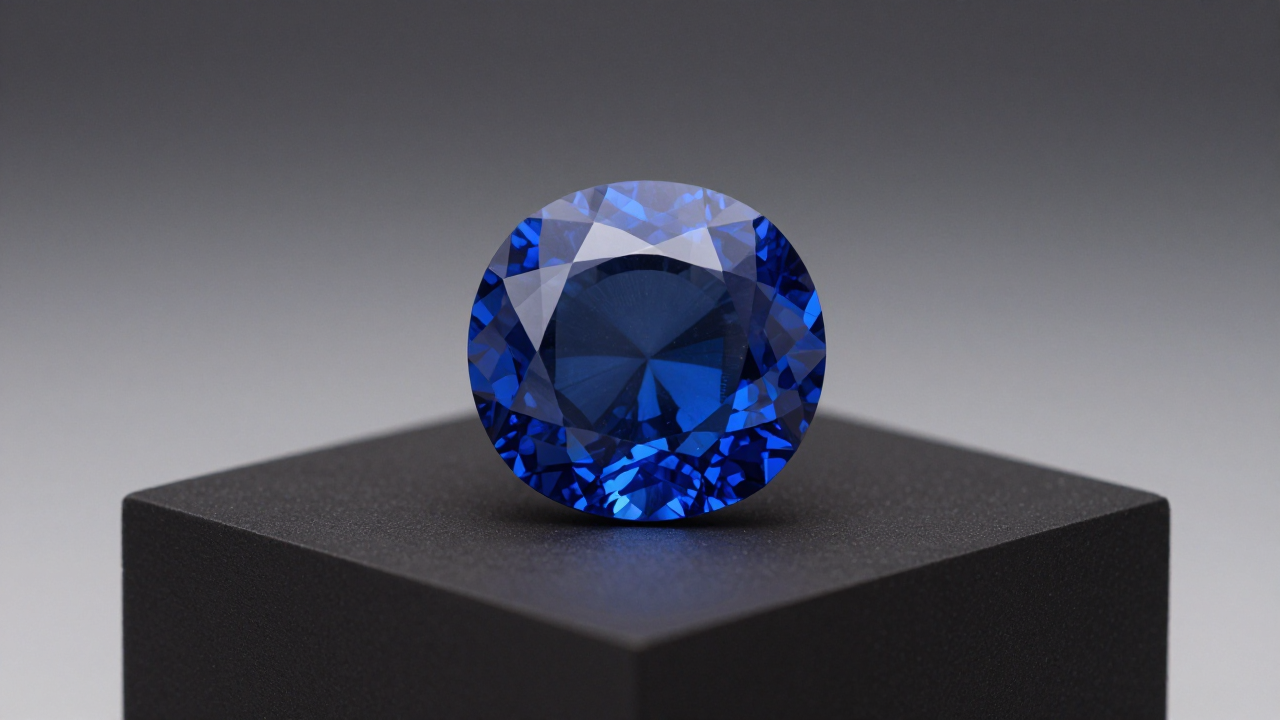
When you buy a sapphire watch crystal, four things decide whether you got a deal or a problem: verified single-crystal provenance, an ion-assisted-deposition AR stack on both faces, tolerances…
written into the PO, and a supplier who answers a claim in days rather than months.
What Separates a Good Sapphire Watch Crystal From a Bad One
Price differences between sapphire watch crystals almost never come from the material, because every piece on the market is synthetic corundum at Mohs 9. The gap sits in growth method, polish grade, and coating process.
Chemically there's no variance. Synthetic sapphire is Al2O3, Vickers hardness roughly 2,000-2,200 depending on which crystallographic axis you measure. So when one quote comes in at $2.10 and another at $8.40 for the same drawing, the material cost is nearly identical. The $6 difference is everything that happened after the boule was grown.
Two growth routes dominate the market. Kyropoulos pulls a cylindrical boule you can slice in any orientation, letting you align the optical axis to control birefringence on a domed part. EFG (edge-defined film-fed growth) pulls a flat sheet, cheaper per square inch and well suited to flat smartwatch covers, but the axis orientation is locked in at growth. Neither route is defective. Buying EFG sheet at a Kyropoulos price is the defect.
Polishing is the other half. Watch-grade crystals get double-side lapped and polished to roughly Ra 0.5-1.0 nm. Cheaper routes stop after one face and leave a haze on the underside that you only catch at a 30-degree angle under a loupe. Retail buyers don't run that check. Repair shops do, which is why aftermarket crystal suppliers carry a reputation they didn't earn from watch brands.
The Four Dimensions I Score Every Quote Against
Score every sapphire crystal quote on four dimensions: optical coating stack, dimensional geometry, material growth and polish grade, and the supplier's inspection and recourse terms. Ignore the brand name on the invoice, and ignore any spec sheet that lists thickness without a tolerance.
Optical Stack That Survives Real Wear
Ask for the transmission curve, not a single transmission number. Single-side AR coating lifts visible transmission to about 99.0%. Both faces gets you 99.4-99.6%. Uncoated sapphire sits at 85-86%, which is why a bare crystal reads gray against a black dial.
The spec that matters more is what the top layer actually is. A hard IAD-deposited AR coating behaves very differently from a soft hydrophobic fingerprint coat. Hydrophobic coats feel excellent in month one and are visibly worn through by month ten to fourteen on a daily-wear watch. If your end customers include tradespeople or gym regulars, that's a warranty claim on a timer.
Geometry and Tolerances
Thickness is the number everyone quotes and the least informative one. A 38-42mm case typically takes a 1.2-1.8mm flat crystal, or 1.5-2.5mm at the apex of a dome.
Failure usually traces to the edge chamfer and the R-angle, not the thickness. A 0.05mm chamfer inconsistency shows up as a light ring at the case gasket seam. Invisible in QC photos. Obvious on a wrist under store lighting. Ask for chamfer tolerance in writing, because most factories round it off in the quote and don't control it on the floor.
(One correction to something I believed for years: I assumed dome height drove most of our breakage claims. Pulling 18 months of return data in mid-2023 showed chamfer quality was the bigger variable. Check your own data before you trust your instincts.)
Material Grade and Polishing Route
Vendors mix watch grade, optical grade, and tool grade in the same price conversation. Ask for axis orientation and the polish route on paper. If the answer arrives as "high quality sapphire," you're talking to a trader, not a factory.
Supplier Process Control and Recourse
AQL sampling plan. First article inspection report. Willingness to run 100% dimensional checks on the first two production lots. Then the recovery question: when 3% of a 5,000-piece order lands with coating pinholes, do you get replacement parts or a credit note? Get the answer before the PO, not after.
What Do You Actually Get for $2, $8, and $25 Per Piece?
FOB pricing for a sapphire watch crystal breaks into three workable tiers at 1,000-piece volumes. Each tier maps to a different retail price point and a different failure profile, and paying tier-3 prices for tier-1 goods is the most common buying error we see.
One market note worth tracking. Smartwatch sapphire volumes climbed again through late 2025, with Vivo shipping the Watch 6 on a sapphire crystal that November. That pushed EFG sheet pricing down, and it also pushed a lot of marginal sheet into the aftermarket. If your domed-crystal quote dropped 30% between Q1 and Q3 2025, ask whether your vendor changed growth methods.
Choose the mid-range tier if you ship more than 2,000 units a year and a single warranty return costs you more than the per-piece delta. Choose the entry tier if you sell under $80 retail and replace crystals instead of repairing them.Two Things Salespeople Never Put on the Spec Sheet
The two parameters that change field failure rates most on a sapphire watch crystal never appear in a quote: the AR coating's deposition method and the residual surface stress left behind by lapping. Neither shows up in a sample photo, and most vendors won't volunteer either one.
Deposition method. E-beam deposited AR coatings run at low packing density. Ion-assisted deposition (IAD) runs dense. An e-beam coat can pass a tape adhesion test on day one and delaminate after 200 hours of humidity. If a quote says "AR coated" with no method named, assume e-beam. Ask for a cross-hatch adhesion result per ASTM D3359. We run that test on every coating lot at Jadezone Optical, and it takes about 20 minutes. Residual stress and annealing. This is the one nobody discusses. Lapping and polishing induce subsurface stress, and a properly annealed crystal survives a 1-meter drop onto ceramic tile at roughly 3-5x the rate of an unannealed one. No spec sheet in this industry lists an annealing step. The practical proxy: ask the vendor for their returned-goods rate on the last three dome orders, in writing. A vendor who won't answer has a number you won't like.What Buyers Get Wrong About Sapphire Watch Crystals
Four beliefs about sapphire watch crystals cost buyers money every year. All four are wrong, and two of them are active sales lines.
Field verification is easier than people think. A diamond tester will separate the two in three seconds: sapphire conducts heat at roughly 25-35 W/m·K and registers on the meter, while mineral glass reads near zero.
How We Screen a New Crystal Supplier
Screen a new sapphire crystal supplier with a 50-piece paid sample order and a handful of physical tests, not with email assurances or a factory tour. The whole exercise costs a few hundred dollars and takes about three weeks. It eliminates most vendors that would have failed you at scale.
The flow we run: 50-piece sample order → 5-point micrometer check on thickness → 200-hour damp heat at 60°C and 90% RH → 90cm tile drop on 10 pieces → 2N tungsten carbide scribe across the coating → process flow documentation with actual equipment names.
The micrometer step is where most cheap suppliers fall out. If thickness spread within a single crystal exceeds 0.01mm, the gasket seal is a coin flip and no downstream process fixes it. The scribe test catches soft top coats before they reach your customers.
On the process documentation: "we have coating machines" is not an answer. "We run a Leybold box coater with ion assist" is. Vendors who own their equipment can control the process. Vendors who broker it can only relay your complaint.
Frequently Asked Questions
How much should a sapphire watch crystal cost?
At 1,000-piece volumes, FOB pricing runs $1.80-$3.50 for entry flat crystals, $6-$12 for double-side polished IAD-coated domes, and $18-$30 for axis-oriented premium parts with full dimensional inspection. Quotes far below these bands usually mean a different growth method or no coating.
How long does the AR coating on a sapphire watch crystal last?
A hard IAD-deposited AR stack holds up for 5-8 years of daily wear. A soft hydrophobic top coat degrades in 10-14 months. Uncoated sapphire never degrades, but it transmits only 85-86% of visible light, which reads as a grayish dial.
Is a sapphire watch crystal really scratch-proof?
Sapphire ranks Mohs 9, so only diamond and a few carbides will scratch it. It is brittle, though. Roughly 1 in 15 domed crystals cracks when dropped 90cm onto ceramic tile, which is worse impact performance than mineral glass delivers.
How do I tell a sapphire watch crystal from glass?
Use a diamond tester. Sapphire conducts heat at roughly 25-35 W/m·K and registers on the meter, while mineral glass reads close to zero. A water-drop test also works, since sapphire's 1.76 refractive index spreads the droplet differently than glass.
What thickness do I need for a 40mm case?
For a 40mm case, 1.2-1.5mm suits flat crystals and 1.8-2.2mm at the dome apex. Dropping below 1.0mm raises breakage sharply, and going past 2.5mm mostly adds weight and cost without improving durability.