
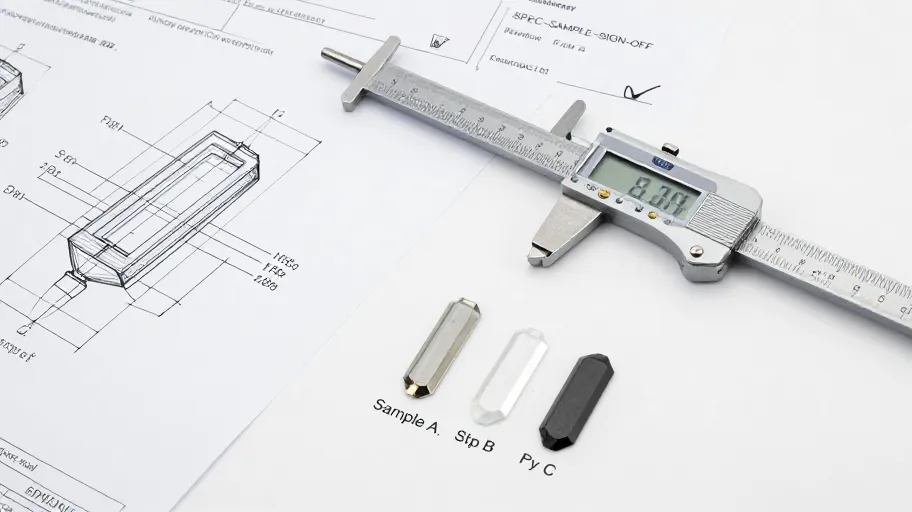
A sapphire crystal replacement succeeds or fails before anything is cut: fix the specification, control the sample loop, and document the approval. The working method is the SPEC–SAMPLE–SIGN-OFF framework. Specify every dimension, finish and coating requirement in a written drawing package; approve samples against written criteria rather than visual impressions; and record sign-off so production and any future reorder match the approved reference. Every sample policy, tolerance and lead time must be confirmed directly with your supplier.
Why replacements are harder than new designs
When you buy a sapphire crystal for a new watch, you control the drawing from day one. When you buy a replacement crystal, you are reverse-engineering someone else's decision — possibly from another factory, another decade, another production standard you cannot verify. The crystal must fit a case you did not design, seat against a gasket you may not have specified, and sit at a height that clears hands that were made to a drawing you may never see.
This is why the biggest risk in a sapphire crystal replacement project is not the sapphire itself. It is ambiguity. The supplier can only manufacture what is specified. If the specification is a sketch, a reference photo and a verbal instruction, every sample round becomes guesswork, and the buyer pays for that ambiguity in iterations.
The remedy is process, not luck.
The SPEC–SAMPLE–SIGN-OFF framework
SPEC — fix the specification. Convert the existing crystal into a complete drawing package: diameter or shape geometry, thickness, dome or flat profile, gasket seat design, edge treatment, date window position and cut if applicable, and any coating requirement. Where you cannot measure precisely, state the measurement method and ask the supplier how they will verify it.
SAMPLE — control the sample loop. Request samples against the agreed drawing, then inspect them with defined instruments and record what you measured. Write down the acceptance criteria before samples arrive, so judgement is not made under time pressure.
SIGN-OFF — document the approval. Once a sample is approved, label it, retain it as the golden reference, and confirm in writing that it is the basis for production. Any deviation request in production should come back to you as a written change, not a surprise at goods-in.
Which specification path fits your project
| Project situation | Recommended spec path | Key risk to manage | What to confirm with the supplier |
|---|---|---|---|
| Replacing a crystal in a legacy case with no drawing | Reverse-engineer from the physical part and case measurements | Measurement error compounding across sample rounds | Measurement method, and whether they verify against the case or only the old crystal |
| New case, new crystal, full drawing available | Forward specification from your own drawing package | Drawing ambiguity in seats and tolerances | Which dimensions they treat as critical and how they inspect them |
| OEM production for your own watch line | Spec plus retained golden sample plus reorder documentation | Drift between the first approved sample and later lots | Retained-reference process and per-lot inspection reporting |
| Small-batch replacement for service or repair work | Simplified drawing with explicit fit criteria | Verbal specs replacing written ones | Whether they accept small custom runs, and on what terms — confirm directly |
| Coating change on an existing design | Spec the coating requirement and its acceptance test | Assuming coating performance without a stated criterion | What coating verification they perform and what evidence they provide |
Building the specification package
A usable drawing package for a sapphire crystal replacement answers these questions without anyone having to email for clarification:
- What is the outer geometry — round, tonneau, cushion — and how was it measured?
- What profile is required: flat, domed, double-domed, or with a defined curve?
- How does the crystal seat — tension fit, gasket, adhesive — and what surface finish does the seat need?
- Is there a date window, and where is it dimensioned from?
- What coating is specified, on which faces, and how will coating quality be judged?
- What edge treatment is required — polished, bevelled, stepped?
- What inspection reports do you want with the shipment?
Note that this article deliberately gives no numeric tolerances. Tolerances depend on your case, your gasket and your assembly method, and they should be agreed per project with your supplier rather than copied from a general article. Ask the supplier what tolerance they can hold for each critical dimension and what measurement evidence they can provide — then write the answer into your drawing.
Running the sample loop: approval questions that prevent rework
Before each sample round, agree in writing on the questions below. They keep the loop short because every party knows what "approved" means.
- Which dimensions on the drawing are critical, and which are reference only?
- What measurement instrument will be used, and will the supplier provide measured values or only a pass/fail statement?
- How will coating quality be assessed — visual, instrumental, or both — and against what criterion?
- If a sample fails one criterion but passes others, does the next round repeat the full inspection or only the failed item?
- Who retains the approved sample, and how is it labelled so it cannot be confused with rejected rounds?
- What change, if any, would the supplier flag as affecting fit in the case — and how will they communicate it?
Sample policy questions — whether samples are charged, how they are shipped, and what happens to fees after an order — vary by supplier and change over time. Confirm the current policy directly rather than assuming anything.
The sign-off gate
Sign-off is a decision point, not a formality. Before you approve:
- Every critical dimension has a recorded measured value, not just "conforms"
- Coating requirement is met and the assessment method is documented
- Fit has been tested in the actual case, with the actual gasket if one is used
- Hands, dial and rehaut clearance are verified in the assembled watch
- The approved sample is physically labelled and stored as the golden reference
- Written confirmation exists that production will follow this reference
- Any open deviations are either closed or formally accepted
Once this gate is passed, you hold a documented reference that makes reorders, audits and dispute resolution straightforward. That documentation is the real deliverable of a well-run sapphire crystal replacement project — the crystal is the output, but the record is the asset.
FAQ
Do I need a full drawing to order a replacement sapphire crystal? A drawing package gives you control and shortens the sample loop. If no drawing exists, the alternative is careful reverse-engineering from the physical part — but expect the specification conversation to take longer and be explicit about measurement methods.
Can I just send the old crystal to the supplier? Sending a physical reference can help, but it does not replace a written spec. Ask the supplier whether they will measure the reference themselves, whether they will measure the case, and what record of those measurements you will receive. Get the answer in writing.
How many sample rounds should I expect? This depends on the completeness of your specification, the complexity of the geometry, and how well the approval criteria were defined up front. Rather than predicting a number, reduce the count: written criteria, measured values and a single named approver on your side.
What should I ask about coatings? Ask what coating options are offered, which faces they apply to, how quality is verified, and what evidence accompanies delivery. Coating performance claims should be supported by the supplier's stated verification — confirm what that is before approval.
How do I keep reorders consistent with the first approved lot? Retain the golden sample, document the approved drawing revision, and ask the supplier how they ensure later lots match the approved reference, including what per-lot inspection reporting they provide.
获取采购 Brief — structured for watch brands, buyers and developers: use it to frame your next sapphire crystal replacement RFQ so nothing is left to guesswork.
Short on time? Start with the sign-off checklist above — it works as a standalone internal approval sheet for any sapphire crystal project.