
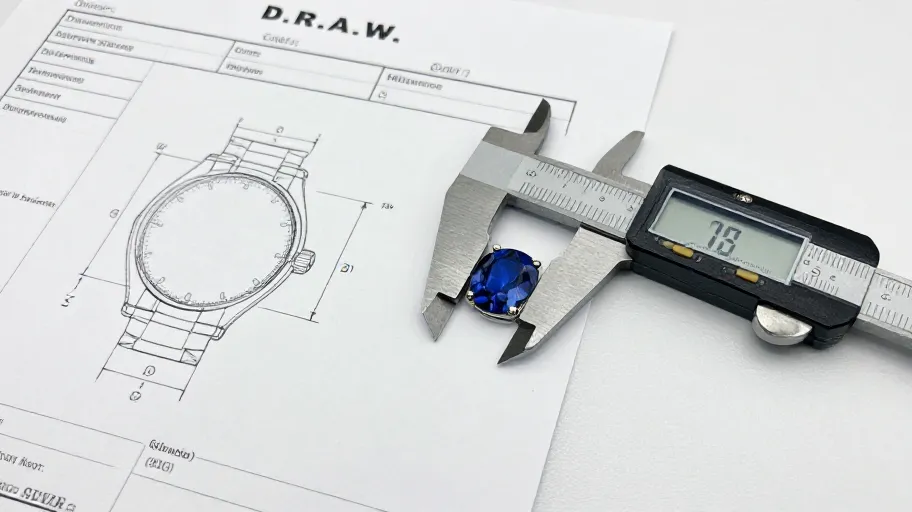
A revised custom sapphire watch crystal sample should be reviewed against the original drawing, not against the previous sample. Use the D.R.A.W. Gate — Dimensions, Reference surfaces, Appearance, Workmanship sign-off — to classify every finding as either a contained revision within the existing part or a genuine re-engineering trigger. Most sampling anxiety comes from conflating the two. Confirm the current policy directly for any project-specific term.
Why revised-sample reviews drift
A revision round creates pressure. The project has already moved; the team wants to approve. When a sourcing manager finds a new issue on sample two, the instinct is to weigh it against the schedule cost of another round rather than against the drawing. That is how borderline parts get approved and defects surface at assembly, where the cost of correction is far higher than in sampling.
The countermeasure is procedural, not motivational. Decide before the sample arrives which findings are contained and which are structural, and record that decision in writing.
The D.R.A.W. Gate
D — Dimensions. Re-measure the revised crystal against the dimension sheet, not against the previous sample. Check every controlled feature: diameter, height, seat geometry, curvature profile where applicable. If the drawing references a gauge or fixture method, use the same method the supplier used, or note the discrepancy in your report.
R — Reference surfaces. Verify the seat, bevel and any locating features against the drawing callouts. Reference-surface errors are the classic cause of "the crystal fits but the dial gap looks wrong" findings later in assembly.
A — Appearance. Inspect edge polish, surface finish, coating uniformity where coating is specified, and any marking. Record findings by location and severity using agreed inspection conditions — lighting and magnification change conclusions, so document the conditions used.
W — Workmanship sign-off. One named person approves or rejects, in writing, against the acceptance criteria captured in the drawing or specification. Diffuse verbal approvals are where traceability dies.
Decision table: contained revision or re-engineering
| Finding class | Contained revision (same part continues) | Re-engineering trigger (drawing-level change) | Action |
|---|---|---|---|
| Dimension within drawing intent, finish variation | Yes | No | Report with measurements; request confirmation of correction method |
| Dimension outside drawing callout | Possibly, if isolated to one feature | If the process cannot hold the callout | Ask supplier for capability evidence before next round |
| Seat or locating geometry wrong | Only if the tool path is adjustable | If the part design must change | Escalate to drawing revision and re-approval |
| New tooling or profile change requested by either side | No | Yes | Treat as new part revision; update drawing version |
| Appearance-only defect, dimensions conform | Yes | No | Log location and condition; request correction in next sample |
| Multiple interacting deviations | Unclear without data | Decide from measurement set, not opinion | Compile full measurement report and hold a joint review |
The purpose of the table is to prevent an emotional read of "another problem means starting over". A single feature outside callout, with dimensions otherwise conforming, is a contained revision conversation. A stack of interacting deviations means the process or the drawing needs review — and it is better to know that from data.
Concrete approval questions for the supplier
Ask these in writing with the revised sample report:
- Which features on this revised sample were changed versus the previous sample, feature by feature?
- Which inspection method and equipment produced the reported measurements, so your team can replicate them?
- Which drawing revision number does this sample correspond to, and is that version recorded in your traveller or batch documentation?
- For each reported finding, is the corrective path a process adjustment on the existing part or a change to the part definition?
- What evidence — measurement data, first-article report — will accompany the next sample for the flagged features?
- Confirm the current policy directly for any commercial term attached to the revision round.
Documentation habits that protect the timeline
- Version every drawing and every sample. "Sample 2 to drawing rev B" is a reviewable object; "the latest sample" is not.
- Keep one consolidated findings log across rounds, so a recurring defect is visible as recurring rather than rediscovered.
- Record inspection conditions (lighting, magnification, gauge) alongside appearance findings.
- Require the supplier's measurement report to map feature-by-feature to your dimension sheet numbering, so gaps are visible rather than implicit.
- Hold the workmanship sign-off to one accountable named approver per round.
Checklist before approving a revised sample
- Every controlled dimension re-measured against the current drawing revision
- Reference surfaces and seat geometry verified against callouts
- Appearance findings logged with location, severity and inspection conditions
- Findings classified using the decision table above
- Supplier written response received for each finding
- Drawing revision number confirmed and recorded
- Named approver has signed off in writing
- Any project-specific commercial term: confirm the current policy directly
Frequently asked questions
Should a revised sample be compared to the first sample or to the drawing? To the drawing. Comparing sample to sample compounds drift; comparing to the drawing keeps the part definition authoritative across every round.
Who should hold final approval on a revised crystal sample? One accountable, named approver working from the acceptance criteria in the drawing or specification. Engineering, QC and assembly should feed findings in, but the sign-off itself must be singular and written.
What if the revised sample fixes the reported defect but introduces a new one? Log it in the same findings log rather than treating it as a separate conversation. A pattern across rounds tells you more about process stability than any single sample does.
How do we avoid "starting over" when a revision fails? Classify the failure first. Tool-path or process issues on an unchanged part definition are contained revisions; changes to the part definition itself are drawing-level events. Confirm with the supplier which class each finding belongs to before assuming a restart.
What should accompany the next sample after a flagged round? A feature-mapped measurement report against your dimension sheet, plus confirmation of the drawing revision the sample represents. Confirm the current policy directly for anything commercial attached to the round.
Next step
Send your drawing or dimension sheet, including the features that failed in the last round, and the review can start from the part definition rather than from memory. Submit a drawing or dimension sheet to JadeZone Sapphire to begin a documented revision review for your custom sapphire watch crystal project.
Before that, run the checklist above on your most recent sample report — if any box is unchecked, that is the conversation to have first.