
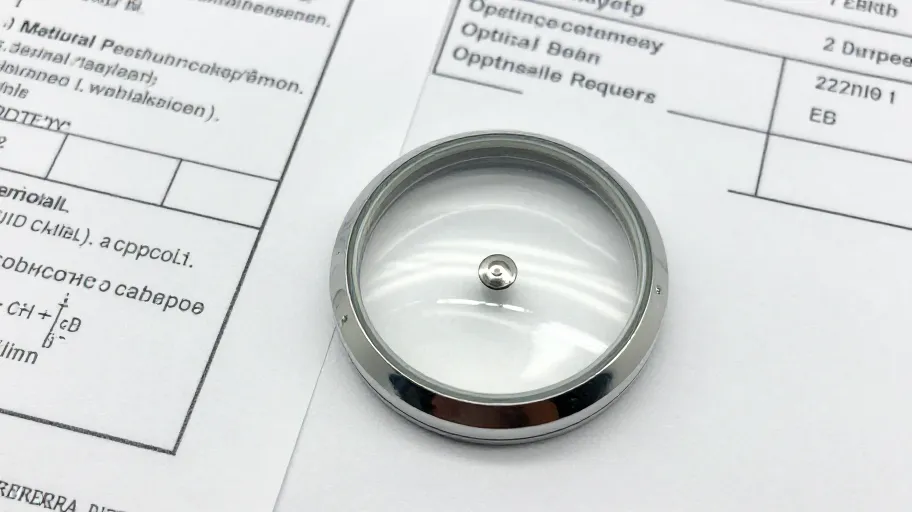
When a supplier proposes switching your crystal to domed sapphire watch glass — or away from it — treat the proposal as a design change, not a procurement footnote. Compare material properties, optical character, process impact and documentation using a fixed framework, and approve nothing until each checkpoint is evidenced in writing.
Why material-change proposals deserve scrutiny
Mid-project material proposals arrive for many reasons: a sourcing constraint, a process refinement, a design review, or a commercial recalibration on the supplier side. The proposal itself is not the problem. The problem is approving a change without a structured interrogation, because a crystal is not an isolated part — it interacts with the dial's visual presentation, the case's sealing interface, the bezel geometry, the hands' clearance and the end customer's perception of quality.
A domed sapphire watch glass, in particular, changes more than scratch resistance relative to mineral or polymeric alternatives. Curvature alters light paths across the dial, changes the apparent depth of the dial, and shifts the dimensional envelope at the crystal seat. Any of those can be desirable — vintage-leaning aesthetics and improved legibility at off-angles are frequent design motivations — but desirability is your call, not the supplier's.
So the question is not "is domed sapphire good?" It is: "does this specific change serve this specific design, and can the supplier evidence it?"
The M-A-P-D Gate: a four-checkpoint review
Use the M-A-P-D Gate to evaluate any proposed material or geometry change:
- M — Material basis. Why is sapphire the proposed substrate, and why now? What changes versus the incumbent material in hardness, optical clarity and chemical resistance — stated as documented specifications, not adjectives?
- A — Aesthetics and optics. How does the dome's curvature affect dial reading, reflection behaviour, edge distortion and perceived dial depth for your dial layout, not a generic one?
- P — Process and interface. What changes in forming, finishing, coating, gasket seating and assembly? What must be re-qualified on the case side?
- D — Documentation. What drawings, revisions, inspection criteria and approval records accompany the change, and who signs each?
A proposal that cannot pass all four gates is not ready for your signature.
Comparison decision table
| Evaluation axis | Domed sapphire watch glass | Flat sapphire | Mineral glass | Polymeric (e.g. hesalite-type) crystal |
|---|---|---|---|---|
| Scratch resistance class | High (verify supplier's specification) | High (verify) | Moderate (verify) | Lower (verify) |
| Optical character | Curvature refracts light; can enhance depth and off-angle legibility; edge distortion possible depending on geometry | Neutral, planar view | Flat unless formed; clarify grades | Can be formed; clarify optical grade |
| Design signalling | Read as premium by many buyers — confirm against your market positioning | Read as modern/clean | Entry to mid positioning varies by market | Associated with certain vintage styles |
| Interface impact | Dome height changes the seating envelope, hand clearance and gasket geometry — re-verify fit | Simpler seat geometry | Similar to flat sapphire if flat | Compressible seating behaviour differs — confirm |
| Coating options | AR coating applicability to be confirmed for the proposed curvature | Confirm per supplier | Confirm per supplier | Confirm per supplier |
| Approval burden | Full drawing revision plus optical and fit re-qualification | Lower re-qualification scope if like-for-like | Confirm scope | Confirm scope |
No cell above assumes a number. Every axis is a question to put to your supplier with your drawings in hand.
Concrete approval questions, gate by gate
Material basis (M)
- Please state in writing why the change to domed sapphire watch glass is proposed now, and what constraint or improvement drives it.
- Provide the material specification sheet and the properties you will guarantee on the purchase documents — not in marketing copy.
- Which properties will not be warranted, and how are those risks to be managed?
Aesthetics and optics (A)
- Show me — via sample, render or prototype — how this curvature reads over this dial, at normal viewing angles and off-axis.
- Where does edge distortion begin on this geometry, and how does it interact with my indices and date window?
- If AR coating is proposed, what is the coating specification and how is it inspected — per lot or per batch? Confirm the current policy.
Process and interface (P)
- Provide the revised crystal drawing, including the seating profile, and identify every case-side dimension that interacts with the dome.
- What dimensional and geometric criteria will appear on the inspection record? (Do not accept verbal tolerance claims; require the documented criteria.)
- Does the change affect gasket specification, bezel fit, hand clearance or assembly sequence? Which of these re-qualifications does the supplier own?
Documentation (D)
- Issue a formal revision to the drawing set, with revision level visible on the crystal drawing itself.
- Define the inspection criteria, sampling approach and acceptance record before the first production batch.
- Confirm sample policy, tooling arrangements, minimum order quantities, lead times and any fees in writing. These are project-specific commercial terms — verify the current policy directly with the supplier rather than relying on any general expectation.
The delivery gate: your approval record
Before you sign, your file should contain:
- Written rationale for the material change
- Material specification sheet with warranted properties
- Revised crystal drawing at a stated revision level
- Optical/legibility evidence against your actual dial
- Interface review covering seat, gasket, bezel and hand clearance
- Inspection criteria and acceptance record defined in writing
- Commercial terms — sample, MOQ, lead time, fees — confirmed in the current quotation
- Named approver and date on the change record
If any line is blank, the change is not approved; it is pending.
FAQ
Is domed sapphire watch glass better than flat sapphire for my watch? Neither is universally better. Dome changes optical character, perceived dial depth and the seating envelope. If your design goal is vintage-flavoured depth or improved off-angle legibility, dome merits evaluation; if your goal is a clean, planar reading surface, flat may serve. Decide against the design brief, not the supplier's preference.
What should I check first when a supplier suggests the change? Ask for the written rationale (Gate M). If the answer is vague, that is your signal to slow the approval, not to accelerate it.
Does curvature affect the crystal-to-case fit? It can — dome height and seating profile interact with gasket geometry and hand clearance. Require a revised drawing and an interface review before approving. Confirm the exact dimensional criteria with the supplier rather than assuming any figure.
How do I evaluate optical performance without a full production run? Request evaluation against your actual dial — via sample or prototype under agreed viewing conditions — and document the observations in the approval record. Confirm the supplier's current sample policy and any associated terms directly.
Who owns re-qualification if the change causes a fit issue later? That depends entirely on the commercial terms you agree in advance. Define ownership of interface re-qualification, acceptance criteria and remedy in the change record before the first order — and confirm current policy in writing.
Next step
If a supplier has proposed moving your design to — or away from — domed sapphire watch glass, request a curvature review with JadeZone Sapphire. Send your case drawing, dial layout and the proposal you've received, and we will review the optical and interface implications against your design before you commit.
Prefer a lighter first step? Download the M-A-P-D approval checklist above and run it against your current proposal — then come back with the gaps.