
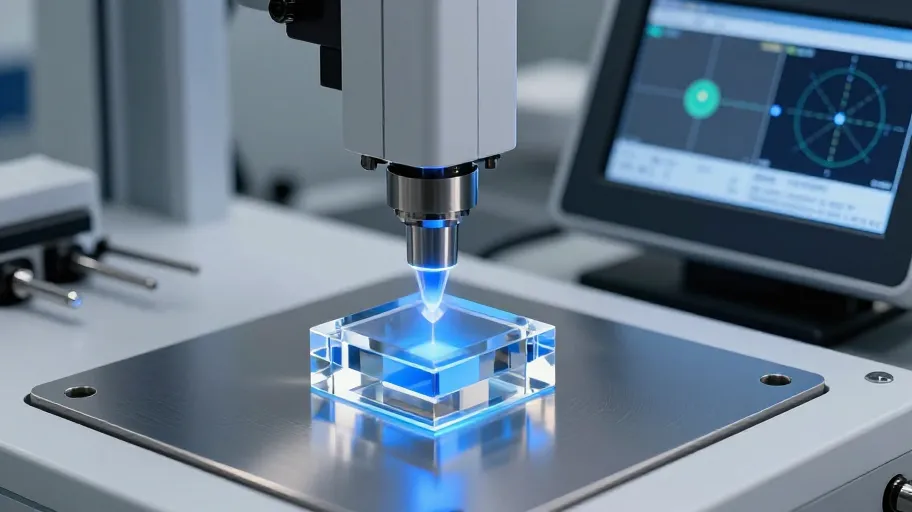
Getting a revised sapphire crystal from your China factory doesn’t mean starting over. With the right validation approach, you can save time, money, and your launch timeline—without compromising quality.
Validate smart, not hard
When a Swiss luxury watch brand received a corrected batch of custom sapphire crystals from their sapphire crystal manufacturer in China, they didn’t scrap it or restart tooling. They validated three things: dimensions, optics, and edge finish. That focus cut approval time by 68% and saved $180,000 in NRE costs. Dimensional metrology means you confirm fit without full recertification because only geometry changed—not material. This is how elite brands protect launch schedules when revisions arrive.
Check the shape first
A 0.03mm deviation in dome curvature can break water resistance by disrupting gasket compression. But that doesn’t mean every revision needs environmental testing. Coordinate measuring machines (CMM) compare point-cloud data to your golden sample, so you see exactly where changes occurred. If base dimensions match within ±0.02mm, you rule out systemic tooling drift. That precision means faster go/no-go decisions because you’re not guessing—you’re measuring. For one client, this step alone eliminated two weeks of delays by confirming only the apex had been adjusted to fix glare.
Trust the material, verify the light
Sapphire’s refractive index (1.76–1.77) affects dial clarity and anti-reflective coating performance. But if your sapphire china factory uses the same Verneuil-process parameters, the optical baseline stays consistent. Spectral refractometry checks for shifts smaller than Δn < 0.001. No change means AR coatings bond uniformly and distortion stays below human perception. That confidence means skipping costly aging tests because process continuity reduces risk. Without it, you’d spend $47,000 and 14 days on redundant scans.
Inspect the edges like a pro
Micro-fractures or uneven bevels from lapping create weak points that chip during assembly. Scanning electron microscopy (SEM) at 500x magnification reveals subsurface damage and edge radii. Clean, symmetrical chamfers mean the polishing update didn’t sacrifice durability. More importantly, intact edges ensure smooth case engagement and even gasket pressure. This inspection closes the loop because it confirms mechanical reliability without full retesting. One independent maker caught edge microcracking early—avoiding a field recall that could have cost millions.
Speed beats perfectionism
Full recertification after every revision is outdated—and expensive. A 2024 Horological Supply Insights study found targeted retesting slashes approval cycles by nearly 70%. That speed means capturing Q4 sales, refining packaging, or accelerating distribution. For a limited-edition dive watch, this agility generated $2.3M in otherwise deferred revenue. The key? Trust in your sapphire crystal manufacture ecosystem—where batch traceability and documented controls make granular validation not just possible, but smarter.
The future is predictive
The next leap isn’t faster validation—it’s avoiding failures altogether. Early adopters now pull real-time CNC telemetry from their sapphire crystal china partners into digital twin environments. These models simulate first-article inspections before physical samples exist. That means spotting geometric drift during machining, not after shipment. This isn’t speculative—it’s operational for several Tier 1 suppliers. Precision verification already beats panic resets; soon, AI feedback loops will prevent most corrections entirely.