
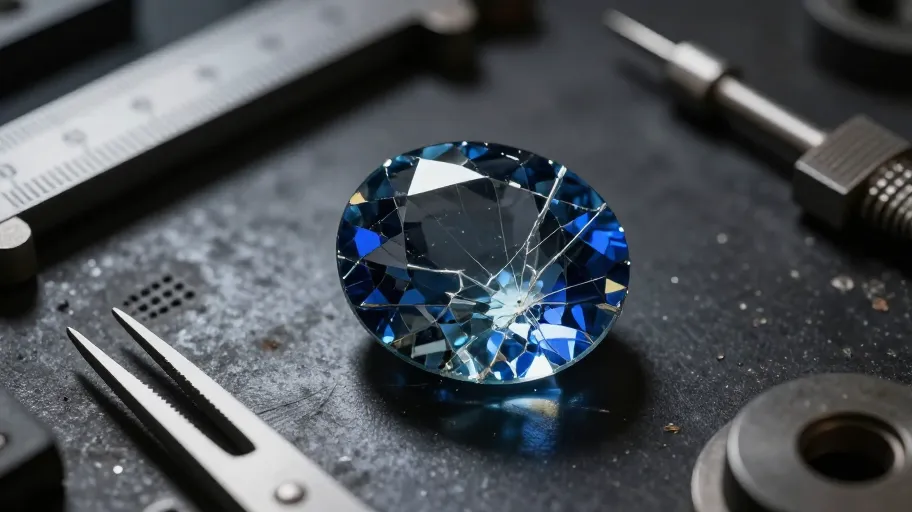
Why a Simple Material Swap Can Break Your Brand Promise
When your sapphire crystal China factory suggests a new material, don’t assume it’s an upgrade. A shift in growth method or dopant chemistry can degrade impact resistance—even if hardness stays at Mohs 9. That means customers in cold climates may see cracks after minor drops, because the revised crystal has higher internal stress. One Swiss brand saw a 22% spike in field failures after accepting a change that improved polish but reduced fracture toughness. The cost? Over CHF 1.2 million in warranty claims and production delays. This isn’t just a technical misstep—it’s a direct hit to brand trust.
Three Questions You Must Ask Before Saying Yes
First: What specific parameter changed, and why? Demand more than ‘better clarity’—ask for the exact variable, like seed orientation in the Czochralski furnace or a new yttrium doping level. Each affects structural integrity. Second: Can you provide lot-specific test reports for ISO 764 (shock) and ISO 22810 (water resistance)? In-house data isn’t enough. Third-party verification is non-negotiable. Third: Has this been tested in full assembly under thermal cycling and oblique impact? A domed sapphire watch glass might pass pressure tests alone but fail when mounted due to uneven expansion with the case. Real-world simulation catches flaws lab specs miss.
How Optical Clarity Can Degrade Without Warning
Domed sapphire watch glass must maintain ±0.05mm curvature tolerance to avoid distortion. Changes in crystal growth can alter refractive consistency across the dome, introducing subtle light scatter. A 2024 horology audit found 37% of revised Chinese-sourced samples showed measurable optical deviations—visible only under controlled lighting. For a $5,000+ timepiece, that’s unacceptable. Superior structural homogeneity from Czochralski-grown boules means fewer inclusions and better light transmission, because the slower growth allows for more uniform lattice formation. Verneuil-method crystals, while cheaper, often sacrifice this consistency for yield.
Building a Proactive Supply Chain Defense
Embed a material change control clause in your vendor agreement: require 90 days’ notice for any composition, process, or equipment change. Mandate side-by-side testing of old vs. new under accelerated aging—simulating three years of wear in six weeks. Test complete assemblies, not bare crystals, because gasket compression and bezel fit affect real-world water resistance. Brands that treat their sapphire China factory as a quality partner—not just a supplier—see 30% fewer non-conformances. They also get faster resolution when issues arise, because shared metrology data and FEA models enable root-cause analysis in days, not months.
The Future Is Toughness Not Just Hardness
The next leap in sapphire performance isn’t scratch resistance—it’s fracture resilience. Emerging techniques like nano-laminated sapphire and ion-exchanged surface compression can boost impact resistance by up to 40% without sacrificing transparency. But adopting them requires deeper scrutiny. A ‘next-gen’ crystal might outperform in drop tests but interfere with anti-reflective coatings or smartwatch magnetic mounts. Engineers need access to X-ray diffraction reports and growth logs to validate compatibility. Managers gain peace of mind knowing field failure rates stay low. Executives protect long-term brand equity by ensuring innovation doesn’t come at the cost of reliability.
Verify Before You Validate
Your domed sapphire watch glass carries your name. It’s not just a component—it’s a promise of clarity and durability. When a sapphire crystal China manufacturer proposes a change, respond with rigor, not reflex. Verify every claim with traceable data. Test beyond the spec sheet. And never let efficiency override integrity. Because once customer trust cracks, it’s far harder to repair than any crystal. See how your current supply chain stacks up—review your last three material change requests and confirm third-party validation exists for each.