
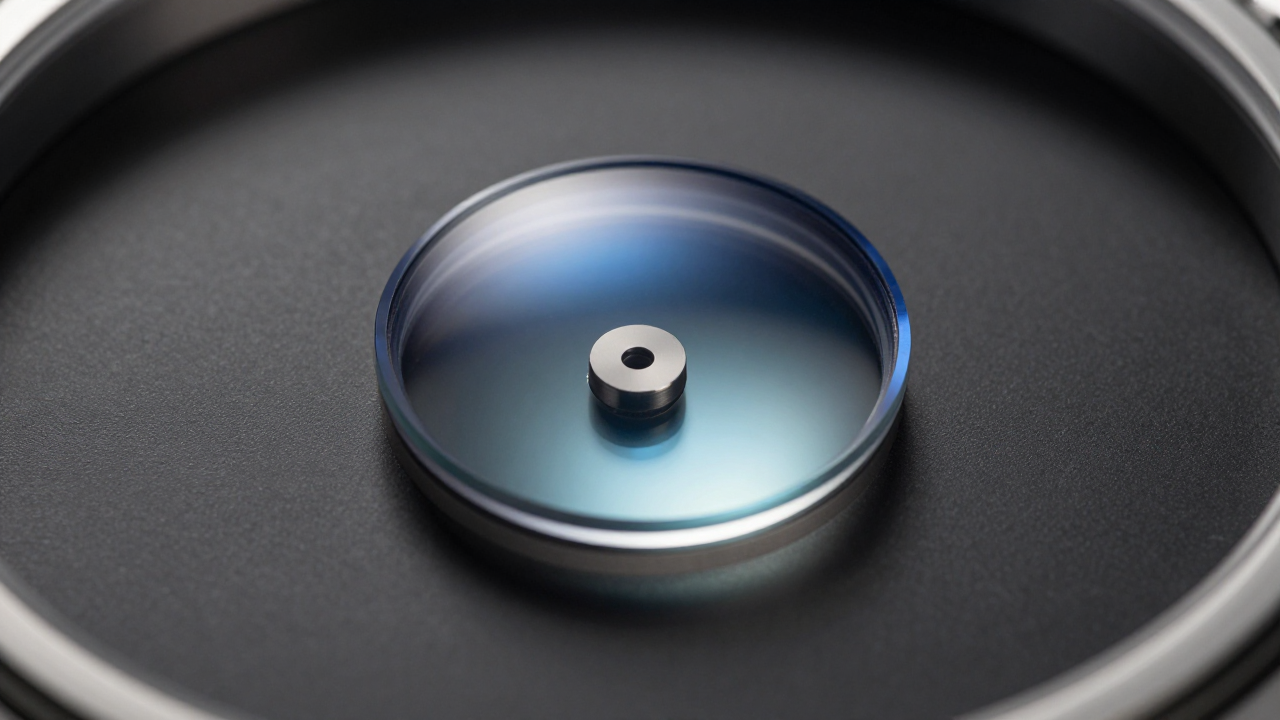
Buying a sapphire watch crystal on hardness and diameter alone is the most common and most expensive error in this category. Hardness never fails anybody.…
Thickness tolerance, dome radius, edge chamfer, and coating placement are what fail. Get those four wrong and a premium sapphire turns into a leak, a chip, or a warranty claim.
The Most Common Sapphire Watch Crystal Mistake
The US aftermarket for watch glass ballooned after 2020, when a wave of microbrands started sourcing crystals directly from Asia instead of through service networks. Listings multiplied. What didn't multiply was spec discipline. A page that says "sapphire crystal, 30.5 mm" is telling you roughly 10% of what you need to know.
What follows are the five mistakes we see most often, ordered by how much they cost. One of them cost us $47,000 before we fixed the root cause.
Mistake 1 — Buying "Sapphire" Without a Material Certificate
Of 61 competitor crystals our incoming QC bench tested in 2025, 19 turned out to be mineral glass with a hard coating rather than sapphire. That one ratio explains most of the warranty claims we get asked to investigate. Sapphire-coated mineral glass is a real product, and the word "coated" is the part that disappears from the listing title.
The product itself is legitimate. Manufacturers deposit a thin hard layer on a borosilicate or mineral substrate, and it wholesales for $1.50 to $3.00. On arrival, the coating passes a light scratch test, so nothing looks wrong at intake. Failure shows up 8 to 18 months later: the coating wears through in the highest-contact zone, the mineral underneath scratches at Mohs 5.5, and the customer blames the watch brand.
We watched a Florida microbrand absorb 40 warranty claims in the spring of 2024 over a $2.80 crystal. The brand paid about $310 per claim in shipping, labor, goodwill, and admin time.
The fix costs one document and one device. Ask for a material certificate naming the growth method — genuine synthetic sapphire is Al2O3 at 99.99% purity, grown by Kyropoulos or EFG (edge-defined film-fed growth), with a Knoop hardness near 2,200 kg/mm². Then verify it. Sapphire's refractive index is 1.76 to 1.77. Mineral glass sits at about 1.52. A $200 refractometer at the receiving dock catches the substitution in under ten seconds per piece.
Mistake 2 — Specifying Diameter and Nothing Else
Thickness, dome radius, and edge profile decide whether a crystal actually fits, and a diameter-only spec sheet guarantees at least one of them will be wrong. Most buyers learn this after a press-fit crack or a failed water test, never before. Measuring the case seat instead of the old crystal takes four minutes and prevents the whole problem.
Here's the pattern. A buyer measures the original with calipers, reads 30.50 mm, and orders 30.50 × 1.00 mm flat. The original was a single-dome at R 60 mm with a 0.15 mm chamfer. The flat replacement sits low in the bezel, the gasket no longer compresses to specification, and the watch fails a 10-bar bench test before it ever reaches a customer.
The tolerances are tighter than most people expect. On a 1.20 mm crystal, a ±0.05 mm window is over 4% of total thickness. Gaskets are sized in tenths of a millimeter and engineered for 20% to 30% compression. A crystal that arrives 0.05 mm thin can bottom out the press before the seal seats.
Our own failure. In November 2021, Jadezone shipped 3,000 single-dome crystals to a microbrand whose assembler works out of Carlsbad, California. The order was quoted at 1.20 mm with a ±0.05 mm tolerance. We ran 1.15 mm average. On paper, compliant. In reality, the client's I-ring gasket was specced for exactly 1.20 mm, and 180 crystals cracked during press-fit. By March 2022, 640 of those 3,000 watches had failed a 10-bar water test. Recalls, rework, expedited air freight, chargebacks, and two unhappy retailers came to just over $47,000 between us. Our first instinct was to blame their gasket. The laser micrometer data said otherwise, which is a humbling thing to read on a Tuesday morning.We quote ±0.02 mm as standard now on anything under 1.50 mm thick, run 100% dimensional inspection, and write a chip standard into every purchase order: no chips of 0.05 mm or larger in the visible area, and 0.10 mm at any edge is an automatic reject. Two automated laser micrometer stations set us back about $18,000. One recall cost more than both of them.
Mistake 3 — Reusing the Old Gasket
A new crystal on a two-year-old gasket will leak, and it will leak on the customer's wrist rather than on your bench. Sapphire doesn't compress. The gasket does all the sealing work, and it's the part everybody skips to save forty cents.
NBR and EPDM I-rings take a compression set. After 24 months of warm-up and cool-down cycles, a gasket that started at 0.50 mm free height may recover to only 0.44 mm. Pair that with a fresh crystal of slightly different thickness and your compression ratio drops from 25% to somewhere near 12%. At 10 bar, that's a leak, and the movement repair runs $300 to $600.
Replace the gasket on every crystal swap. Specify FKM (Viton) for watches that see heat or sunscreen, treat Shore A 70 hardness as a starting point, and confirm compression with a depth gauge before the case back closes. Then pressure test at 1.25× the rated depth. ISO 22810:2010 is the standard behind your water resistance claim, and it's the document a US retailer will ask about when a claim escalates.
For domed or custom crystals bonded in with UV adhesive rather than a gasket, one detail trips up a lot of assemblers. UV light passes through sapphire, so the adhesive cures through the crystal — unless the inside surface carries an AR coating, which blocks the UV. Cure from the edge in that case, or you'll ship watches with a soft bond line that fails in the field three months later.
Mistake 4 — AR Coating on Both Sides
Double-sided AR coating delivers roughly 96% light transmission against about 92% for an inside-only coating, and it scratches at Mohs 6 to 7 — well below the sapphire it sits on. On a daily wearer, the "better" spec is the wrong answer, and it's the one retailers request most often.
Uncoated sapphire reflects about 7.5% per surface. An inside-only coating pulls total transmission into the low 90s; a double-sided coating adds three or four points on top. Nobody perceives three percent of visible light on a wrist. What they do perceive is a hazy spiderweb on the outside of the crystal 14 months in.
Once the outer coating is scratched, you can't polish it out without stripping the coating, and the stripping labor costs more than a replacement part. Casio's 2026 MRG-B2100 runs a sapphire crystal with anti-reflective coating behind a Cobarion bezel and DLC-treated hardware, which is the sensible pattern for a tool watch: soft layer protected, hard layer exposed. On a dress watch that lives in a box, double-sided AR is a reasonable call. Just budget for replacement.
Mistake 5 — Why Do Sapphire Watch Crystals Chip?
Sapphire is scratch resistant against nearly everything it meets on a wrist, and helpless against a granite countertop edge or a carbide scraper. A chip is a fracture, not a wear mark, and the two need completely different responses. Confusing them is what leads people to destroy an otherwise salvageable crystal.
The polishing mistake follows the chip within about an hour. Someone reaches for cerium oxide and a Dremel, the way they would with acrylic. Cerium oxide has no measurable effect on a surface at Knoop 2,200 — you'll burn through the AR coating and the gasket and leave the chip exactly where it was. Diamond paste at 1 to 3 micron does work on sapphire, but you're looking at 45 to 90 minutes per surface on a lap wheel, and the result may still show a wave in reflected light.
Replace instead of repair, and write down a threshold. A chip under 0.20 mm on the outer edge, outside the seal line, is cosmetic and can be monitored. Anything in the visible area or crossing the sealing surface means the crystal comes out. Cleaning habits matter too: ammonia-based glass cleaner attacks AR coatings, and ultrasonic baths can lift coating at the edge of a mounted crystal. Mild soap, warm water, microfiber. That's the routine.
The Sapphire Watch Crystal Self-Check List
Run this list before the purchase order goes out, then again before the case back closes. Every line is cheap to verify and expensive to skip. Print it, tape it to the bench, and check the boxes with a pen — the act of marking a box is what makes people actually do it.
Frequently Asked Questions
Can you tell if a watch crystal is real sapphire without a lab?
A refractometer costs about $200 and reads sapphire at 1.76 to 1.77 against mineral glass at 1.52. On an uncoated crystal, that test is definitive. If the crystal has an AR coating, test the edge or the underside where the coating stops.
How much should a sapphire watch crystal replacement cost in 2026?
A flat 30 mm sapphire crystal wholesales for $6 to $18. A single-dome part with inside AR runs $12 to $35. Installed retail with a new gasket and pressure test, expect $150 to $400 depending on the watch. Anything under $60 installed is almost certainly mineral glass.
How long does a sapphire watch crystal last?
The crystal usually outlives the watch. The gasket does not. Plan on gasket replacement every three to five years, and treat the crystal as a lifetime part unless it chips. Double-sided AR coatings are the exception, showing visible outer-coating wear at 12 to 24 months on a daily wearer.
Why does sapphire chip if it never scratches?
Scratch resistance and impact resistance are separate properties. Sapphire sits at Mohs 9 and Knoop 2,200, which stops keys and steel. It's brittle, so a sharp impact against granite, ceramic tile, or a diamond file removes a piece rather than a line. Mineral glass would scratch there instead.
What thickness tolerance should I specify for a sapphire watch crystal?
Treat ±0.02 mm as the working standard for crystals under 1.50 mm thick. Wider windows are fine on thick, flat crystals in non-sealed applications. Any crystal seated against a compression gasket needs the tight tolerance, because a 0.05 mm deviation can shift gasket compression by 10 percentage points or more.