
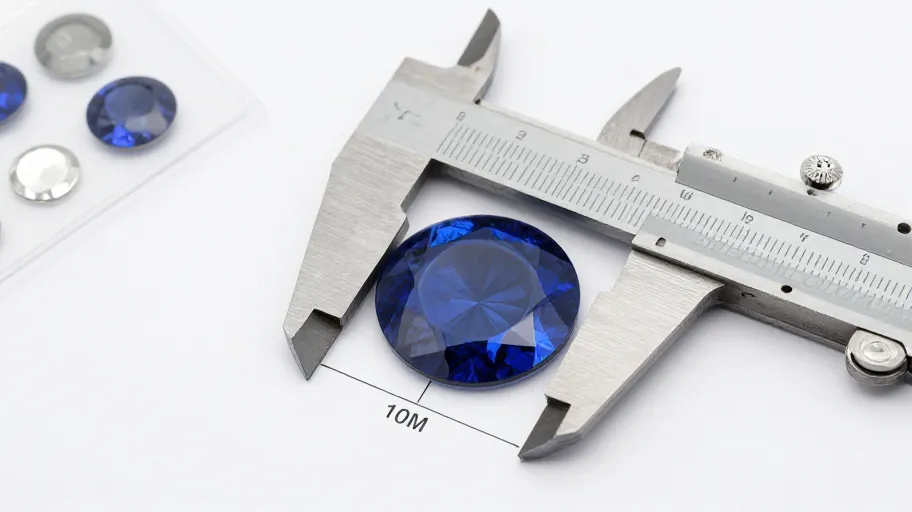
How much does a sapphire watch crystal cost? For a custom or OEM crystal, there is no single published price: the cost is a function of your specification, order volume, process choices and approval path. A quotation is built line by line. This guide gives you the SPEC-LOCK framework, a decision table and the approval questions to use before you commit — so your quote reflects your drawing, not guesswork.
Why no supplier can answer "how much" without your drawing
A sapphire watch crystal is a machined, polished optical component made from a hard, single-crystal material. Unlike catalogue parts, custom crystals are quoted against a drawing: the shape, thickness profile, edge geometry, coatings, printing and dimensional grade all change the machining route, the inspection load and the yield risk.
That means the honest answer to "how much does a sapphire watch crystal cost?" is another set of questions. A supplier who quotes a firm number before seeing your drawing has either assumed a spec you did not agree to, or has padded the quote for unknowns. As a buyer, your goal is to remove unknowns before the quotation, so the number you receive is comparable across suppliers and defensible internally.
The SPEC-LOCK framework for cost-relevant crystals
Use SPEC-LOCK to structure your RFQ and your internal cost conversations:
- S — Shape and form. Flat, domed, stepped, boxed, curved on one axis or two. Complex forms require more grinding and polishing operations, which changes both unit cost and yield.
- P — Production volume. Prototype, pilot and series volumes sit on different cost curves. Tooling and setup amortise differently at each stage, so confirm at which volume tier the quote is valid.
- E — Edge and finishing. Edge profiles, chamfers, polished versus ground side walls, and printed or unprinted borders each add or remove process steps.
- C — Coatings and treatments. Anti-reflective coatings, inner-face or double-face application, and any marking or ink work must be specified precisely, including where the coating is and is not allowed.
- L — Lenses and features. Date windows, magnifiers, openings and through-holes introduce machining and alignment steps that affect both cost and inspection.
- O — Optical and dimensional grade. Surface quality, allowed defects and dimensional tolerances define inspection effort. Tighter grades cost more to achieve and to verify.
- K — Keep-outs and tolerance stack. How the crystal interfaces with the case, gasket and movement. Tolerance stack decisions here drive rework risk far more than the crystal itself.
Each letter is a question to answer in your RFQ package — not a claim about pricing levels, which depend on the supplier and the project.
Decision table: what to resolve before you ask for a quote
| SPEC-LOCK element | Question to resolve in writing | Effect on how you evaluate the quotation |
|---|---|---|
| Shape and form | Is the form fully dimensioned, including curvature and thickness profile? | Prevents quotes based on an assumed simpler form |
| Production volume | Which volume tier is quoted, and does the quote state tooling separately? | Makes multi-supplier quotes comparable |
| Edge and finishing | Which faces and edges are polished, ground or printed? | Stops hidden process assumptions |
| Coatings | Which faces are coated, and how is coating uniformity inspected and approved? | Defines acceptance evidence at sample stage |
| Lenses/features | How are date windows and magnifiers dimensioned and positioned relative to the dial? | Avoids late redesign and re-quote cycles |
| Optical/dimensional grade | What defect criteria and measurement methods apply? | Aligns inspection expectations before first article |
| Tolerance stack | Has the crystal–case–movement interface been reviewed against the movement datasheet? | Reduces fit failures not caused by the crystal alone |
Samples, first articles and approval
Cost is not only the quoted unit price. Rework after approval is the most expensive line item in many crystal programmes. Structure approval in documented stages:
- Drawing approval. Both parties sign off a dimensioned drawing with tolerances, defect criteria and coating zones.
- Sample approval. Define what the sample is meant to prove — form, finish, coating appearance, fit in your case — and how you will record the result.
- First article approval. Define which dimensions and features are measured, with what method, and what evidence you receive.
Concrete approval questions to ask
- What dimensional report accompanies a sample or first article, and which points are measured versus referenced?
- What happens commercially if a sample does not meet the agreed drawing — rework, re-submission, or re-quote?
- What is the documented change process if we revise the drawing after sample approval?
- How are coating appearance and coverage approved — against a limit sample, a drawing note, or a written criterion?
- Who signs off fit testing in our case, and what evidence is retained?
Answers to these questions belong in your project file. A supplier's willingness to answer them in writing tells you as much about the working relationship as the price does.
Commercial terms you must confirm directly
Because no sample, cost, shipping or production policy was supplied for this article, treat every commercial term as an open question to confirm with the supplier in writing:
- MOQ per shape or per order, and how it differs between prototype and series.
- Whether tooling and setup are quoted separately or amortised.
- Sample fees, shipping responsibility, and the current sample policy — confirm directly; do not assume any arrangement.
- Lead times for samples, first articles and series, and what triggers them.
- Payment terms, currency and quotation validity.
Do not accept verbal answers on these points. A written confirmation is the buyer's real price protection.
FAQ
Is a sapphire crystal more expensive than other crystal materials? Material hardness is one cost driver among many. Machining and polishing time, form complexity, coating and inspection grade shape the final quotation, so compare quotes on a like-for-like drawing rather than on material category alone.
Can I get a price without a finished drawing? You can get an indicative range for budgeting, but a binding quotation requires a dimensioned drawing. Investing in the drawing first produces quotes you can actually compare.
How many suppliers should I quote? Enough to test whether quotes converge on the same spec interpretation. If quotes diverge sharply, the drawing is probably ambiguous — resolve that before negotiating price.
What documentation should I require with a quotation? The drawing revision, the spec points quoted, volume tier, tooling treatment, sample terms to be confirmed, and quotation validity — all in writing.
Get the sourcing brief
Before your next RFQ, 获取采购 Brief — a structured checklist built around SPEC-LOCK so your specification, samples and approval stages are locked before pricing discussions begin.
Prefer to start smaller? Use the SPEC-LOCK checklist above to review your current crystal drawing, mark any unresolved letters, and bring those questions to your next supplier conversation.