
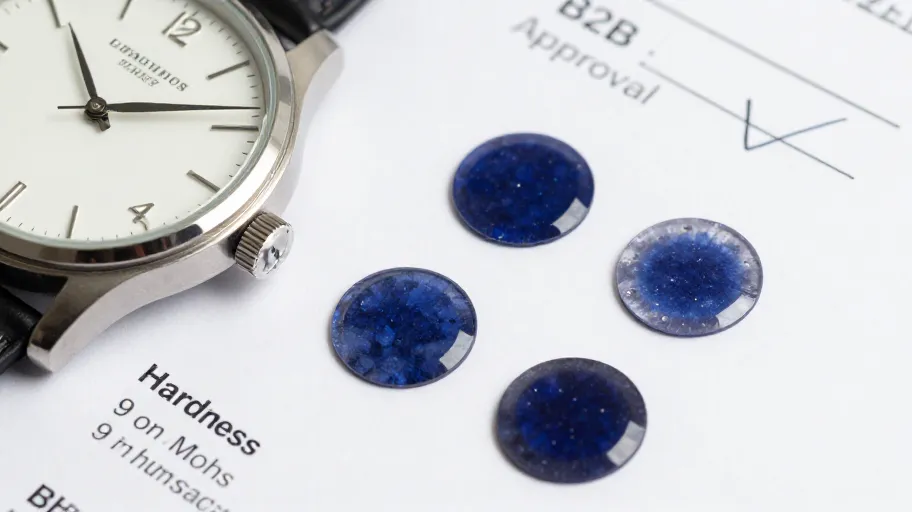
Is a sapphire crystal good for a watch? For most mid- and upper-positioned watch programmes, yes — synthetic sapphire offers exceptional scratch resistance and optical clarity that buyers can specify, sample and verify. But "good" at B2B level is not a material property; it is a documented specification, a passed sample review and a signed approval that fits your collection's positioning and economics.
This guide reframes the consumer question as a sourcing decision. It gives you a framework (SPEC–SAMPLE–SIGN-OFF), a decision table, and the approval questions to put in front of any supplier — including JadeZone Sapphire — before you commit.
What "good" means when you are the buyer
A consumer asks whether sapphire scratches less than mineral glass. A sourcing manager asks a different set of questions: does the crystal meet the drawing, will the coating survive the product's use cases, will the gasket seat correctly at volume, and can the supplier demonstrate consistency from sample to production?
That reframing matters because the answer to "is a sapphire crystal good for a watch?" is genuinely conditional. Sapphire is hard and optically clear; it is also more brittle than some alternatives and its cost structure differs. Whether that trade-off is right depends on the collection's price positioning, warranty exposure, target user and assembly method — not on the material alone.
Decision table: when sapphire fits your programme
| Programme factor | Sapphire tends to fit when… | Question it when… | Verify with supplier |
|---|---|---|---|
| Price positioning | The collection is positioned where scratch resistance is a selling point and warranty expectations are high. | The collection is entry-priced and crystal cost is decisive. | Ask for cost implications of sapphire vs. alternatives at your volumes — in writing. |
| Use case | The wearer expects daily wear with visible-durface durability claims. | The watch is a fashion item with short expected life or replaceable crystals. | Confirm which durability claims your marketing can make based on evidence the supplier provides. |
| Assembly | Your case and gasket design accommodates the crystal form and thickness you want. | Your case design is fixed and the crystal must conform to tight existing geometry. | Share the case drawing and ask for a fit review before quoting. |
| Optical requirements | You need high light transmission and optional anti-reflective coating for dial legibility. | Coating performance claims cannot be evidenced for your specific application. | Ask what coating test data exists and what it covers — per coating type and side. |
| After-sales strategy | You plan long spare-parts support and want a stable, re-orderable custom part. | The design may change frequently, making custom tooling uneconomic. | Ask how design changes are handled after first approval. |
No row in this table should be answered from general assumptions. Each one becomes a written question in your sourcing brief.
The SPEC–SAMPLE–SIGN-OFF framework
To keep the decision auditable, split it into three gates:
- SPEC — define the crystal as a technical document, not a material name.
- SAMPLE — validate the specification against physical parts you can inspect.
- SIGN-OFF — close with documented acceptance criteria that production will be measured against.
Skipping the first gate is the most expensive mistake. If your specification is only "sapphire crystal, 36 mm," every supplier fills the gaps differently and quotes stop being comparable.
Gate 1: SPEC — what your specification should define
A defensible spec sheet for a custom sapphire crystal should cover:
- Form: flat, domed, double-domed, or box — and how the dome profile is defined on the drawing.
- Dimensions and fit: diameter, thickness, gasket seat geometry — expressed as your requirements, to be confirmed against the supplier's stated capability for your part.
- Coating: whether anti-reflective coating is applied, to which side(s), and what performance evidence the supplier can provide.
- Surface finishes and printing: any inner-circle printing, logos, or date-window magnification.
- Acceptance criteria: what you will inspect at incoming goods, and what constitutes a reject.
Do not accept a verbal tolerance or a verbal coating promise. Ask the supplier to state, per part, what dimensional tolerances they commit to and how they are measured — then write those numbers into your approval document.
Gate 2: SAMPLE — what to check before approval
A sample review is only meaningful against your spec. Inspect for:
- Dimensional conformance to your drawing, measured with your own equipment or a mutually agreed method
- Dome profile and overall optical appearance under your dial, not just in isolation
- Coating presence, side, and visual result (any colour shift or reflection behaviour)
- Gasket fit in your actual case, with your actual gasket
- Printing or marking alignment, legibility and adhesion
- Edge quality and chamfer consistency under magnification
- A sample-to-sample comparison if you receive multiple pieces, to gauge consistency
Photograph and document everything. A sample that passes on your bench but was never measured is an opinion, not an approval.
Gate 3: SIGN-OFF — approval questions to ask before production
Close the loop with these questions, in writing:
- What are the committed dimensional tolerances for this exact part, and how are they inspected?
- What coating is applied, to which side, and what evidence supports its performance for our use case?
- What is the MOQ for this custom part, and how does reordering work?
- What is the current lead time from approved sample to production delivery for this part?
- How are production parts inspected, and what documentation ships with each order?
- How are defects or non-conforming parts handled once identified?
- What happens if we change the design after approval — new tooling, new sample, new approval?
Every one of these is project-specific. Policies differ between suppliers and between parts, so treat any answer that is not written into your approval document as unconfirmed.
Supplier evaluation: how to compare fairly
When comparing suppliers — including JadeZone Sapphire — resist comparing material names. Compare documents:
- Does each supplier return a spec sheet answering your drawing, or a quote with gaps?
- Does each state tolerances and inspection methods per part?
- Does each provide sample parts you can measure, not just photographs?
- Does each answer the sign-off questions in writing?
A supplier who answers precisely, even where the answer is "we need to confirm that for your geometry," is easier to work with than one who promises broadly. Both Shenzhen- and Hong Kong-based manufacturing and trading structures have legitimate strengths; what matters for your programme is documented capability for your specific part.
FAQs
Is a sapphire crystal always better than mineral glass for a watch? For durability and positioning, sapphire has clear advantages in hardness and scratch resistance. But "better" depends on the collection's price point, warranty exposure and whether scratch resistance is a claim you intend to market. Run the decision table above before deciding.
Can a sapphire crystal still scratch or break? Sapphire is extremely hard but not indestructible. Hardness resists scratching; brittleness means sharp impacts can still cause damage. Ask your supplier what impact and durability evidence exists for your crystal geometry and thickness — and what your warranty terms should reflect.
How do I specify a custom sapphire crystal for an OEM watch? Define form, dimensions, gasket seat, coating, printing and acceptance criteria on a drawing, then require the supplier to confirm tolerances and inspection methods in writing. The SPEC gate above is the checklist.
What should sample approval cover before mass production? Dimensional conformance, dome profile, coating, gasket fit in your real case, printing, edge quality and piece-to-piece consistency — all documented against the spec. Use the sample checklist above.
What should I confirm about MOQ, samples, cost and lead time? Everything, in writing, per project: MOQ for the custom part, sample policy and cost treatment, shipping responsibility, and lead time from approved sample to delivery. These vary by supplier and part — confirm current policy directly rather than relying on any general figure.
Next step: get the sourcing brief
获取采购 Brief — download the JadeZone Sapphire sourcing brief and turn every unknown in this guide (tolerances, MOQ, sample policy, lead time, coating evidence) into a written confirmation request before you commit to production.
Prefer to start smaller? Take the sample-review checklist above into your next supplier call — it works with any supplier and costs nothing to use.