
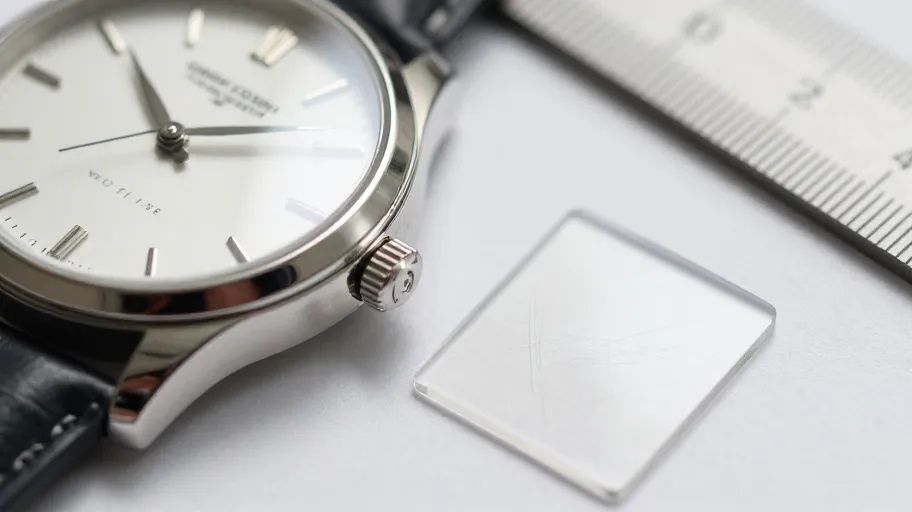
The honest answer: for most watch programmes above entry-level positioning, yes — but "worth it" is a programme decision, not a material fact. Sapphire earns its place when scratch resistance protects your brand promise, warranty exposure and service costs. It does not when the price tier, product lifecycle or target buyer cannot absorb the cost. The way to decide is not opinion — it is a three-gate evaluation: verify the specification, validate the sample, formalise the sign-off.
The SPEC–SAMPLE–SIGN-OFF ladder
Instead of asking "is sapphire worth it?" as a single question, break it into three gates you can actually control:
- SPEC — Define and verify the specification: material grade, geometry, coating, gasket interface, and what each choice commits you to.
- SAMPLE — Validate a physical sample against that written specification before any volume commitment.
- SIGN-OFF — Formalise acceptance criteria, test methods, re-approval triggers and responsibilities in documentation.
The ladder matters because the most expensive failures in crystal sourcing are not material failures — they are specification failures: a coating that does not match the drawing, a gasket seat that does not match the case, or an approval nobody can reproduce after a design change.
Decision table: when sapphire earns its place
Use this table to build a defensible internal position. It is a framework for your own judgement, not a rule.
| Programme attribute | Sapphire is the stronger case when… | Mineral glass is the defensible case when… |
|---|---|---|
| Brand positioning | Scratch resistance is part of the promise (dive, tool, dress-luxury) | The promise is affordability or fashion replaceability |
| Warranty exposure | Scratched crystals would generate service claims you fund | Crystals are treated as user-replaceable consumables |
| Product lifecycle | Long service life, servicing programme, resale narrative | Short fashion cycles, planned refresh |
| Environmental exposure | Hard use, salt water, dust, impact-adjacent activities | Occasional wear, protected environments |
| Service economics | Crystal replacement is complex (coated, domed, tension-fit) | Crystal swap is simple and cheap |
| Margin structure | The material uplift is small relative to retail price | The uplift threatens viability of the tier |
| Approval capacity | You can run a proper sample and inspection gate | Timeline cannot accommodate validation cycles |
If sapphire clears the first column on three or more rows, the material question shifts from "whether" to "how to buy it well" — which is what the rest of this guide covers.
The SPEC gate: what to verify in the specification
A crystal specification is more than "sapphire, round". Before you request a quotation, document and confirm with the supplier:
- Growth method and grade. Confirm what material the supplier proposes and how grade is defined and controlled on their side. Ask how consistency between lots is documented.
- Geometry. Diameter, thickness, dome profile, box-section, plano-convex or double-domed — each affects tooling, cost and gasket behaviour. Ask which geometries are within their current capability rather than assuming.
- Gasket interface and case fit. The crystal does not exist alone. Confirm who owns the fit study: the case maker, the crystal supplier, or you coordinating both.
- Coating. If anti-reflective coating is specified, confirm which faces, how it is specified, and what inspection method proves it is present and within spec.
- Surface finish and edge quality. Define acceptable polish, edge chamfer and dimensional verification method — without documented methods, "within tolerance" is unenforceable.
Questions to put to the supplier at the SPEC gate: How do you define and document the material grade? Which of these geometries are within your current confirmed capability? What dimensional verification method will you use, and what evidence will each shipment carry? Who is responsible for the case-fit interface? These are project-specific questions — the answers should shape your drawing, not the reverse.
The SAMPLE gate: validating a physical part
A sample is only meaningful if it is validated against a written specification. Treat the sample as evidence, not as a gift.
- Inspect against the drawing, feature by feature. Any feature you do not check is a feature you have implicitly accepted.
- Test the functional interface: gasket fit, seating depth, closing behaviour in the actual case — not a representative case if you can avoid it.
- Assess optical quality under the lighting conditions your customers will use: coating effectiveness, distortion, internal clarity.
- Scratch-test judgement belongs to you, not marketing literature. Define what evidence of hardness or coating performance you require, and ask the supplier what tests they can document.
Sample policy varies by supplier and project. Confirm directly: what samples are offered, at what cost, who bears shipping, and what happens if the sample fails — in writing, before you depend on it.
The SIGN-OFF gate: approval questions and documentation
Approval is where sourcing discipline pays for itself. Before any volume commitment, get written answers to these questions:
- What exactly was approved — drawing revision, material specification, coating spec, inspection method?
- What triggers re-approval — a geometry change, a material lot change, a process change at the supplier?
- What documentation accompanies each shipment — inspection reports, dimensional evidence, material documentation?
- What is the agreed process for a non-conforming lot, and who decides acceptance?
- What tolerances and acceptance criteria are stated numerically on the approved drawing, agreed by both parties?
An approval that cannot be reproduced from documentation is not an approval. It is a memory.
Approval checklist
Work through this before committing to volume:
- Written specification exists and matches the current drawing revision
- Material grade and verification method confirmed with the supplier in writing
- Geometry, coating and gasket interface defined numerically
- Fit validated in the actual case, not a proxy
- Sample inspected against every drawing feature
- Sample policy, costs and shipping terms confirmed directly with the supplier
- Acceptance criteria and per-shipment documentation agreed
- Re-approval triggers documented
- Non-conformance process agreed before the first order, not after the first dispute
FAQs
Is a sapphire crystal really worth it for a mid-range watch? It depends on what "worth it" protects. If scratches would drive warranty claims, hurt reviews, or undermine a tool-watch positioning, sapphire is an investment in brand durability. If your buyer treats the watch as replaceable fashion, mineral glass may be the more honest specification. Use the decision table above to build your case.
What should I actually check on a sapphire crystal sample? Dimensional conformity to the drawing, gasket fit in the real case, optical quality including coating performance, and edge finish. Every feature you skip inspecting becomes a feature you have accepted by default.
How do I verify a supplier's sapphire is genuine sapphire? Ask what material documentation and verification methods they can provide per lot, and build the requirement into your acceptance criteria. Verification is a contractual matter, not a claim to trust.
Does anti-reflective coating change the approval process? Yes — coating adds a specification, an inspection method and a failure mode. Confirm which faces are coated, how presence and quality are measured, and what evidence accompanies shipments.
What documentation should accompany each production shipment? At minimum, whatever you agreed at sign-off: inspection reports, dimensional evidence against the approved drawing, and material documentation. Define it before the first order.
Next step: run this framework on your own range
获取采购 Brief — request the sourcing brief and use the SPEC–SAMPLE–SIGN-OFF ladder to evaluate sapphire for your specific programme, with the specification and approval questions ready to put to suppliers.
Prefer to start smaller? Download the approval checklist above and use it on your next crystal project — it works with any supplier and costs you nothing but discipline.
JadeZone Sapphire manufactures custom sapphire watch crystals and precision sapphire components for brands and component buyers from Shenzhen and Hong Kong. All sample, pricing, capability and production terms are project-specific and must be confirmed directly before ordering.