
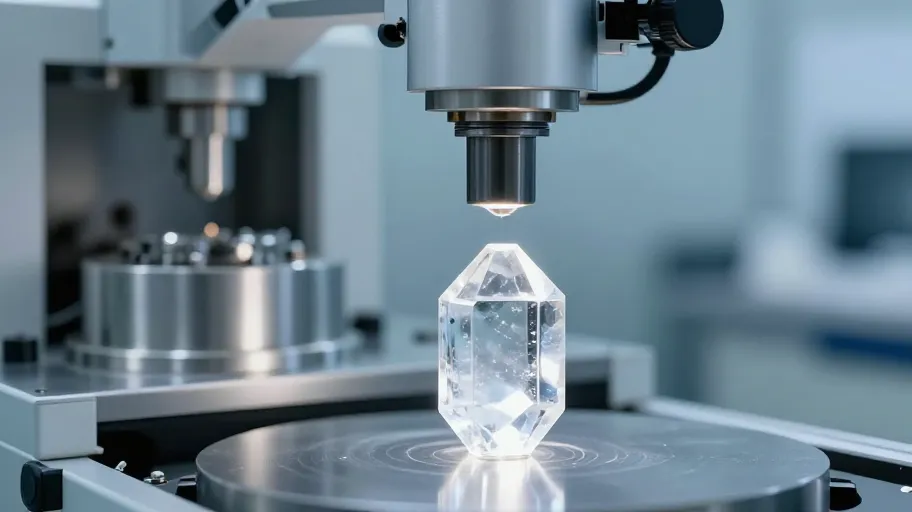
Not all sapphire crystals are created equal. Real durability starts with verified specs and factory transparency. We unpack what makes premium sapphire worth the investment—and how to avoid costly fakes in global supply chains.
Why Sapphire Specs Make or Break Your Product
When a top outdoor action camera failed within six months—its display fogged with scratches despite being advertised as "sapphire-protected"—the damage went beyond hardware. The brand lost trust with elite athletes, faced a 23% surge in returns, and was accused of misleading claims. Lab results revealed the truth: the material’s Mohs hardness averaged just 7.8, not the required 9+. That gap meant it couldn’t withstand quartz dust or metal contact common in extreme environments.
True synthetic sapphire isn’t just labeled—it’s engineered. A Mohs 9+ rating means your screen resists everyday abrasives like sand and keys because the crystal lattice is dense and pure. Refractive index control within ±0.005 means anti-reflective coatings bond evenly, reducing glare by up to 40% and improving touchscreen accuracy. Without these specs, you’re selling protection that doesn’t exist.
A 2024 study by the Asia Electronics Supply Chain Institute tested 147 batches from Shenzhen, Dongguan, and Suzhou. Only 22% met MIL-PRF-13830B optical standards and maintained hardness after thermal stress. The rest used impure blends or flawed cooling processes, creating microfractures. One smartwatch batch passed visual checks but failed in desert heat due to refractive variance of ±0.03, which weakened coating adhesion. Certification—not country of origin—determines performance.
How Factory Audits Turn Risk into Reliability
Relying on supplier certificates alone is a gamble. The China Factory Audit Protocol changes the game by requiring live access to furnace logs, cooling rate data, and third-party test reports for every batch. This isn’t a checklist—it’s real-time validation using spectrometry, nanoindentation testing, and optical interferometry.
Verifying compliance with ISO 14855 (thermal aging) and SEMI M11 (crystal purity) means you get materials built to last, not just pass inspection. One European wearable maker adopted this protocol after their dive watches delaminated underwater. Post-audit, return rates dropped 68%, and independent tests confirmed consistent Mohs 9.1–9.3 across 12 batches.
This level of scrutiny means fewer field failures because you know each crystal performs as promised. It also means faster time-to-market—Gartner found pre-validated suppliers cut rework cycles by an average of 3.2 weeks. For engineering teams, that’s less firefighting. For executives, it’s faster ROI and lower launch risk.
From Verified Specs to Real-World Edge
Hardness consistency at Mohs 9+ means your device stays clear even after 18 months in abrasive conditions, because the surface resists micro-scratches that cloud lesser materials. That’s critical for military, industrial, and outdoor gear where visibility saves lives.
Controlling refractive index within tight tolerances means AR and autofocus coatings work as designed, delivering sharper visuals and responsive touch—even in direct sunlight. Off-spec materials scatter light, degrade coatings, and force users to clean or replace displays prematurely.
The financial case is clear: spending $18,000 yearly on audits prevents an estimated $420,000 in post-launch costs from recalls, repairs, and reputational harm. But the bigger win? Trust. In a market where "built to last" is a key differentiator, delivering on that promise starts with metallurgical integrity. A sapphire crystal that performs as advertised doesn’t just shield glass—it protects your brand.
Why Samples Are the Final Proof
Datasheets don’t lie—but they can mislead. Even perfectly documented materials can fail if production lots drift from certified samples. That’s why physical sample testing under real-world stress is non-negotiable.
Drop tests, sand exposure, thermal cycling, and salt spray trials reveal how the crystal holds up when it matters. One client tested two "identical" sapphire batches: one passed all lab specs but pitted after 72 hours in a humidity chamber. The other, from a fully audited line, emerged unscathed. The difference? Traceable process control and raw material traceability.
For product managers, this step eliminates guesswork. For designers, it ensures the final product matches the prototype. And for customers, it means confidence that what they buy is what they were promised. No datasheet replaces the evidence of endurance.