
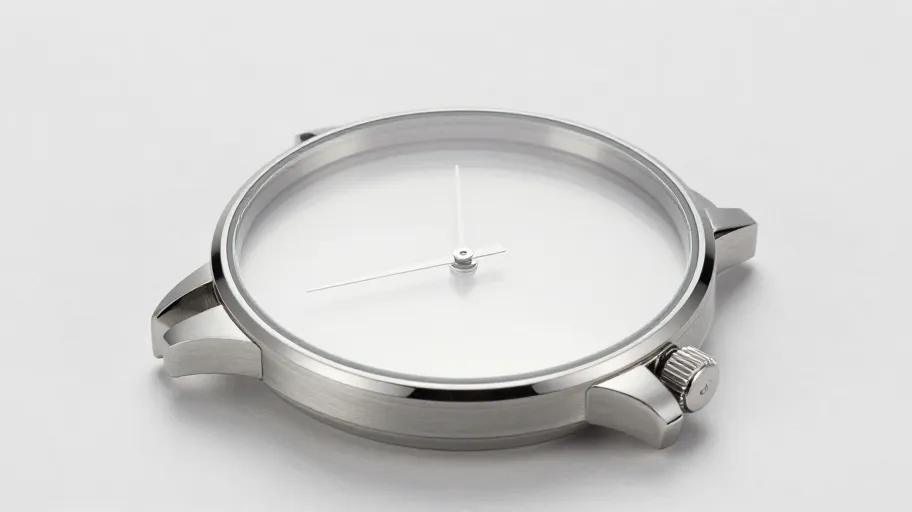
How to Save 30% on Sapphire Without Losing Scratch Resistance
Thinner sapphire crystals aren’t weaker—they’re smarter. For mid-tier Swiss and hybrid brands using Shenzhen OEMs, dropping from 1.8mm to 1.5mm on flat or gently domed designs cuts material use and machining time, slashing unit costs by up to 30%. That’s not a compromise—it’s precision engineering at work.
At 1.8mm, a domed sapphire requires aggressive CNC shaping and longer polishing to achieve symmetry. Those extra steps account for nearly 27% of the final price. But modern ion-assisted deposition (IAD) coatings now allow thinner substrates to outperform thicker, uncoated ones. A 1.5mm flat sapphire with single-side AR coating delivers Mohs 9 scratch resistance, ~99.8% light transmission (vs. ~92% uncoated), and fewer internal stress points—which means better impact resilience. You get superior optics and durability at a lower cost.
IAD coating means stronger anti-reflective performance because ion bombardment densifies the layer during application. This creates a molecular bond that resists delamination under humidity and temperature swings. So you’re not just saving on raw sapphire—you’re upgrading optical quality while reducing long-term failure risk.
Tighter thickness control also improves batch consistency. Advanced factories use closed-loop metrology: every crystal is scanned post-polish, and deviation data feeds back into CNC algorithms in real time. This reduces variance from ±0.05mm to ±0.02mm, ensuring perfect gasket fit and fewer assembly-line rejects. That kind of precision isn’t a bonus—it’s expected at this level of manufacturing.
Why Over-Specifying Costs Time and Money
Demanding complex domes or tight curves on thick sapphire doesn’t just raise material costs—it inflates NRE fees and delays time to market. Each prototype iteration for high-gauge doming runs $1,500–$3,000 and adds 7–10 days to approval cycles. For seasonal launches, that’s a critical delay.
Flat or low-dome 1.5mm crystals stabilize faster because they require less tool adjustment and generate fewer surface defects. According to a 2024 benchmark by Watch Component Insights, optimized geometries reduced average sample approval from 28 days to 16. That acceleration means brands can respond faster to trends and reduce buffer inventory.
One Swiss-Danish brand switched from an Italian supplier to a vertically integrated Shenzhen factory and cut crystal costs by 33%. But the bigger win? First-pass yield jumped from 82% to 96%. Fewer defects meant less rework, fewer returns, and faster shipping. When you factor in logistics and QA savings, their total landed cost per approved unit dropped 41%.
This isn’t just about cheaper parts. It’s about reliable, repeatable production. Factories running ISO 9001 and IATF 16949 standards treat sapphire like semiconductor wafers—controlled environments, calibrated tools, trained operators. The result? Higher yields, fewer surprises, and easier scaling.
Turn Your Crystal Into an IP Protection Tool
Laser etching directly into the sapphire edge isn’t just for branding—it’s a counterfeiting deterrent. High-end Chinese factories embed micro-etched logos or serial patterns during finishing, creating identifiers invisible to casual inspection but verifiable under magnification.
One European brand added edge etching across its lineup and saw gray-market diversion drop by 40% within six months. Resellers couldn’t easily swap or replicate authenticated crystals, making unauthorized resales riskier. That turned a functional component into a supply chain control point.
Embedded etching means built-in authentication without third-party tags or software. Because the mark is part of the crystal itself, it survives cleaning, polishing, and even minor impacts. For brands fighting knockoffs, this is a low-cost, high-leverage defense.
Beyond security, this capability signals factory maturity. Only facilities with cleanroom coating lines and precision laser systems offer this service. If a supplier can deliver thin, coated, etched sapphire consistently, they’ve already passed a high technical bar. That makes qualification faster and audits less intensive.
From Specs to Supplier: Building Better Partnerships
Optimized specs don’t just reduce cost—they simplify factory vetting. Suppliers capable of delivering 1.5mm AR-coated sapphire with ±0.02mm tolerance have proven process control. Their traceability systems, defect logs, and calibration records are typically more detailed than generalist vendors.
That means fewer on-site audits, faster onboarding, and higher confidence at scale. Instead of treating supplier approval as a hurdle, treat it as validation of capability. Ask for:
- Certifications (ISO 9001, IATF 16949)
- Sample metrology reports (thickness, flatness, transmittance)
- Coating adhesion test results (humidity, thermal cycling)
- Evidence of embedded etching in production runs
A streamlined spec attracts better partners. Factories with advanced capabilities won’t waste time on outdated requirements. When you show you understand modern sapphire engineering, you signal that you’re a serious buyer—one worth prioritizing.
The bottom line: sapphire isn’t just a luxury add-on. It’s a performance lever. Brands still insisting on 1.8mm domes to “ensure quality” aren’t protecting standards—they’re subsidizing inefficiency. The future belongs to those who treat sapphire as engineered optics, not symbolic glass.
Ready to cut your crystal costs by 30% and speed up approvals? Start by reevaluating your thickness and coating specs with a qualified Shenzhen partner.