
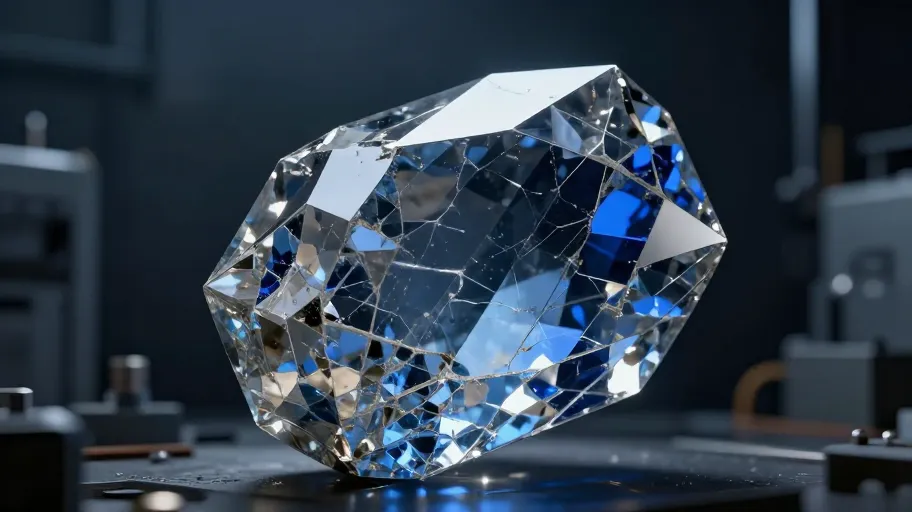
Why skipping a technical audit is like betting your brand on a coin toss
Choosing a sapphire crystal factory in China without a technical audit isn’t cutting corners—it’s inviting disaster. One U.S. wearable tech startup skipped vetting and paid $2 million to recall smartwatches with shattering screens. The culprit? Microfractures from outsourced sapphire blanks cooled inconsistently during annealing. These flaws didn’t show up in factory tests but spread under real-world temperature swings.
This wasn’t bad luck—it was predictable. The supplier didn’t grow their own crystals using the Kyropoulos method, so they couldn’t control internal stress. That means you get inconsistent material strength, even if surface specs look good. Controlling crystal growth in-house means predictable performance because thermal history is documented and optimized across every boule.
Data backs this up. A 2024 Global Optoelectronics Consortium study found factories growing their own sapphire averaged defect rates below 2.3%. Those buying blanks from third parties? 8.7%. That fivefold jump means more warranty claims, lower yields, and higher lifetime costs—even if the initial quote looks attractive.
The real risk isn’t just broken glass—it’s broken timelines. One medical device maker learned this when early prototypes passed dimensional checks but failed environmental testing due to optical distortion. Their low-cost vendor had no control over cooling cycles, which introduced birefringence. Switching to a factory with instrumented growth chambers and real-time pyrometry cut redesign time by four months and cleared the way for FDA submission.
How automation separates top-tier sapphire china factories from the rest
Not all Chinese sapphire producers are the same. The best have closed the gap with Swiss and German suppliers—not by undercutting prices, but by investing in automation that reduces human error and boosts consistency.
Automated annealing lines, for example, minimize residual stress by up to 65% compared to manual batch handling. That means fewer microcracks and higher first-pass yields. One European luxury watch brand tested three Chinese partners in 2025 and found two delivered curved sapphire crystals at 94%+ yield—on par with their Swiss vendors—but at nearly half the cost.
Laser cutting guided by AI path optimization achieves kerf widths within ±5 microns. That precision means less material waste and far fewer edge chips during shaping. For complex geometries like domed crystals or thin bezel-integrated windows, this translates into better optical clarity and easier assembly downstream.
These capabilities aren’t just about efficiency—they enable co-engineering. When a consumer electronics firm partnered early with an automated sapphire china factory, they used its internal stress simulation models to refine dome curvature. That cut prototype iterations from seven down to two. Automation doesn’t just make parts faster; it accelerates innovation because feedback loops are tighter and data-rich.
Six things you must verify before signing with a sapphire crystal factory
A strong technical audit goes beyond ISO 9001 certificates. Compliance doesn’t guarantee capability. Here’s what actually matters:
- In-house crystal growth: If they don’t pull their own boules, they can’t control stress profiles or trace material origin.
- Real-time process monitoring: Pyrometry and dynamic feedback during pull cycles mean consistent crystal structure because temperature deviations are corrected instantly.
- Non-contact metrology: White-light interferometers measure flatness down to nanometers—so you avoid warping issues in high-precision optics.
- Traceability systems: Each crystal linked to growth logs and QC data means full documentation for audits, recalls, or regulatory filings.
- Optics expertise: Staff trained in crystallography and optical finishing catch issues early—like birefringence or coating adhesion risks.
- Design-for-manufacturability support: Factories that offer DFM input reduce rework because they flag unfeasible tolerances before tooling starts.
Missing any of these? You’re outsourcing risk. One brand learned this when a vendor promised “ISO-certified quality” but subcontracted polishing. Coating delamination emerged post-launch because surface prep varied between shops. Full vertical integration means one team owns the outcome—from seed crystal to final polish.
The hidden value of integrated operations: IP protection and speed
Beyond yield and cost, there’s a silent benefit to choosing a fully integrated sapphire china factory: security. When growth, machining, and polishing happen under one roof with access controls and digital logs, your design stays protected. Fragmented supply chains—where drawings pass through multiple vendors—create openings for reverse engineering.
For brands developing proprietary shapes or anti-reflective treatments, this isn’t optional. One AR glasses maker required a unique elliptical sapphire lens with nano-textured edges. Only a vertically integrated factory could guarantee no third parties touched the design. They also provided encrypted build records—a requirement for investor due diligence.
Integration also speeds time-to-market. McKinsey’s 2025 Advanced Materials Sourcing Report found companies using technically vetted partners launched 22% faster on average. Why? Because aligned suppliers engage earlier, suggesting manufacturable tweaks during design instead of rejecting tooling later. That shift turns your sapphire crystal factory from a vendor into an R&D extension.
Stop chasing low quotes—start building reliable partnerships
The goal isn’t to find the cheapest sapphire crystal manufacturer in China. It’s to find one where quality, speed, and trust align. Commodity vendors compete on price. Engineering partners compete on performance, predictability, and problem-solving.
You’ll pay more upfront for a factory with laser interferometry, in-house growth, and co-design support. But you’ll save in reduced scrap, faster launches, and fewer customer returns. One client calculated a 38% lower total cost of ownership after switching from a low-cost supplier to a technically sound partner—despite a 15% unit price increase.
The next step isn’t another RFQ. It’s a site visit—or a virtual audit with live process data. Ask for growth chamber footage, annealing cycle logs, and recent interferometry reports. If they hesitate, walk away. Reliable sapphire crystal factories have nothing to hide because their processes are repeatable, documented, and built to last.
See how your current supplier stacks up—download our free Sapphire Factory Audit Checklist to uncover hidden risks before your next production run.