
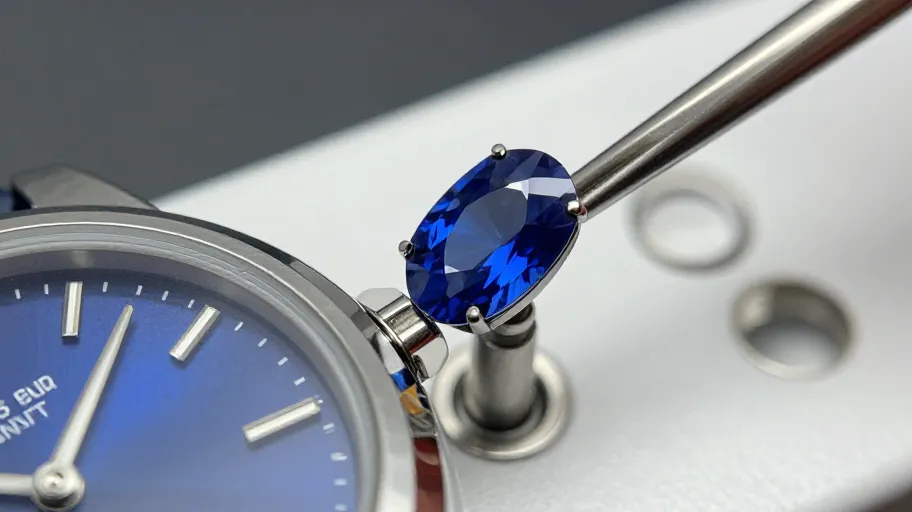
Sapphire watch crystal benefits for a B2B buyer come down to four verifiable properties: extreme surface hardness that resists scratching in daily wear, optical clarity that keeps a dial legible, chemical and thermal stability across plating and assembly processes, and dimensional consistency when a crystal must seal against a gasket. Whether those benefits materialise in your programme depends on spec alignment, sample evaluation and a documented approval — all of which you control.
The benefits, stated as engineering properties — not slogans
Sapphire's appeal in watchmaking rests on measurable characteristics. Before treating any benefit as settled for your project, translate each one into something you can document:
- Scratch resistance. Synthetic sapphire is an extremely hard crystalline material. For your programme, the relevant questions are: what hardness basis does the supplier quote, what finish is applied, and how is the surface inspected before shipment?
- Optical clarity. Clarity depends on material quality, polish process and any anti-reflective coating. Ask what coating options exist, where coating is applied, and how optical defects are checked.
- Chemical and thermal stability. Sapphire withstands solvents and process temperatures better than most transparent alternatives — but confirm compatibility with your own assembly and plating sequence rather than assuming it.
- Dimensional consistency. A crystal is a sealing component. Its benefit only counts if height, diameter, chamfer and gasket groove geometry match your case drawings every production run.
The practical sapphire watch crystal benefits, in other words, are conditional. They show up when the specification, the process and the inspection are aligned — and they disappear when any of the three is vague.
The SPEC–SAMPLE–SIGN framework
To evaluate sapphire crystal benefits without relying on supplier marketing, run a three-stage review:
SPEC — align the drawing before anything else. Submit a complete crystal drawing: geometry, finish, coating, marking requirements, packaging expectations and inspection standard. Confirm the supplier's questions back to you; a supplier that asks precise questions about gasket fit and case geometry is easier to work with than one that accepts an incomplete drawing.
SAMPLE — evaluate against written criteria. Request samples and evaluate them against criteria you define before the samples arrive: dimensional measurement against your drawing, visual inspection under agreed lighting and magnification, coating appearance, and fit in your actual case and gasket. Document every observation.
SIGN — approve on evidence, not goodwill. Approval should reference the drawing revision, the sample batch, the inspection results and any agreed corrective actions. This becomes your reference standard for production, and your baseline if a dispute arises later.
Decision table: comparing sapphire crystal options
| Evaluation factor | What to request from the supplier | What to document | Red flag |
|---|---|---|---|
| Material and crystal quality | Material origin or grade description in writing | Grade and grade basis in the spec sheet | Vague "high quality" language with no basis |
| Geometry and fit | Confirmation of every dimension on your drawing | Measured sample values vs drawing | Refusal to measure against your drawing |
| Surface finish | Finish type, polish process, inspection method | Finish acceptance criteria | No visual inspection standard |
| Coating | Coating options, application location, appearance limits | Coating spec and appearance reference samples | Coating described only in marketing terms |
| Inspection and quality control | Inspection stages, sampling approach, defect classification | Agreed acceptance criteria | No written inspection description |
| Production capability | Evidence of custom (not catalogue-only) production | Sample history relevant to your geometry | Only standard sizes offered for a custom brief |
| Commercial terms | MOQ, pricing, sample terms, lead time, shipping policy | Written quotation and policy confirmation | Any term explained only verbally |
Confirm the current policy directly for every commercial row before making comparisons between suppliers.
Concrete approval questions before sign-off
Use these questions in your sample review and supplier qualification:
- Which drawing revision were these samples produced to, and can you confirm it in writing?
- What inspection steps were completed on this sample batch, and can I see the results?
- Which dimensions will you measure on every production batch, and which only on first article?
- How do you classify and control visual defects, and what reference samples or limits apply?
- What changes in my case or gasket design would require a new sample round?
- What packaging will protect coated surfaces in transit to my assembly site?
- If a production batch fails my incoming inspection, what is the agreed corrective process?
None of these can be answered generically — and a supplier's specific, written answers are themselves evidence of capability.
Sourcing questions that protect your programme
Beyond samples, ask any candidate supplier:
- Can you produce custom geometry from my drawing, or only catalogue sizes?
- What documentation accompanies each shipment (inspection reports, material confirmation, batch traceability)?
- How do you handle engineering change requests mid-programme?
- Who is my technical contact, and in which language and time zone do they work?
- For cross-border delivery, what are the shipping, customs and packaging arrangements?
For commercial terms — minimum order quantity, pricing, sample fees, delivery timing and related policies — confirm the current policy directly, in writing, before comparing suppliers on anything other than engineering merit.
Frequently asked questions
Why choose sapphire over mineral glass for an OEM watch? Sapphire's hardness gives it strong scratch resistance in daily wear, which reduces warranty exposure and supports a premium positioning. Mineral glass may suit cost-sensitive lines. The right choice depends on your price tier, target user and service expectations — evaluate both against your own product brief.
How do I evaluate a sapphire crystal sample fairly? Define acceptance criteria before samples arrive: dimensional measurement against your drawing, visual inspection under agreed conditions, coating appearance, and fit in your actual case. Score each criterion in writing so different suppliers — or different sample rounds — can be compared on the same basis.
What should a crystal specification include? Geometry for every surface, overall height, diameter, chamfers, gasket contact features, finish type, coating and any printing or marking, plus inspection standard and packaging requirements. Anything left out of the drawing becomes a negotiation later.
Can I get custom shapes, not just round crystals? Many sapphire manufacturers offer custom geometry. Whether your specific shape is feasible depends on thickness, curvature, cutouts and volume — submit the drawing and ask for a feasibility confirmation with the supplier's questions documented.
What should I confirm before the first production order? That the approved sample, the drawing revision and the written quotation all reference each other, and that inspection and corrective-action arrangements are documented. An approval that cannot be traced back to evidence protects no one.
Next step
获取采购 Brief — request the sourcing brief to get the full specification checklist, sample evaluation template and supplier question list for your custom sapphire crystal programme.
Or start lighter: reply with your case drawing and target specification, and we will confirm feasibility and the questions you should ask next.