
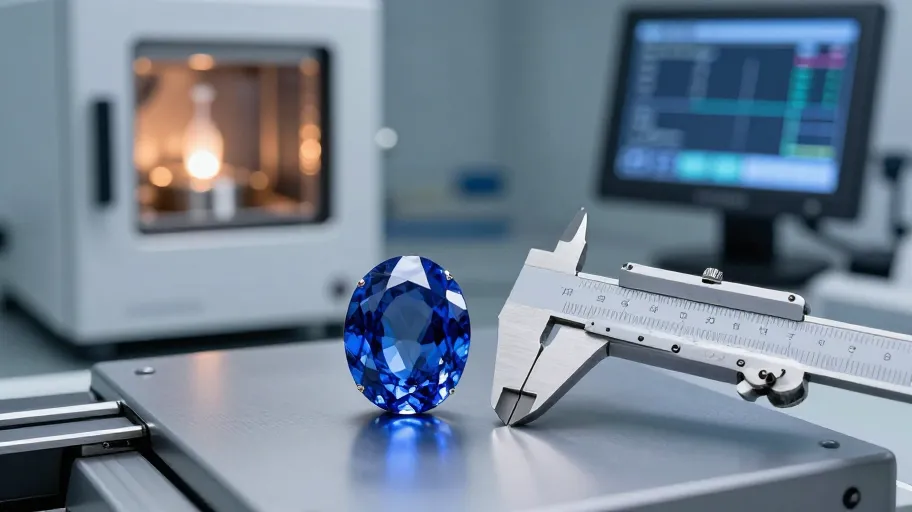
The Real Value Behind Chinese Sapphire Crystals
Sourcing sapphire crystals from China means accessing high-performance materials without premium pricing—because leading factories combine lab-grade precision with industrial scale. For a Swiss dive watch brand launching a new series, this translates to a crystal that resists saltwater, blocks UV damage, and survives shock impacts—all while maintaining perfect clarity underwater. The benefit? You launch a tougher product faster, at higher margins, or reinvest savings into branding and distribution.
Engineers already know sapphire is essential: rated 9 on the Mohs scale, it’s nearly scratch-proof compared to mineral glass. But their real challenge has been finding consistent quality at viable cost. That used to mean European or Japanese suppliers—until Chinese manufacturers closed the gap through vertical integration. Now, they control everything from raw sapphire growth to final certification, ensuring every batch meets exacting standards.
Synthetic Sapphire Growth with Precision Control
Modern Chinese sapphire production starts with the Verneuil process—but upgraded for the 21st century. By using digital monitoring and ultra-pure alumina, factories produce boules with over 98% light transmission and minimal internal stress. This means dials stay readable in low-light dives, and anti-reflective coatings bond evenly because the surface is defect-free.
Unlike older methods that introduced bubbles or tints, today’s closed-loop systems regulate temperature and gas flow in real time. The result? Optical clarity isn’t luck—it’s engineered. And because the process scales efficiently, large-diameter blanks for oversized cases don’t come with exponential price hikes. That matters as consumer demand shifts toward bolder, more rugged designs.
CNC Machining Delivers Micron-Level Accuracy
Precision shaping means each crystal fits its case with ±0.02mm tolerance—because CNC machines guided by 3D CAD models replace inconsistent manual grinding. This eliminates micro-gaps that could compromise water resistance during deep dives.
It also speeds up prototyping: a design tweak submitted Monday can yield a validated sample by Thursday, cutting iteration time by up to 40%. A 2024 benchmark found top Chinese suppliers achieved 97% first-pass yield on complex domed shapes, versus 82% among mid-tier European processors. Higher yield means less waste, lower unit costs, and faster ramp-up when launching new collections.
Certifications Prove Durability Beyond Doubt
SGS and ISO 9001 certifications aren’t just paperwork—they’re proof of standardized quality. Independent audits verify material traceability, environmental controls, and repeatable processes across batches. That consistency lets global brands source from multiple factories without risking variation in thickness or curvature, which could affect pressure testing.
Every dive-ready crystal undergoes ISO 1413 shock testing—simulating a 3kg weight dropped from 1 meter. In Guangdong audits, certified factories showed failure rates below 0.5%. They also run salt-fog (ASTM B117) and UV aging tests, proving these offshore-made crystals meet or exceed European durability benchmarks.
Agility Fuels Innovation and Market Response
Vertical integration gives Chinese suppliers unmatched agility. When a design change requires a thinner bezel seat, they adjust diameter and bevel angle in days, not weeks. If a brand wants AR-coated double-domes, they apply multi-layer coatings in-house using magnetron sputtering—technology once limited to German optics labs.
This flexibility lowers the risk of innovation. One European designer launched a limited edition with gradient blue-tinted sapphire in under eight weeks via a Shenzhen partner. The result? A sold-out run with a 22% higher average selling price and press coverage praising its 'ocean-inspired resilience.'
The Bottom Line Is a Strategic Advantage
A 40% reduction in crystal cost plus 30% faster time-to-market gives brands two choices: boost gross margins by 12–15 points or reinvest in marketing and service. Either way, you gain leverage.
And when you market a silent upgrade—a tougher, clearer crystal tested for extreme environments—you build trust through reliability. Sourcing from China isn’t a fallback; it’s a competitive lever. The next evolution of your timepiece doesn’t start in the boardroom. It starts in the crystal-growing chamber, where value is forged molecule by molecule—and proven ready for the harshest conditions on Earth.