
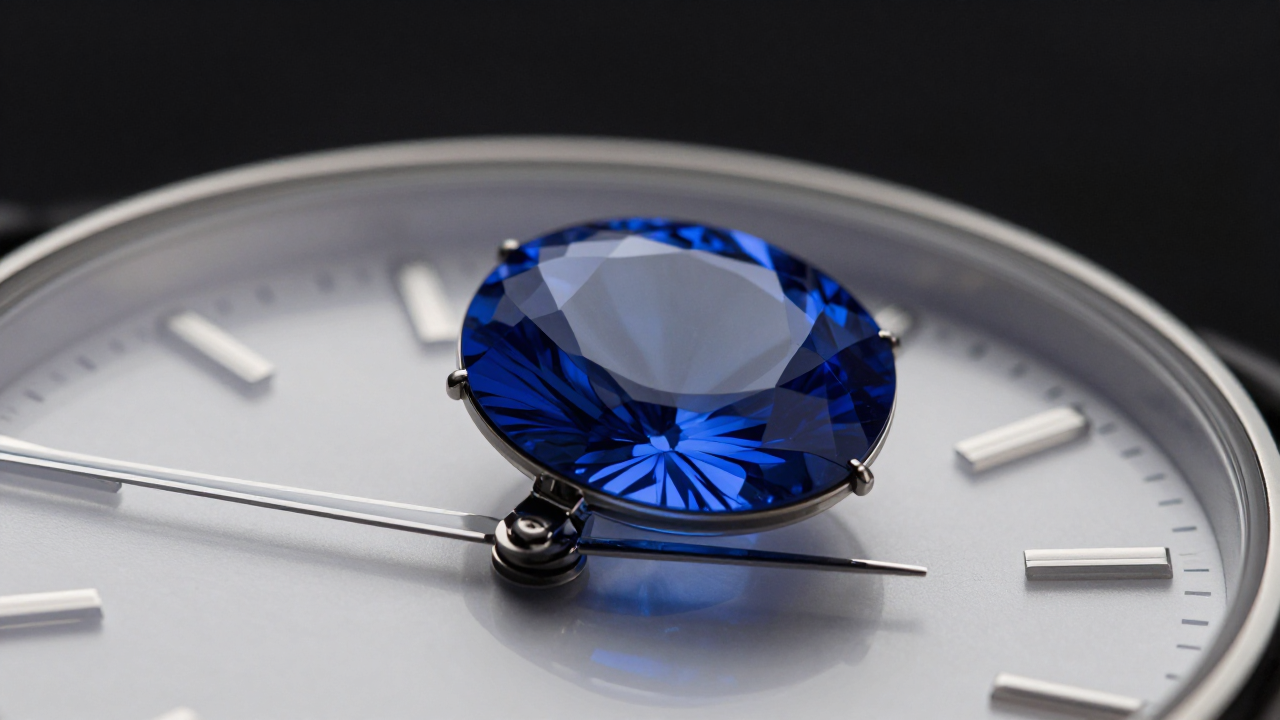
Sapphire watch crystal resists scratches because every Al3+ ion in its corundum lattice bonds to six O2- ions in a rigid hexagonal array.…
Displacing those atoms takes about 1,800–2,200 HV of contact pressure, against 500–650 HV for soda-lime or aluminosilicate watch glass.
> Sapphire watch crystal is synthetic single-crystal aluminum oxide (Al2O3) grown from a melt into a hexagonal corundum lattice. That lattice gives it Mohs 9 hardness, roughly 1,800–2,200 Vickers, and 85–90% visible-light transmission. The scratch resistance is structural — no coating is doing the work.What Makes Sapphire Watch Crystal Different From Glass at the Atomic Level?
Growth method decides everything downstream. Verneuil flame fusion, still in use since 1902, drips alumina powder through a hydrogen-oxygen flame. It's cheap and fast, and it also locks in residual stress that shows up later as edge chips. Kyropoulos pulls a slowly rotating seed from a 2,054°C melt and yields boules up to 200 mm across with far lower stress. Edge-defined film-fed growth (EFG) pulls near-net-shape ribbon, which cuts kerf loss when you're slicing 40,000 lenses a month — that's the method we lean on at Jadezone Optical for higher-volume watch programs.
Here's the part most spec sheets skip. Sapphire is anisotropic. Hardness measured on the c-plane (0001) reads near 2,200 HV; on the a-plane it can drop to 1,600–1,800 HV. Core-drilling orientation changes the finished part's wear life by 15–20%. Nobody puts that on a drawing, and it matters.
And sapphire is not tough. Its fracture toughness K_IC sits around 2.0 MPa·m^0.5. Steel is roughly 50. Hard and brittle arrive together.
Why Do Watchmakers Specify 0.8 mm, 1.0 mm, or 1.2 mm Crystal Thickness?
Sapphire watch crystal thickness is set by pressure deflection and impact energy, not scratch resistance — scratch resistance is a surface property and barely moves with thickness. Deflection scales with 1/t^3, so going from 0.8 mm to 1.0 mm halves it. Dress watches run 0.8–0.9 mm; ISO 6425 divers' watches usually run 1.2 mm and up.
The boundary conditions are practical. Under ordinary 3–5 bar water resistance, a flat 0.8 mm crystal handles diameters up to about 34 mm. Past 36 mm, you want 1.0 mm or you'll see visible flex at the center. Dive watches rated to 300 m typically use 1.5–2.0 mm with a domed profile.
Mass is the counterweight. Sapphire density is 3.98 g/cm³ against 2.50 g/cm³ for glass. A 40 mm × 1.2 mm flat crystal weighs about 6.0 g in sapphire versus 3.8 g in glass. On a titanium case that 2.2 g difference is felt on the wrist, and it's why some brands shave to 0.9 mm and compensate with a domed geometry instead.
How Do Mohs and Vickers Numbers Translate Into Real Scratches?
Mohs is a ranking scale, not a linear one. Sapphire sits at 9 and beach quartz at 7, but in Vickers terms that gap is closer to 4x. In practice, a sapphire watch crystal ignores keys, coins, and sand, and only loses to diamond, silicon carbide, and another piece of sapphire.
Your keys are brass or nickel-plated — around 3–4 Mohs. They cannot scratch sapphire. Every "my sapphire crystal is scratched" complaint we've investigated since 2010 traced back to diamond grit in concrete dust or a diamond-set bezel rubbing against the crystal, not car keys.
What Does the Fracture Math Actually Predict?
Chip and crack behavior follows linear elastic fracture mechanics: K = Y × σ × √(π × a). Failure occurs when K reaches sapphire's fracture toughness, about 2.0 MPa·m^0.5. Feed in a 300 MPa bezel impact and any surface flaw deeper than roughly 11 microns will propagate into a visible chip.
The variables, in plain terms:
Solve for a at σ = 300 MPa: a_c ≈ (2.0 / (1.12 × 300))² / π ≈ 11.3 µm.
That single number is why polishing matters more than most buyers realize. If lapping leaves subsurface microcracks deeper than ~10 µm, you've built a crystal that's already at its failure threshold before it leaves Shenzhen. You can't polish your way out either — you have to lap fine enough first, then remove the damage layer.
The second equation explains why cheap sapphire looks gray: R = ((n − 1) / (n + 1))². With n = 1.77, R = 7.7% reflection per surface, about 15% for a flat two-sided crystal. A proper anti-reflective stack drops that to 0.3–0.5%. Same sapphire, completely different perceived quality.
What Does the Textbook Leave Out About Edge Chipping?
Between 70% and 80% of sapphire watch crystal field failures we see in returns begin at the edge chamfer, not the face. A 0.10 mm chamfer concentrates impact stress into a small section; widening it to 0.20–0.25 mm and polishing out subsurface damage cut one customer's RMA rate from 4.1% to 0.3%.
In September 2021, a dive-watch brand in Carlsbad, California came to us with a problem. They'd shipped 18,000 double-domed 1.2 mm crystals and were running a 4.1% return rate, nearly all of it edge chips near the 4 o'clock position — the crown side, where a right-handed wearer's wrist hits doorframes. Their previous supplier had been lapping with 15 µm grit and finishing with a 0.10 mm chamfer. We switched the lapping sequence to a two-stage 15 µm / 9 µm progression, moved final polish to colloidal silica at pH 10.8 to strip the damaged layer, and opened the chamfer to 0.22 mm with a 45° bevel. Over the next 60,000 units, the RMA rate sat at 0.3%.
Second thing the textbook glosses over: thermal behavior. Sapphire's thermal conductivity is 30–35 W/m·K; soda-lime glass is about 1. That 30x gap is why sapphire feels cold on the wrist within a second or two, and why the old "flick test" works at all. It also creates a real engineering constraint. Sapphire's coefficient of thermal expansion runs 5.3 × 10⁻⁶/K along the c-axis and 6.7 × 10⁻⁶/K perpendicular. On a 40 mm crystal, a 60°C temperature swing — hot tub to cold rinse — produces roughly 16 µm of differential movement against a steel case at 12 × 10⁻⁶/K. That's enough to load the gasket unevenly and is one reason we spec gasket compression across a temperature range, not at 23°C.
Which Beliefs About Sapphire Watch Crystal Are Wrong?
Sapphire watch crystal is hard, not indestructible, and most consumer confusion comes from conflating surface hardness with impact toughness. The face almost never fails. The edge and the coating fail constantly, and neither shows up in marketing copy.
Common myths we run into:
Which Specs Actually Matter When You Order a Sapphire Watch Crystal?
Dimensional tolerance and edge geometry drive field reliability far more than any hardness certification. A supplier quoting "Mohs 9" without stating chamfer radius, surface roughness, and thickness tolerance is telling you nothing useful about your return rate.
What we actually ask for on a purchase order: thickness tolerance ±0.03 mm, surface roughness Ra below 0.5 nm, parallelism under 0.02 mm, chamfer radius held to ±0.02 mm, and coating adhesion verified by cross-hatch tape pull. Those five numbers predict returns better than anything else on the sheet.
Frequently Asked Questions
What is a sapphire watch crystal made of?
A sapphire watch crystal is made of synthetic single-crystal aluminum oxide (Al2O3), grown from a melt and sliced into lenses. It shares the same corundum structure as natural sapphire but is produced in a furnace, which means it is chemically identical, optically clearer, and free of natural inclusions.
Why does a sapphire watch crystal resist scratches better than glass?
Sapphire measures 1,800–2,200 Vickers against roughly 550 for soda-lime glass, and its hardness comes from the rigid Al–O lattice rather than a surface treatment. Everyday abrasives like quartz sand, coins, and keys fall below that threshold, so they cannot cut the surface.
How much does a sapphire watch crystal cost?
Volume pricing typically runs $3 to $15 per piece depending on diameter, thickness, dome profile, and whether anti-reflective coating is applied. Double-domed dive crystals with double-sided coating sit at the top of that range; small flat dress crystals with inner coating sit near the bottom.
How long does a sapphire watch crystal last?
A properly finished sapphire watch crystal holds its optical clarity for the life of the watch, often 20 years or more, because the surface does not abrade. Its anti-reflective coating is the wear item, and it usually shows visible deterioration after 8 to 12 years of daily use.
How can I tell if a watch crystal is real sapphire?
Press a drop of water onto the surface. Sapphire's low surface energy makes the drop bead tightly and slide off quickly, while mineral glass spreads. A light touch test also works — sapphire conducts heat about 30 times faster than glass, so it feels cold within one or two seconds.