
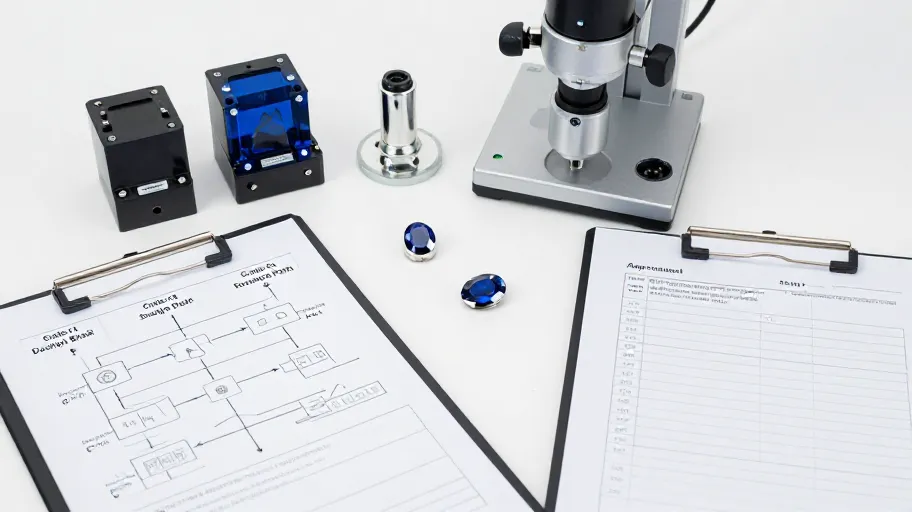
Before you commission custom sapphire parts, you need three things locked down: a written specification (geometry, aperture, finishing, coatings), a defined prototype evaluation method, and a sign-off checklist that both sides sign. This article walks you from first design brief to final approval using the 3-Gate Sourcing Path, so nothing rests on assumptions.
Why preparation decides the outcome
When a watch brand sources custom sapphire parts, the expensive failures are almost never about the material itself. They happen upstream: an ambiguous drawing, an undefined edge finish, a coating expectation nobody wrote down, or a prototype judged by opinion instead of criteria. Sapphire is a hard, precise material, and every ambiguity in your brief becomes an engineering decision someone else makes on your behalf.
The remedy is process. Treat the purchase as a sequence of three gates, each with documented inputs and documented approval. This is the 3-Gate Sourcing Path:
- Gate 1 — Specification Lock. Both parties agree on a written, unambiguous specification.
- Gate 2 — Prototype Verification. You evaluate a physical part against agreed checks, not impressions.
- Gate 3 — Approval Sign-off. A named person approves a defined checklist before any production commitment.
Commercial terms — quantities, pricing, sampling arrangements, timelines, shipping — are project-specific at every gate. Confirm the current policy directly with your supplier before relying on any of them.
Gate 1: What belongs in the design brief
A strong brief reduces back-and-forth and produces comparable quotations. Include at minimum:
| Brief element | What to specify | Why it matters |
|---|---|---|
| Crystal geometry | Flat, domed, double-domed, box, bevelled edge profile | Geometry drives the cutting and polishing method, and therefore the quote |
| Dimensions and tolerances | Nominal diameter, thickness, and the tolerances your case design genuinely needs | Over-tight tolerances add cost without benefit; under-specified ones create fit risk. Ask the supplier what they recommend per feature |
| Aperture or date window | Position, shape, edge treatment of the cut-out | Cut-outs are a distinct manufacturing step with their own checks |
| Coating | Anti-reflective: none, single-side, double-side | Coating choice affects appearance and inspection criteria |
| Finishing | Surface polish level, edge finish, any printing or logo requirements | Determines inspection and tooling questions |
| Mounting interface | How the crystal seats in your case; gasket or adhesive assumptions | Prevents fit surprises at assembly |
| Reference documents | 2D drawing with GD&T, 3D model where relevant, sample parts to match | Gives the supplier something measurable to quote against |
| Intended use | Watch model context, any functional or cosmetic reference standard you hold | Lets the engineer flag manufacturability questions early |
Where you do not yet know a value — a tolerance, a coating preference, an edge profile — mark it as "supplier to advise" and ask directly. For dimensions and tolerances, request the supplier's recommendation for your application rather than assuming a figure; do not carry over numbers from previous glass or plastic projects without confirmation.
Gate 2: Evaluating the prototype
When a prototype of your custom sapphire parts arrives, evaluate it against written checks. Confirm with the supplier in advance which of these they can document for your project, and which inspection reports or process evidence they provide:
- Dimensional checks. Were the agreed dimensions and tolerances measured, and are the results recorded? Ask for the measurement method (contact probe, optical, other) so you can judge the numbers.
- Edge and surface finish. Inspect under your own lighting and magnification against your reference standard. Photograph what you see; do not rely on memory between reviews.
- Aperture treatment. Check cut-out edges and positions against the drawing, including corner radii.
- Coating verification. Ask how coating presence and quality are checked for your project, and what evidence you will receive.
- Fit trial. Seat the part in the actual case or a representative fixture. Fit problems found here are cheap; found at assembly, they are not.
- Cosmetic reference. Compare side-by-side with your approved reference part or sample under identical lighting.
Decision table: what to do after Gate 2
| Finding | Meaning | Action |
|---|---|---|
| All checks pass, documentation complete | Specification is met and evidenced | Proceed to Gate 3 sign-off |
| Cosmetic deviation only, function correct | Finish or coating expectation mismatched | Document with photos; request revision against a written finish reference |
| Dimensional deviation within usable range | Tolerance interpretation differs between parties | Re-confirm the tolerance definition and measurement method; re-verify |
| Repeat deviation after documented revision | Process or communication gap | Compare against your alternative supplier options; re-source if unresolved |
| Supplier cannot provide inspection evidence | Verification is not possible | Require documented measurement before approval, or escalate |
Gate 3: The approval checklist
Before you approve production of custom sapphire parts, every line below should be a documented yes:
- Written specification signed by both parties, including revision number and date
- All dimensions and tolerances confirmed, with measurement method agreed
- Prototype inspection results recorded and filed
- Coating specification confirmed and evidenced for this project
- Edge and surface finish matched to an approved physical reference
- Fit trial completed in the actual case or fixture
- Cosmetic approval given under agreed lighting by a named approver
- Packaging and handling requirements for sapphire parts documented
- Quality agreement: what happens if a delivered lot deviates — confirm the current policy directly
- All commercial terms — quantities, pricing, timelines, sampling, shipping — confirmed in writing; confirm the current policy directly
A checklist is not bureaucracy. It is the difference between "it looked fine" and "we verified it", and it protects both buyer and supplier when questions arise after delivery.
Comparing suppliers fairly
If you are evaluating more than one source of custom sapphire parts, run every quote through the same grid: what is included in the specification, what inspection documentation accompanies the parts, how revisions are handled, and what each party commits to in writing. Suppliers who welcome a written specification and documented approval process are easier to work with across a product lifecycle than those who prefer verbal agreement — verify this by observing how each supplier responds to your checklist, not by their marketing claims.
FAQ
Do I need finished drawings before contacting a manufacturer about custom sapphire parts? No, but you need a clear intent plus whatever you have: reference crystals, case dimensions, target geometry, and coating direction. Mark unknowns as "supplier to advise" and ask for engineering input early. A good first conversation is a technical dialogue, not a quotation request.
What tolerance should I specify for a sapphire crystal? Do not carry a number from a previous project or a different material. Define what your case design genuinely requires — the fit allowance, the gasket or adhesive system — and ask the supplier to recommend tolerances per feature for your application. Document the agreed figures in the specification.
How do I judge a sapphire prototype without lab equipment? You can verify a surprising amount: fit in the actual case, edge finish under magnification and consistent lighting, aperture position against the drawing, and a side-by-side comparison with your reference part. For everything measurable, ask the supplier to supply recorded inspection data and tell you the measurement method used.
Can I change the design after approving a prototype? That depends on what stage the change affects — cosmetic finishing, geometry, or tooling. Treat any change as a new revision: update the drawing, increment the revision number, and confirm with the supplier how the change is evaluated and documented before re-approving.
What should I ask about coatings before approval? Ask how coating is specified (side, type, purpose), how it is verified for your project, what inspection evidence you will receive, and how coated surfaces should be handled during assembly. Confirm every answer in the written specification rather than in email fragments.
获取项目 Brief — Get the Project Brief. A ready-to-use template covering specification fields, supplier comparison grid and approval sign-off for custom sapphire parts. Request it and start your next sourcing conversation from a document, not a blank page.
Prefer something lighter first? Copy the Gate 3 approval checklist above into your next project file — it works with any supplier, including us.