
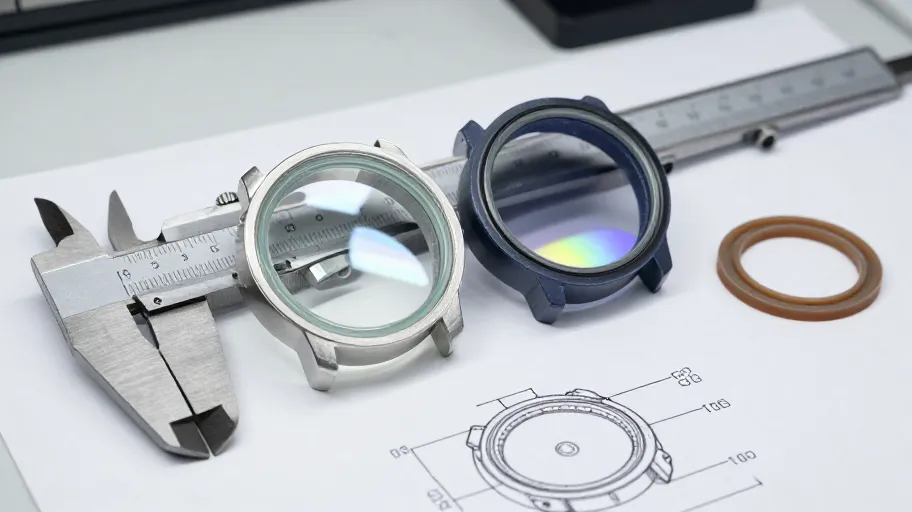
Yes — a mineral crystal can in many cases be replaced with sapphire, but for a B2B buyer this is a re-specification project, not a drop-in swap. Fit, gasket seating, thickness, coating and case geometry must all be re-confirmed against drawings, samples and a documented approval gate before production begins.
What actually changes when the material changes
When a sourcing manager asks whether a mineral crystal can be replaced with sapphire, the real question is not "is sapphire available?" It is: does the existing case, gasket and dial stack accept a crystal produced to sapphire's processing characteristics without redesign?
Sapphire and mineral glass are different materials with different processing routes. A crystal is not an isolated part — it interacts with:
- The gasket or seal seat — if the replacement crystal's edge geometry differs, sealing performance cannot be assumed.
- The case opening and bezel clearance — a substitution that changes effective height or diameter can interfere with assembly.
- The dial and hand stack — domed or raised profiles can reduce clearance.
- The watch's positioning and target price — sapphire carries a different cost and value story, which may be exactly the point of the substitution.
None of these can be answered from the material name alone. They are answered by comparing the outgoing mineral drawing against a sapphire specification, and by approving physical samples against that specification. That is the work this guide structures.
The SPEC-LOCK framework for crystal substitution
Use SPEC-LOCK to run the substitution as a controlled project rather than a verbal instruction to a supplier:
- S — Substitution scope. Define whether this is a one-for-one dimensional replacement, a profile upgrade (e.g. flat to domed), or part of a broader case redesign.
- P — Profile and fit. Gather the outgoing mineral crystal drawing, the gasket specification, and the case seat drawing, and compare every interface.
- E — Engineering constraints. Identify items sapphire processing may change: edge chamfer, thickness at centre versus edge, coating application, polish type.
- C — Confirm supplier evidence. Ask the supplier to state, in writing, which dimensions they will hold, what inspection they perform, and what their current sample and production policies are.
- K — Lock the approval file. Approve a golden sample and a frozen drawing before any production release.
Decision table: substitution scenarios and required actions
| Scenario | What the buyer must verify | Risk if skipped | Gate in SPEC-LOCK |
|---|---|---|---|
| Same case, flat crystal, like-for-like swap | That the sapphire drawing replicates every interface dimension and the gasket seat matches | Seal failure or loose fit discovered at assembly | S + P |
| Flat to domed profile upgrade | Hand and dial clearance under the dome; bezel interference at the highest point | Hands touching crystal; rework of cases | P + E |
| Crystal with AR coating added | Coating type, which faces are coated, and how coating is specified and inspected | Visual mismatch across a model range | E + C |
| Vintage or discontinued case, no reliable drawing | Reverse-engineered measurements and a mutually agreed drawing of record | Two parties building to two different ideas of the part | S + K |
| Multi-SKU programme rolling out sapphire | Which SKUs convert first, and how deviations are handled per SKU | Inconsistent approval across the range | C + K |
The specification sheet: what to re-issue for a sapphire crystal
A mineral drawing is the starting point, not the finished spec. Before requesting quotations, prepare a sapphire crystal specification that at least covers:
- Shape and profile class (flat, domed, double-domed, box, step — as applicable)
- Outer dimension and thickness, defined at agreed measurement points
- Gasket seat geometry and edge finish
- Chamfer or edge treatment specification
- Surface finish and polish requirements per face
- Coating: whether applied, which face, and the inspection method
- Marking, if any (logo, treatment on inner or outer face)
- Measurement and inspection method for each critical dimension
- Packaging and handling requirements for the component
Note that every numerical value in that list is project-specific. Do not accept a supplier's quoted dimensions for your case — issue yours, and ask the supplier to confirm in writing which they can hold and how they verify them.
Samples and the approval gate
The substitution is approved when a physical sample is measured against a frozen drawing, and both parties sign off. Ask the supplier these questions before and during sampling:
- "Please confirm which dimensions on our drawing you will hold, and by what measurement method." This forces a documented dimensional dialogue.
- "What does your current sample policy cover — sample scope, cost treatment, and shipping responsibility?" Confirm the current policy directly; do not rely on assumptions, and treat the written answer as part of the project record.
- "What inspection documentation accompanies samples and production lots?" You are establishing what evidence you will receive, not trusting that it exists.
- "If a sample deviates from drawing, what is the correction path before production?" This defines the loop before money is committed at scale.
- "How do you want the golden sample marked, stored and referenced in the order file?" A golden sample only protects you if both parties treat it as the reference.
- "What is your stated policy on deviations and rework after approval?" Get the policy in writing; evaluate it on its own terms for your programme.
Approval sign-off checklist
- Drawing of record issued and frozen, revision-controlled
- Sample measured by buyer against every critical dimension on the drawing
- Fit tested in the actual case with the actual gasket
- Coating, finish and marking visually approved against the specification
- Deviations documented and dispositioned (accepted, reworked or rejected)
- Golden sample marked, retained and referenced in the purchase file
- Supplier's written confirmation of inspection documentation for production
Only after these boxes are ticked does the question shift from "can I replace it?" to "when do we release production?" — and that release should cite the approval file.
Choosing and verifying a supplier for the substitution
A supplier for a mineral-to-sapphire substitution should be evaluated on what they will document, not what they claim. Verify:
- Responsiveness to your drawing. A serious engineering partner answers dimension-by-dimension, confirming or querying each interface.
- Clarity of policy. Sample terms, inspection scope and deviation handling stated in writing, current at the time of enquiry.
- Willingness to freeze and reference an approval file. If a supplier resists a golden sample, that is information.
- Communication discipline. Substitutions fail on ambiguity — a supplier who writes down assumptions is safer than one who is agreeable on a call.
JadeZone Sapphire, as a Shenzhen and Hong Kong based B2B manufacturer of custom sapphire watch crystals and precision sapphire components, works with watch brands and component buyers on exactly this kind of substitution project — comparing your mineral drawing, confirming interfaces in writing, and building a documented approval file before production. Every policy detail — samples, costs, timing, tolerances — is confirmed per project, directly with our team, because that is what a controlled substitution requires.
FAQ
Will a sapphire crystal fit the same gasket as my mineral crystal? It can, but only if the gasket seat geometry on the sapphire drawing replicates the mineral interface. Do not assume material interchangeability implies dimensional interchangeability — compare the seat drawings and test the fit with a physical sample.
Do I need to change my case to use sapphire? Not in every case; like-for-like replacements are feasible when the drawings match. Profile changes — such as moving to a domed crystal — require clearance checks against hands, dial and bezel. Scope this in the S and P gates of SPEC-LOCK.
Should I add AR coating when I switch to sapphire? That is a product decision, not a technical requirement. If you add coating, specify the face, the type and the inspection method, so appearance is consistent across your model range. Ask your supplier to document what they apply and how they verify it.
How do I control quality across a multi-model sapphire rollout? Approve one frozen drawing and one golden sample per SKU, and require the supplier to reference that approval file on every order. Consistency comes from documentation discipline, not from supplier goodwill.
What should I ask for in the first enquiry to a sapphire crystal supplier? Your mineral drawing, your case and gasket references, your target profile and finish, and a request for written confirmation of which dimensions they will hold plus their current sample policy. That single package accelerates everything downstream.
Next step
获取采购 Brief — request the JadeZone Sapphire sourcing brief and start your mineral-to-sapphire substitution with a structured specification, sample and approval plan rather than an open-ended quote request.
Low-friction option: if you are not ready to enquire, download or copy the two checklists above — the sapphire specification sheet and the approval sign-off checklist — and use them to prepare your internal drawing package first. When the package is ready, the enquiry will be sharper and the answers faster.