
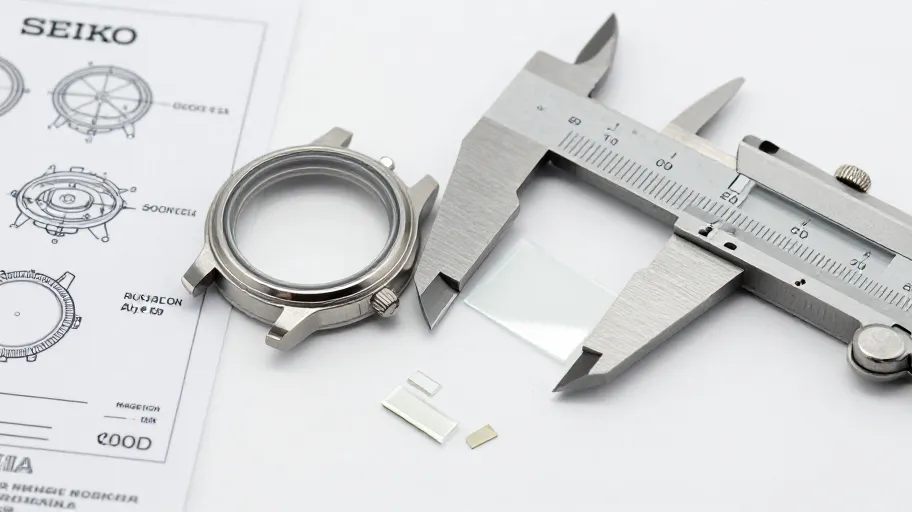
There is no single defensible answer to the question "how much does it cost to replace a Seiko sapphire crystal?" for a B2B buyer. Cost is a function of the specification you draw — dimensions, thickness, coatings, edge and finishing — and of each supplier's current pricing, sampling and order policies. The productive move is not to chase a number; it is to lock a specification, validate it against physical samples, and gate the order behind written approval. This guide shows you how.
Why a replacement-cost question is really a specification question
Most public answers to this question are written for consumers replacing one crystal on one watch. That is not your job. If you are a watch brand, component buyer, product developer or watchmaker sourcing custom or OEM sapphire crystals, the Seiko replacement question is useful for a different reason: it exposes exactly which variables move cost, and those variables are identical whether you are replacing a single crystal or specifying a production run.
A Seiko movement-and-case system is a disciplined reference point. Crystal fit depends on the case aperture, the gasket or retaining construction, the crown and stem clearances, and the intended water-resistance class. When you ask what a replacement costs, you are really asking: what geometry, what finish, what coating, what fit tolerance, and which supplier's policies apply. Translate that discipline into your own specification package and you have converted an unanswerable consumer question into an answerable procurement one.
The honest position on numbers: no currency figure quoted anywhere in this article would survive verification, because price depends on the supplier's current pricing structure, order quantity treatment, tooling decisions and sampling terms — all of which must be confirmed directly. What you can control is the completeness of what you send.
The SPEC–SAMPLE–SIGN-OFF framework
Use a three-gate framework for any sapphire crystal procurement, whether it originates as a replacement need or as a new OEM design:
| Gate | What you do | What it protects against |
|---|---|---|
| SPEC | Freeze a written specification: drawing, nominal geometry, gasket-seat detail, coating choice, edge finish, marking or logo requirements, and the inspection criteria you will apply. | Vague quotations, re-quoting cycles, "assumed" options. |
| SAMPLE | Request physical samples against the frozen spec and inspect them against your documented criteria before any order commitment. | Substituted materials, incorrect coatings, fit failures at the gasket seat. |
| SIGN-OFF | Approve in writing — drawing revision, sample reference, inspection result — and make that approval the reference for production. | Disputes over what was agreed; drift between sample and delivery. |
The framework's value is that every cost conversation happens at a defined gate. At SPEC you compare like with like because every supplier quotes the same drawing. At SAMPLE you spend the least money learning the most about a supplier. At SIGN-OFF you convert knowledge into a defensible order.
The specification variables that drive cost
When a supplier quotes a sapphire crystal, the price responds to decisions you make before the quotation is ever requested. Work through each field deliberately:
- Geometry and form. Flat, domed, box-domed or shaped crystals carry different processing complexity. More complex forms mean more grinding and polishing operations to specify and inspect.
- Thickness and cross-section. Thickness interacts with hand clearance, case design and perceived quality. Specify it on the drawing rather than leaving it to supplier default.
- Gasket seat and fit construction. The seat geometry — its profile and surface condition — determines whether the crystal seals as intended. This is the single most consequential field for a replacement or OEM fit, and the one most frequently under-specified.
- Coatings. Anti-reflective treatment, and whether it is applied to one side or both, changes both the process route and the inspection plan. Confirm the coating scope and how conformity will be verified.
- Edge and surface finish. Polished edges, bevels, and specified surface quality all belong on the drawing.
- Marking and decoration. Any printing, logo or indexing adds operations and approval criteria.
- Quantity structure. How the supplier treats order quantity, tooling and setup is a policy question, not a published constant — ask for the current terms directly.
Decision table: comparing quotations on equal terms
| Question to ask each supplier | Why it matters | What a strong answer looks like |
|---|---|---|
| Can you quote against our frozen drawing, with drawing revision referenced in the quote? | Prevents like-for-unlike comparisons. | Quotation tied to a named revision, not a verbal description. |
| What is your current sample policy — availability, cost treatment and shipping terms? | Determines your cheapest validation step. | A clear, current written policy; confirm it directly, do not assume. |
| What is your current MOQ and order-quantity treatment? | Sets the entry point for commercial discussion. | A stated policy you can plan around. |
| How will dimensional conformity be inspected and documented? | Links spec to verifiable evidence. | Defined inspection points and reporting method. |
| How is coating conformity (if specified) verified? | Coating claims are unenforceable without a method. | A named verification approach you can audit. |
| What are your current lead-time and capacity commitments for this part? | Feeds your production planning. | Current commitments in writing, not indicative ranges. |
| Who owns the tooling or fixtures if any are required? | Affects total cost and future reordering. | Explicit ownership terms stated before commitment. |
Samples and approval: the questions that protect the order
The sample stage is where a buyer earns certainty. Inspect against the frozen drawing, and close the loop with a written sign-off that names the drawing revision, the sample identifier and the inspection result.
Concrete approval questions to put to your supplier before sign-off:
- Which drawing revision does this sample represent, and can you confirm it in writing?
- Which inspection method was used for the gasket seat and overall geometry, and what are the results against our specified criteria?
- If a coating is specified, how was it applied and inspected, and what documentation accompanies it?
- Are there any process deviations or substitutions between this sample and what production would deliver?
- What is your current policy on discrepancies discovered after delivery — claim process and resolution route?
- What reference marking or traceability will link production parts to this approved sample?
Treat answers as part of the approval record. A supplier's willingness to answer precisely is itself procurement information.
Sample-and-approval checklist
- Drawing frozen, with revision number and date
- Gasket-seat geometry and fit construction specified explicitly
- Coating scope (none / one side / both sides) stated, with verification method
- Edge and surface finish criteria documented
- Inspection criteria and reporting format agreed before sampling
- Sample policy — cost, shipping, terms — confirmed directly with the supplier in writing
- Physical sample inspected against documented criteria
- Deviations logged and dispositioned (accept / rework / reject)
- Written sign-off referencing drawing revision and sample ID
- Production order released only against the signed-off reference
How to structure your enquiry to JadeZone Sapphire or any supplier
Whether you are replacing a crystal in an existing case system or launching an OEM design, send a package that lets a supplier quote without guessing: a dimensioned drawing with revision control, the case or gasket reference it must fit, your coating and finish requirements, your target quantity structure, and your inspection expectations. Then ask, in writing, for the supplier's current pricing, sampling, MOQ, tooling and lead-time policies — and treat the answers as dated documents to reconfirm at order time.
This is where a Shenzhen/Hong Kong manufacturing base works in your favour: proximity between engineering and production shortens the SPEC–SAMPLE loop, and a supplier that welcomes a frozen drawing and documented approval is signalling the process maturity a B2B buyer should require. Verify that signal through the sample gate before committing volume.
FAQs
Is a sapphire crystal replacement for a Seiko more expensive than the original part? There is no verifiable general answer. Cost depends on the specification of the replacement (form, thickness, coating, fit construction) and the supplying manufacturer's current pricing and order policies. For a B2B buyer, the comparable unit is your frozen drawing quoted by multiple suppliers — confirm current pricing directly.
Can I order a custom sapphire crystal to fit a Seiko case for my own watch line? Yes, as a specification exercise: provide the case aperture geometry, gasket-seat detail, target water-resistance construction, and finish and coating requirements. Fit suitability must be validated at the sample stage against your documented inspection criteria before any order commitment.
How many samples should I approve before ordering? That is a policy and risk question to settle with the supplier when you request the sample policy. What matters is that approval is written, references a drawing revision and sample identifier, and that production is released only against that approved reference.
Do coatings change how I inspect and approve a sapphire crystal? Yes. A specified coating needs a defined verification method and documentation; otherwise the requirement is unenforceable at the sign-off gate. Agree the verification approach before sampling, and include coating conformity in the written approval.
How do I compare suppliers when their quotations look nothing alike? Normalise them: send every supplier the identical frozen drawing and require quotations to reference the drawing revision. Then compare against the decision table above — sample policy, MOQ treatment, inspection documentation, tooling ownership and current lead-time commitments — rather than against a single headline figure.
Ready to run a disciplined procurement process? [获取采购 Brief] — request the sourcing brief and use it to structure your specification, sample and approval package before you commit to any quotation.
Not ready to enquire yet? Download the sample-and-approval checklist above and run it against your current crystal specification — it will show you, in minutes, which fields are missing from your drawings before any supplier sees them.