
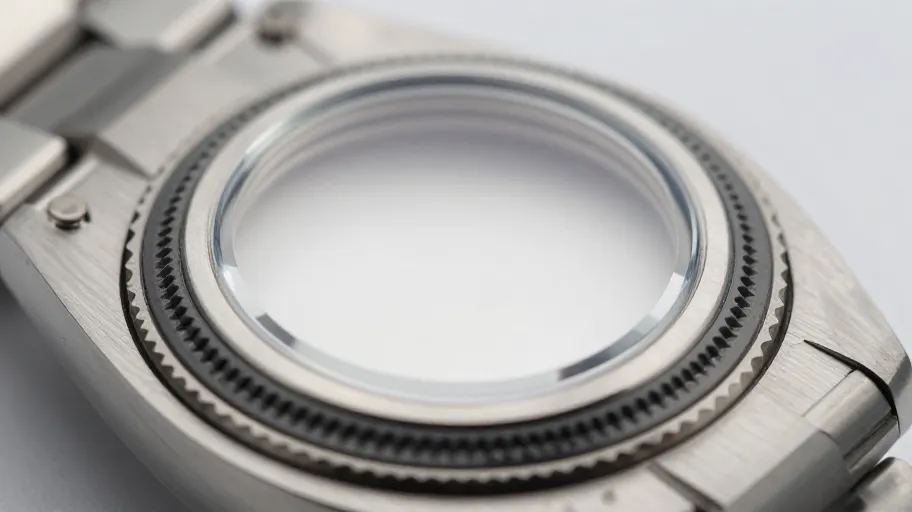
There is no single verifiable answer to "how much is a Rolex sapphire crystal replacement?", and no currency figure is given here. For component buyers, replacement cost is driven by specification — geometry, coating, edge finish, gasket interface and volume — so the productive question is: which spec decisions control your quote, and how do you approve a supplier against them?
Why the phrase-level question has no single number
Searchers arriving at this question fall into two groups. Consumers want a repair price for one watch. Sourcing managers, watch brands and product developers arrive via the same phrase but need something different: a repeatable process for pricing and approving custom or OEM sapphire crystals across a production programme.
For the B2B reader, the replacement-cost question dissolves into a set of specification variables that you control. Two suppliers quoting "the same" crystal can be quoting materially different parts if the drawing does not pin down:
- Blank geometry: flat, domed, double-domed, box or stepped profiles.
- Coating and surface treatment: anti-reflective treatment on one or both faces, or none.
- Edge and gasket interface: polished or ground edge, tension ring compatibility, gasket seat geometry.
- Diameter, thickness and any non-round shapes.
- Marking or printing requirements on the inner face.
- Volume and delivery cadence for the programme.
Because none of these carry a universal price, and because this brief contains no confirmed pricing, MOQ, lead time or tolerance data from JadeZone Sapphire, every figure-level question must be turned back into a documented specification and a direct confirmation with the supplier. That is not a dodge — it is how disciplined buyers avoid comparing quotes that were never built on the same part.
A note on brand context: querying a Rolex replacement price signals familiarity with sapphire crystals as the reference material for watch glazing. For OEM sourcing, the productive path is not to chase brand-equivalent parts but to define your own drawing and qualify a specialist manufacturer such as JadeZone Sapphire against it. Whether any specific part, tolerance, coating performance or production capability applies to your programme is a question to verify and document during sampling — not an assumption to carry into a purchase order.
The SPEC–Sample–Approve (SSA) Gate Framework
To keep sourcing decisions clean, run three gates in order and do not let a later gate open before the earlier one closes.
Gate 1 — SPEC: freeze the drawing before any price. Produce a controlled drawing that states geometry, coating, edge treatment, gasket interface and marking. Every quote request references the same revision. If a supplier cannot quote to your drawing, the quote is not comparable to any other quote you hold.
Gate 2 — Sample: qualify against the frozen spec. Request samples produced to the frozen drawing. Sample policy — including any fees, shipping responsibility and what happens to fees on order — is set by each supplier and changes over time. Confirm the current policy directly, in writing, before ordering samples. Do not rely on prior arrangements, forum claims or assumptions.
Gate 3 — Approve: gate the sign-off on documented criteria. Define acceptance criteria before samples arrive: dimensional verification method, visual inspection standard, coating verification approach, and a fit test with your case and gasket. Record the result, approve or reject in writing, and lock the approved sample as the reference for production.
Decision table: what changes your sourcing outcome
| Spec variable | Why it matters to the buyer | What to decide at SPEC gate | What to confirm at Sample gate |
|---|---|---|---|
| Geometry (flat, domed, box) | Drives material usage, machining path and yield risk | Fix profile and dimensional callouts on the drawing | Verify measurement method and recorded results against the drawing |
| Anti-reflective coating | Affects appearance, placement (inner/outer/both) and verification | State faces treated and verification expectation | Confirm how coating conformity will be evidenced |
| Edge and gasket interface | Determines fit, sealing and case compatibility | Specify edge treatment and seat geometry | Fit test with actual case and gasket; document the result |
| Marking/printing | Affects tooling and inner-face processing | Define artwork, placement and permanence expectation | Inspect printed sample against artwork under agreed conditions |
| Volume and cadence | Shapes how a supplier responds to capacity questions | State programme volume expectations honestly | Ask the supplier to confirm what volume they can commit to and on what evidence |
| Reference sample | Anchors quality across the whole programme | Nominate an approved golden sample at sign-off | Retain and version the approved sample; reference it in the PO |
Approval questions to put to any sapphire crystal supplier
Bring these to your first technical call. The quality of the answers tells you as much as the sample does.
- Can you quote to our controlled drawing revision, and what happens to the quote if the drawing changes?
- What dimensional verification method do you use, and what results will you document with the sample?
- How do you evidence coating conformity for the treatment we specified?
- What is your current sample policy — fees, shipping responsibility, and how fees are handled if we proceed to order? (Confirm in writing; policies are supplier-specific and change.)
- What production volume can you commit to for our programme, and what evidence supports that commitment?
- What is your current lead-time expectation for samples and for production, and what assumptions does it rest on?
- How do you handle a defect found after delivery — what is the escalation and resolution route?
- Do you hold any current certifications or test reports relevant to our programme, and can you share the documents?
None of these has a default answer. A supplier who answers precisely, in writing, is one you can document and approve against; a supplier who answers vaguely at the sample stage has told you something too.
Sample and cost policy questions — confirm directly
This article deliberately states no price, no MOQ, no lead time, no tolerance and no sample-fee arrangement, because no such facts were supplied and none should be inferred. Before publication of any buyer-facing claim, and before any purchase order, confirm with JadeZone Sapphire in writing:
- Current pricing structure for your specification and volume.
- Current MOQ, if any, for sample and production runs.
- Current sample fee policy, shipping responsibility, and fee treatment on order.
- Current lead times for sampling and production.
- Available certifications and test evidence applicable to your programme.
- Defect-handling and after-delivery resolution process.
Until confirmed, treat all of these as open project questions, not supplier attributes.
FAQ
Is a Rolex-branded replacement crystal the right reference for OEM sourcing? Not directly. The search phrase reflects sapphire's status as the reference glazing material. For OEM programmes, define your own drawing and qualify a specialist manufacturer against it, rather than pursuing brand-name equivalents. Compatibility with any branded watch must be verified case by case and is not addressed here.
Why won't a supplier quote a price without a full drawing? Because geometry, coating, edge treatment and volume change the work content materially. A quote without a frozen specification cannot be compared with any other quote — which is why the SPEC gate comes first in the SSA framework.
What should I check when a sample arrives? Dimensional results against the drawing, visual quality under agreed lighting, coating conformity evidence, and a fit test with your case and gasket. Record everything and lock the approved sample as your golden reference.
How do I compare two sapphire crystal suppliers fairly? Quote both against the same drawing revision, use the same acceptance criteria at sample stage, and compare documentation quality — measurement methods, evidence of coating conformity and written answers to the approval questions — not just the headline number.
What happens if a delivered batch has defects? That depends entirely on the supplier's stated process, which you should have in writing before ordering. Ask the escalation and resolution question at the sample stage, not after delivery.
Get the sourcing brief
If you are preparing an RFQ for custom or OEM sapphire crystals, start with a documented specification rather than a price hunt. 获取采购 Brief — request the JadeZone Sapphire sourcing brief and build a comparable, approval-ready request.
Low-friction next step: the pre-quote checklist
Not ready to request a brief yet? Run this five-point checklist first:
- Controlled drawing revision exists and states geometry, coating and edge treatment.
- Gasket interface and case reference are defined.
- Volume expectation and cadence are stated internally.
- Acceptance criteria for the sample are written down before samples ship.
- All policy questions (pricing, MOQ, fees, lead time, certifications) are listed for written confirmation.
Complete all five, and you are ready to approach JadeZone Sapphire — or any supplier — with a request that produces comparable answers.