
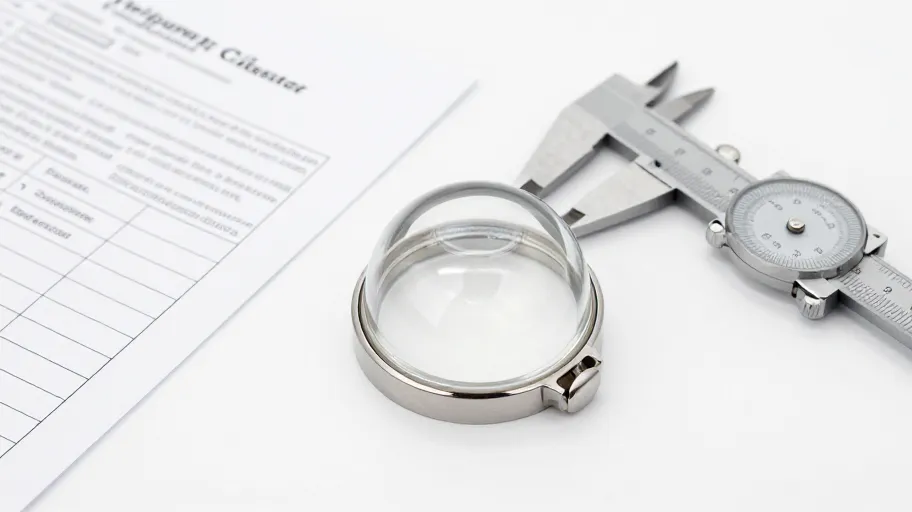
A domed sapphire crystal watch component should be bought against a written specification, a measured sample and a documented approval — never against a photo or a verbal description. This guide gives watch brands, component buyers and sourcing managers a framework — S.A.P.: Specify, Approve, Protect — covering dome geometry, case interface, optical checks and the questions to ask before you commit. Every policy detail is project-specific: confirm the current policy directly.
Why domed crystals need a tighter spec conversation
A flat crystal is defined by diameter, thickness and finish. A domed sapphire crystal watch component is defined by more: the height of the dome above the bezel plane, the curvature profile from centre to edge, how that curvature transitions at the perimeter, and how all of that interacts with the case seat, gasket and dial clearance.
That extra geometry is exactly what makes domed crystals attractive — a pronounced dome changes the light play across the dial and signals a considered design. But the same geometry creates the two failure modes buyers see most clearly at the sample stage: visible distortion of the dial or hands when viewed off-axis, and fit problems at the case interface that only appear at assembly.
Neither failure is a materials problem. Sapphire's hardness and scratch resistance are the reason buyers choose it. Both failures are specification problems — and specification problems are solvable before tooling, if the buyer asks the right questions in the right order.
The S.A.P. framework: Specify, Approve, Protect
Specify. Convert your design intent into a drawing and written spec that a supplier can quote and a inspector can measure. Ambiguity in the dome profile is the single largest source of rework.
Approve. Evaluate a physical sample against defined acceptance criteria — measured dimensions, controlled viewing conditions for optical distortion, and a documented pass/fail record — before releasing production.
Protect. Ensure the agreed specification, inspection method and change-control process live in written project documentation, so both parties measure the same things at every milestone.
Specification checklist: what to define before you request a quote
- Dome height: the rise of the crystal at centre relative to the seating plane.
- Curvature profile: continuous radius, multi-radius, or free-form — described on the drawing, not in words alone.
- Edge transition: how the dome meets the wall; sharp, rounded or stepped.
- Overall diameter, wall geometry and thickness at seat, wall and crown.
- Case interface: seated, tensioned, bonded or gasketed — and the gasket reference if applicable.
- Dial and hand clearance: verify total height inside the case with the movement installed.
- Optical finish: polish quality expectations on both surfaces, viewed under agreed lighting.
- Coating intent: whether an anti-reflective coating is in scope, single or double sided — confirm the current coating options directly.
- Date window or aperture treatment, if the design requires it.
- Marking or printing requirements, if any.
Each item should appear as a measurable or visually referenced line on the drawing package you send for quotation. Where you cannot yet define an item, flag it as open and ask the supplier to propose options for your review.
Decision table: choosing your specification route
| Project situation | Recommended spec route | Key document | Approval gate |
|---|---|---|---|
| New case design, dome is a design feature | Full parametric dome profile defined by your design team | 2D drawing + 3D model with dome height and radius callouts | First-article dimensional report + visual review on case |
| Case exists, retrofitting a domed crystal | Reverse-engineer from the case seat and gasket channel | Measured interface sketch approved by both parties | Trial fit in the actual case, documented clearance check |
| Small batch, dial distortion is the main concern | Prototype-first with two or more dome profiles compared | Comparison sheet with viewing-angle notes | Team review of optical appearance under fixed lighting |
| Scaling an approved design to a new diameter | Scale with review, do not copy blindly — curvature does not scale linearly | Revised drawing referencing the approved parent | Sample approval against the new drawing before batch release |
Sample evaluation: the approval gate
When a sample arrives, approve it against a written record, not an impression. A workable approval gate has three passes:
- Dimensional pass. Measure the items on your spec sheet — dome height, diameter, thickness points, edge geometry — and record each against the drawing. Anything not measured is not approved.
- Interface pass. Fit the crystal to the intended case and gasket. Document the fit result and any interference or clearance observations.
- Optical pass. Inspect the crystal on the dial under controlled lighting and at defined viewing angles. Note any distortion zones, reflections or finish irregularities, and their location. Off-axis viewing is where dome distortion shows itself.
Record the outcome as approved, conditionally approved with listed actions, or rejected with reasons. That record becomes your reference for production consistency checks later in the project.
Concrete approval questions to put to any supplier
- Can you confirm the dome profile from our drawing, or do you require a reference sample or 3D model to work from?
- What dimensional report will accompany the sample, and which features will it cover?
- How do you inspect polish quality and optical appearance before shipment?
- What is your process if the first sample does not meet the drawing — and how are revisions documented?
- What anti-reflective coating options can you offer for this geometry, and how is coating quality verified?
- How are changes to the specification after approval handled and re-approved?
- What documentation will you provide with production batches so we can verify consistency against the approved sample?
For every question touching sample terms, costs, shipping or production arrangements, confirm the current policy directly.
FAQ
Does a higher dome always distort the dial more? Not necessarily. Distortion depends on the curvature profile, thickness distribution and viewing angle, not dome height alone. That is why the profile belongs on the drawing and the optical check belongs in the approval gate. Compare profiles on samples before committing.
Should I specify the crystal or the case first? For new designs, develop them together. The dome geometry, case seat and gasket interact; specifying one in isolation invites fit problems. For retrofits, start from the measured case interface and design outward.
How many sample rounds should a project plan for? Treat this as project-specific. A fully defined drawing may approve on the first sample; an evolving design may need comparison samples of different dome profiles. Agree the sampling loop and revision process with your supplier in writing.
What is the difference between approving a sample and approving production? Sample approval confirms the design. Production approval confirms consistency — that later parts match the approved sample. Define what documentation accompanies batches so you can verify both.
Can a flat-crystal drawing be adapted for a domed version? It can be a starting point, but curvature does not scale by simply adding height. Re-specify the profile, verify dial and hand clearance inside the case, and re-run the full approval gate on a physical sample.
Next step
If this guide maps to a project on your desk, use the framework as your enquiry document: specify, approve, protect.
[获取采购 Brief]
Prefer to start lighter? Download the one-page domed sapphire crystal specification checklist and use it to structure your first conversation with any supplier, including us.
[Get the specification checklist]