
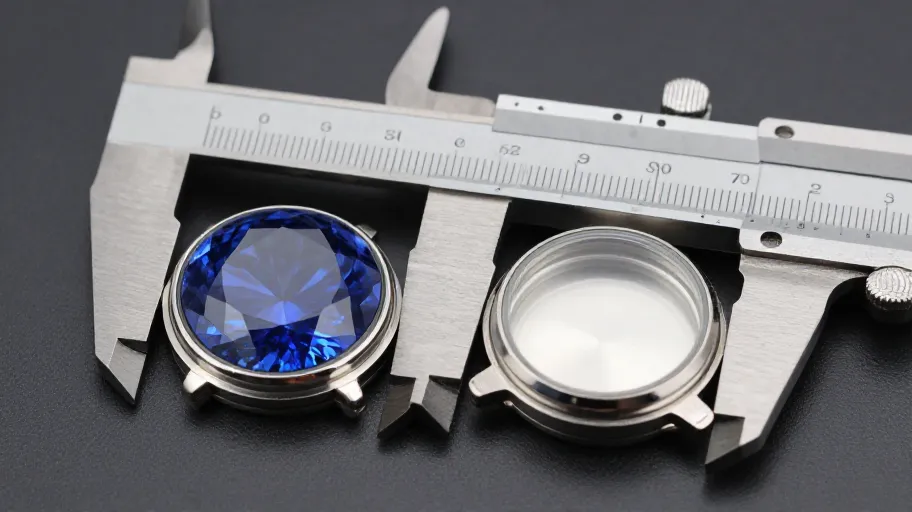
Choosing between a domed and flat sapphire crystal is a geometry decision with consequences for case height, dial legibility, coating performance, tooling cost and assembly fit. Compare both options against your case design, evaluate physical samples under real lighting, and document approval criteria in writing before committing to production tooling.
Why the crystal profile is a sourcing decision, not just a style choice
When buyers treat crystal geometry as a late-stage aesthetic call, problems surface after tooling: a dome that raises case height beyond the design envelope, a flat crystal that reveals dial reflections the concept renders never showed, or an edge profile that does not seat correctly in the bezel. The domed vs flat question sits at the intersection of industrial design, mechanical fit and optical performance — which is why it deserves the same rigor as movement or case sourcing.
A domed crystal curves outward from the dial. A flat crystal presents a level top surface. Between them sit variants — box crystals with vertical walls and a flat or gently curved top, and double-domed designs with curvature on both surfaces. Each variant changes the optical path, the perceived dial depth, the exposed edge area and the way the crystal interfaces with the case.
Because you are buying custom or OEM parts, your comparison is not against a catalogue standard. It is against your own case drawing. The questions below are written to help you run that comparison in a disciplined way.
Domed vs flat at a glance
Use this decision table early in the design phase, then verify every item against your actual case geometry and your supplier's confirmed capabilities.
| Decision factor | Domed crystal | Flat crystal | What to confirm with your supplier |
|---|---|---|---|
| Optical character | Magnifies dial slightly; can add perceived depth and vintage character | True, undistorted view of dial and print | Request physical samples of both profiles on your dial if feasible |
| Reflection behaviour | Curved surface spreads reflections across a wider angle | Reflections concentrate on a single plane, which can read as glare | Ask how AR coating placement (one side, both sides) interacts with each profile |
| Case height | Dome adds vertical height above the bezel | Minimal added height | Confirm total watch height against your design envelope |
| Edge exposure | More curved edge area exposed to impact | Edge sits closer to bezel protection | Discuss edge finish and how each profile seats in your bezel construction |
| Gasket and fit | Curved base may change gasket contact geometry | Simpler flat seating surface | Ask which gasket design each profile assumes in their process |
| Dial clearance | Curve can reduce clearance over hands at the edges | Even clearance across the dial | Share hand heights and confirm clearance checks on samples |
| Drawing complexity | Dome height, base curve and radius must all be specified | Fewer geometric variables | Confirm which dimensions they need on your drawing to quote and tool |
No row in this table is a verdict. A dive-inspired design may favour flat; a heritage-inspired design may demand a pronounced dome. Your job as a buyer is to convert that design intent into a documented, testable specification.
The CLEAR framework: from preference to approved specification
Use the CLEAR approval framework to move a geometry preference through to a signed-off specification. It keeps design, engineering and sourcing aligned, and it creates a paper trail that protects both sides.
C — Confirm geometry
Start from the case, not the crystal. Document case opening diameter, bezel construction, target overall watch height, hand clearance and dial chapter ring position. Then specify the candidate profile precisely: for a dome, the dome height at centre, the base curve if any, and the edge thickness; for a flat crystal, the top surface spec and edge geometry.
Questions to answer in writing:
- What is the maximum total watch height the design allows, and how much of that budget can the crystal consume?
- What hand stack heights must clear, and at which points on the dial?
- Is the intended look driven by side-profile curvature, top-down magnification, or both?
L — Lock specifications
Once geometry is confirmed, lock the full specification set: material (sapphire), profile and dimensions, thickness at centre and edge, coating (whether AR coating is applied, and on which surfaces), edge finish, and marking or logo requirements if any.
Ask your supplier which dimensions they need to see on the drawing, how they prefer tolerances expressed, and what dimensional checks they can document for each shipment lot. Do not assume tolerance values — request the specific tolerances they can hold for your part, in writing, and record them in your approval document.
E — Evaluate samples
Physical samples are where the domed vs flat decision becomes real. Renders flatter; glass on the wrist does not. Evaluate candidate samples on the actual dial and movement stack, not a reference dial, and under multiple lighting conditions — daylight, office light, and the angled lighting that shows reflection behaviour.
Document what you observe: distortion at dial edges, reflection placement, perceived depth, seating in the case, and any interference with hands. If both profiles are still viable, evaluate both on the wrist of the intended product, since dome perception changes strongly with viewing angle.
A — Align tolerances and process
Before tooling, align on how the part will be inspected and accepted. Ask:
- What inspection reports accompany samples and production lots?
- Which dimensions are critical to your assembly, and are those the dimensions they measure?
- How are coating adhesion and scratch performance verified, and what evidence can they provide for your specific part rather than for a category of parts?
- What is the documented change process if a dimension drifts between sample approval and production?
These are process questions, not accusations. Suppliers who can answer them clearly make approval faster on both sides.
R — Record approval
Produce a one-page approval record: the approved drawing revision, the sample reference, the photograph set, the specification sheet, agreed tolerances, coating spec, inspection method, and sign-off from design, engineering and sourcing. Any later change goes through the same record. This document is what protects you when production ramps and memories of "what we agreed" diverge.
Approval questions to put in writing before tooling
- Which crystal profile — domed, flat, box or double-domed — does the supplier recommend for this case construction, and why, in their own words?
- What are the exact dimensions and tolerances they commit to holding for this part?
- What coating options apply to each profile, and on which surfaces can coating be applied?
- What inspection documentation accompanies samples and production shipments?
- What is the change-control process between sample approval and production, and who signs off on each side?
- What happens if a production part deviates from the approved sample — is there a documented acceptance and resolution path?
None of these answers can be assumed from general market knowledge. Policies differ by supplier and change over time. Confirm every item directly, in writing, for your specific part.
Sample evaluation checklist
Use this checklist each time you receive candidate crystals — it works equally for domed and flat samples.
- Sample matches the approved drawing revision, confirmed against the drawing
- Profile verified: dome height or flatness measured and recorded
- Sample seated in the intended case and bezel without force
- Hand clearance verified across the full dial sweep, including date change if applicable
- Reflection behaviour observed under at least three lighting conditions
- Edge finish and gasket interface inspected
- Coating presence and placement verified as specified
- Photographs taken from consistent angles for the approval record
- Observations logged, including anything to raise with the supplier
- Approval record updated and signed by design, engineering and sourcing
FAQ
Does a domed crystal affect dial legibility compared with flat? A dome changes the optical path, which can add perceived depth and slight magnification, while a flat surface gives an undistorted view. Neither is inherently more legible — the result depends on dial print, viewing angle and reflection management. Evaluate both profiles on your actual dial under real lighting before deciding.
Is one profile better for thinner watches? Flat crystals add less height than a dome of the same diameter, but the total height outcome depends on case construction, bezel design and base thickness. Set a height budget first, then confirm with your supplier which profile fits within it for your specific dimensions.
Can AR coating be applied to both domed and flat crystals? Coating applicability depends on the surface geometry and the supplier's process. Ask which surfaces — inner, outer or both — they can coat for each profile, and how they verify coating performance for your specific part. Do not accept category-level claims as part approval.
What should a crystal RFQ include for a custom part? A case-referenced drawing with all critical dimensions, the target profile (domed, flat, box, double-domed), thickness at centre and edge, coating requirements, edge finish, gasket interface, intended hand heights, and any marking requirements. The more of the CLEAR framework you complete before the RFQ, the more comparable the quotes will be.
How do I compare two suppliers offering different profiles? Ask both to quote against the same drawing and to state their tolerances, inspection documentation, sample policy and change-control process in writing. A supplier's willingness to document answers to the same question set is itself decision evidence.
Next step
获取采购 Brief — request the sourcing brief to structure your crystal RFQ, sample evaluation and approval records before you commit to tooling. It consolidates the specification questions, approval questions and checklists above into a document you can send directly to your supplier.
Prefer to start smaller? Download the sample evaluation checklist above and run it on the next crystal sample you receive — it takes one bench session and gives you a documented baseline for every supplier conversation that follows.
JadeZone Sapphire manufactures custom sapphire watch crystals and precision sapphire components for watch brands and OEM buyers from Shenzhen and Hong Kong. Every policy, tolerance and process detail referenced in this guide must be confirmed directly with our team for your specific project before ordering.