
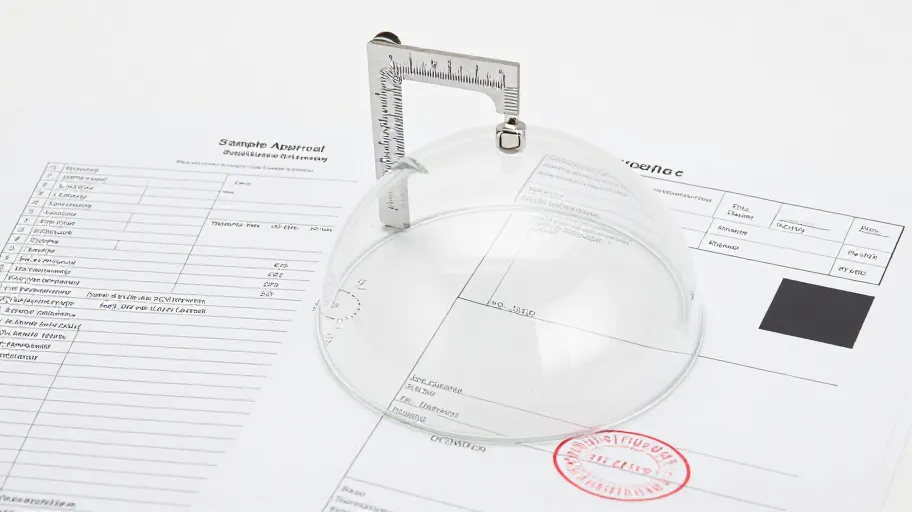
Sourcing a domed crystal for a men's watch comes down to three controlled stages: a complete specification package, a documented sample exchange, and a formal sign-off before production. This guide gives watch brands, component buyers and product developers a working framework — SPEC, SAMPLE, SIGN — so your domed sapphire crystal RFQ is unambiguous, your sample approval is evidence-based, and your production release is defensible.
Why domed crystals demand tighter spec discipline than flat crystals
A domed crystal is a formed optical component, not just a protective window. Curvature changes the apparent dial size, distorts or clarifies markers depending on height and base thickness, interacts with bezel geometry, and shifts how anti-reflective coating behaves at the edges. When buyers source a "domed crystal watch men" project without locking geometry, the result is rework: crystals that fit the case but ruin the dial reading, or look right but sit proud of the bezel in a way the design team never intended.
Because a dome has no single reference plane the way a flat crystal does, every dimension in your drawing has to be anchored to something measurable — a datum edge, a seated height, a curvature radius. That is why the first stage of the framework matters more than any negotiation on price.
Stage 1 — SPEC: the specification package a supplier needs
Before requesting a quotation from any supplier, including JadeZone Sapphire, assemble the following. Missing items are the single largest cause of quote rework.
| Spec element | What to define | Why it matters to the buyer |
|---|---|---|
| Mounting type | Front-fit (snap), gasket-fit, glue-fit, or screw-down via bezel | Determines case-tube geometry and who owns the sealing interface |
| Base shape | Round, tonneau, cushion, or custom footprint | Non-round domes constrain forming and polishing approaches |
| Dome profile | Single dome, double dome, or box (stepped side with domed top) | Profile drives optical distortion pattern and total height |
| Height and curvature reference | Seated height, dome apex, or curvature radius — with datum defined | Prevents the "fits but looks wrong" failure mode |
| Diameter tolerance | The dimensional tolerance band your case design actually requires | Ask the supplier what they can confirm for your part; do not assume |
| Thickness | Base thickness and edge thickness | Affects both strength and optical character |
| Coating | None, inner-side AR, double-sided AR | Ask for coating options, evidence, and care requirements |
| Decoration | Logo printing, index marks, date-window cutting and position | Affects tooling, artwork approval and inspection points |
| Surface finish | Polished clarity requirements, edge finish | Defines acceptance criteria for visual inspection |
| Reference parts | Existing drawing, step file, or a physical sample crystal | Gives the supplier an unambiguous target |
Note on tolerances: do not accept or state a numerical tolerance in your RFQ until the supplier has confirmed what it can verify for your specific geometry and your measurement method. Tolerance is a negotiated, documented agreement — ask for the measurement method (contact probe, optical scan, gauge) in writing.
Stage 2 — SAMPLE: from drawing to a part you can judge
Once the specification is complete, request a sample. Before any fee is paid or any sample is shipped, confirm the current policy directly with the supplier. Do not assume that a sample is free, that shipping is included, that fees offset against production orders, or that fees are handled one way or another — every one of these points is a supplier policy that can change and must be confirmed in writing for your project.
Key sample-stage questions to put to the supplier:
- Can you produce a sample against my drawing, and what do you need from me beyond the drawing?
- What is your current sample policy, including fees, shipping responsibility and timelines? (Confirm directly; do not rely on past projects or general expectations.)
- What inspection report or dimensional data comes with the sample?
- If the sample does not meet the drawing, what is the correction process before tooling or production?
- How are artwork and printing positions approved — on a drawing, a printed proof, or the sample itself?
When the sample arrives, judge it against the drawing, not against impressions. Seat it in the actual case (or the case model), evaluate it under the lighting conditions your end customer will use, and document everything — photographs, measurements, observations — because this documentation becomes your approval record.
Decision table: dome options and their project consequences
| Option | Design consequence | Sourcing questions to confirm |
|---|---|---|
| Low single dome | Minimal distortion, restrained vintage-modern look | Confirm achievable curvature radius at your diameter |
| High single dome | Strong vintage character; more edge distortion and higher seated profile | Confirm bezel clearance and gasket interaction |
| Double dome | Reduced edge distortion while retaining dome height | Confirm whether the profile is formable at your diameter and thickness |
| Box crystal | Domed top with vertical wall; accommodates tall hands | Confirm wall height, corner geometry for non-round shapes |
| Inner AR only | Reduced reflection with scratch exposure on outer face | Confirm coating process and any durability evidence |
| Double-sided AR | Clearest reading; outer coating needs care in handling | Confirm care instructions and inspection criteria for coating defects |
| Printed logo / indices | Brand presence on the crystal | Confirm artwork format, position tolerance and approval steps |
Stage 3 — SIGN: approval questions and the pre-production gate
Approval is where sourcing protects the brand. The sign-off should be a short, written record — an email or signed approval sheet referencing the sample, the drawing revision and the agreed inspection criteria.
Approval questions to answer in writing:
- Does the approved sample match drawing revision [x], and is that revision frozen for production?
- Which dimensions were measured, by what method, and are the results recorded?
- What are the agreed visual acceptance criteria for coating, polishing and printing?
- What is the agreed process if a production part deviates from the approved sample?
- Are packaging and protective requirements documented for shipment to your assembly site?
Pre-production sign-off checklist
- Drawing revision number frozen and shared with supplier
- Dome profile, height datum and diameter tolerance agreed in writing
- Measurement method for critical dimensions documented
- Sample seated and evaluated in actual case under agreed lighting
- Coating type confirmed; care and inspection criteria recorded
- Printing artwork approved at final position
- Sample approval recorded in writing, referencing sample ID and drawing revision
- Sample, fee, shipping and correction policy confirmed directly with supplier in writing
- Packaging and inbound QC plan agreed
- Change-control process defined for any post-approval modification
FAQs
What information does a supplier need to quote a domed crystal for a men's watch? At minimum: mounting type, base shape, dome profile with a defined height datum, diameter with your required tolerance, thickness, coating preference, any printing or date-window features, and either a drawing or a reference crystal. Tolerances should be agreed with the supplier rather than assumed.
How do I judge whether a domed sample is acceptable? Seat the sample in the actual case, measure critical dimensions against the frozen drawing using the agreed method, evaluate optical distortion and coating under realistic lighting, and document results. Acceptance should reference the drawing and the written criteria — not visual impressions alone.
Are sample fees deducted from production orders? That depends on the supplier's current policy and your project. Confirm fee treatment, shipping responsibility and any offset arrangement in writing with the supplier before committing. Do not rely on assumptions or prior arrangements with other vendors.
Should I specify double-sided anti-reflective coating? It depends on the watch's design intent and how the crystal will be handled through assembly. Double-sided coating can improve dial legibility, but outer-face coatings require defined handling and cleaning procedures. Ask the supplier what evidence they can provide and build the care protocol into your assembly documentation.
How do I prevent the dome from interfering with hands or the bezel? Define seated height and total height against your movement and hand stack early, confirm bezel clearance in the drawing, and verify both on the physical sample before sign-off. Height verification belongs in the approval record.
Your next step
If you are preparing an RFQ for a domed crystal for a men's watch, start with the framework above — and before you contact any supplier, 获取采购 Brief (download our Sourcing Brief). It consolidates the spec checklist, sample questions and approval gate into one working document you can circulate to your design and QC teams.
Low-friction alternative: Not ready to talk specs? Copy the pre-production sign-off checklist above into your project file and use it as your internal review sheet — then come back when your drawing revision is frozen.