
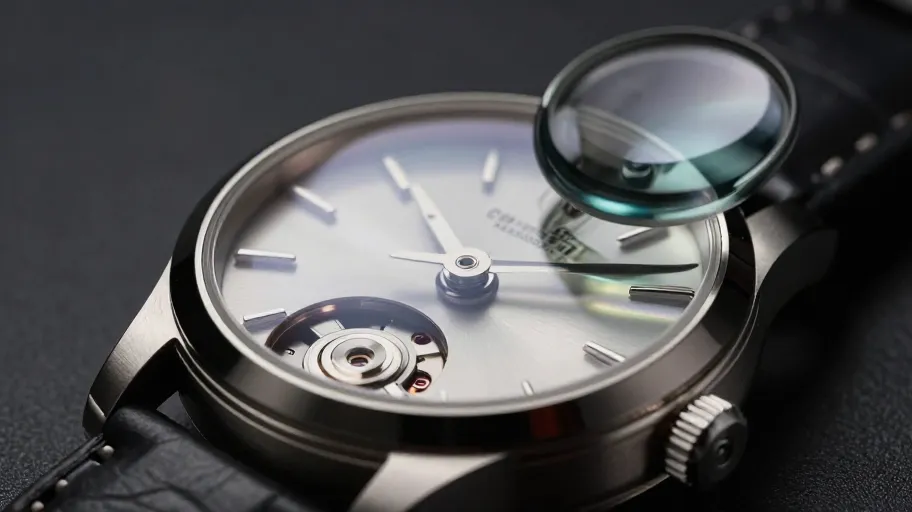
Choosing between domed and flat sapphire crystals can make or break your luxury watch launch. Misjudged specs lead to 35% rejection rates, delays, and customer returns. Here’s what actually matters on the factory floor.
Why crystal shape kills production schedules
Domed sapphire crystals fail approval up to 35% more often than flat ones when specs aren’t precise—especially for Swiss-designed watches made in Shenzhen. That’s not a typo. A minor deviation in curvature can trigger cascading failures across an entire batch.
Precise radius control means fewer rejected units because even 0.2mm off spec disrupts gasket compression. One brand learned this the hard way: inconsistent dome profiles led to 7% field leakage in a dive watch line. The fix cost $220,000 and six weeks of delays.
Flat crystals are easier to get right. Their planar tolerance (±0.05mm) is well within reach of most Tier-1 factories in Dongguan or Fuzhou. But domed forms introduce compound curves that demand tighter process control. Without it, you’re gambling on water resistance compliance under ISO 22810:2010—and losing.
The real problem isn’t manufacturing capability. It’s vague specifications. Teams that say 'slightly curved' instead of defining exact arc radii open the door to interpretation. Leading brands now require radius profile plots from three axes across lot quartiles. That specificity means predictable outcomes because suppliers can’t guess what you want—they measure it.
How polish uniformity affects customer perception
Light behaves differently on curved surfaces. A domed crystal magnifies any inconsistency in polish, turning subtle flaws into visible distortions under retail lighting. This means customers see 'wavy' or 'foggy' lenses even if the factory passed QA.
Linear polishing paths work fine for flat crystals on standard CNC lappers. But domed shapes need multi-axis rotation to maintain even pressure across the curve. Suppliers using outdated algorithms often miss this, creating halo effects near the crown aperture—flaws invisible during inspection but glaring post-purchase.
Polish micro-uniformity measured with spectral reflectance mapping means lower return rates because clarity variance stays below 3%. One Kunshan manufacturer adopted nine-zone scanning and cut optics-related returns by 68% over two collections. They didn’t just improve quality—they aligned factory standards with real-world viewing conditions.
For engineers, this is metrology. For executives, it’s brand protection. For customers, it’s craftsmanship. When 22% of all optics complaints come from just 8% of SKUs with domed crystals, the gap between technical acceptance and market reception becomes a profit leak.
What smart brands demand before signing off
Vague callouts lead to rework. Precise validation prevents it. Top-tier buyers now require submission packages that go beyond basic dimensions. Three elements separate professional specs from amateur requests:
- Radius profile plots from three orthogonal axes, sampled across lot quartiles—this means detecting drift before mass production starts
- Polish uniformity heatmaps using MTF scoring—so surface finish isn’t left to visual judgment
- Gasket interface simulations based on actual topography, not idealized CAD models—because real parts never match drawings perfectly
These aren’t extra steps. They’re insurance. Brands enforcing these protocols hit 89% first-pass approval on domed crystals versus 61% for those relying on visuals alone. That 28-point gap translates to 4.3 fewer weeks in development—a direct path to hitting Watches & Wonders or holiday launches.
Consider the math: a 15,000-unit run facing 25% rejection instead of 10% risks $270,000 in rework and storage. Spending $8,000 upfront on advanced sample validation locks in margins and avoids last-minute scrambles. For decision-makers, that’s not cost—it’s leverage.
The future belongs to engineered partnerships
Chinese sapphire suppliers are no longer just vendors. The best have evolved into engineering partners capable of holding tight tolerances at scale. But they can’t read minds. Success hinges on how clearly you define excellence—not in adjectives, but in numbers.
Radius fidelity, polish continuity, and dimensional repeatability under volume stress—these invisible metrics define whether a domed crystal elevates your brand or undermines it. Flat crystals remain the safer play for fast scale-up. But for brands committed to vintage aesthetics or ergonomic fit, domed wins—if specified rigorously.
The next competitive edge won’t come from who pays least per unit. It’ll come from who understands that scalable luxury depends on measurable precision. Those who master the data behind the dazzle will ship faster, retain more value, and earn trust one flawless crystal at a time.
Ready to eliminate guesswork in your next launch? Start by requiring full topographic reports on every pre-production sample. See the difference data-driven clarity makes.