
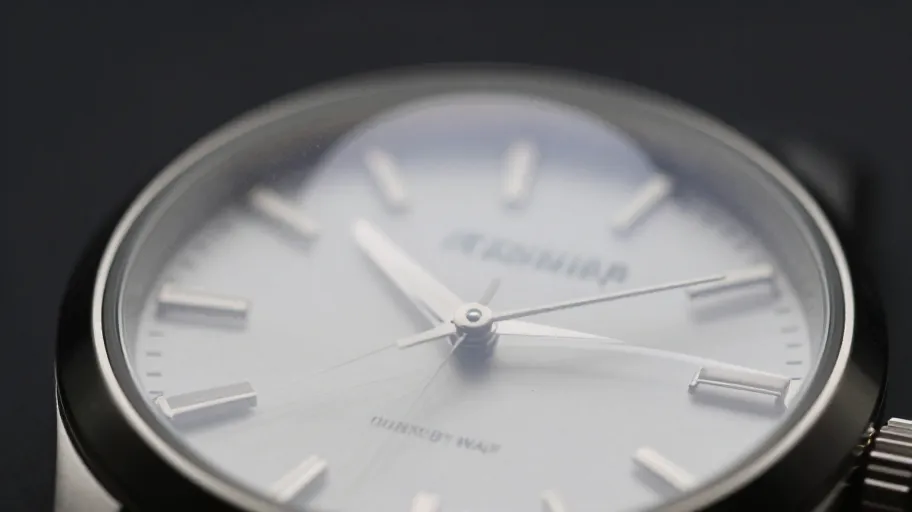
Why a Tight Spec Sheet Is Your Best Insurance
Precise domed sapphire crystal specifications mean fewer production surprises because they lock in optical, mechanical, and sealing performance before tooling begins. One brand in Shenzhen learned this after an unapproved 2.3-degree shift in dome curvature caused dials to appear distorted under retail lighting—leading to a 30% rejection rate despite flawless water resistance. That wasn’t a QC failure; it was a specification gap.
This isn’t rare. A 2024 benchmark of 68 mid-tier watch brands found 41% faced major delays due to crystal incompatibility, costing an average of $217,000 per model in rework and air freight. The real damage? Returns citing 'blurry' or 'foggy' appearance—even though the glass passed scratch tests.
The deeper issue: dome geometry affects more than looks. It determines how evenly the crystal compresses against the gasket during assembly. ISO 22810:2010 requires consistent pressure distribution for water resistance. If dome height varies beyond ±0.3mm, micro-leaks form. One brand discovered 15% of a 10,000-unit run failed pressure testing—not from gasket flaws, but from batch-to-batch CNC drift in low-tier factories.
The fix? Enforce ±0.05mm tolerance on dome height and radius. This precision means every crystal fits identically across batches, so you don’t need retooling for future runs. For global brands managing multi-factory rollouts, that consistency can shave weeks off time-to-market. It also transforms supplier relationships from transactional to collaborative—you’re not just buying parts, you’re co-engineering a system.
Not All Sapphire Is Created Equal
When you specify 'sapphire crystal,' you might assume uniform quality—but the manufacturing process changes everything. Most Chinese suppliers use the Verneuil (flame fusion) method to grow sapphire boules. While cost-effective, this process introduces internal stresses if cooling isn’t tightly controlled. Those stresses become dangerous during doming: under thermal load, uneven expansion increases microfracture risk at the bevel edge.
Top-tier sapphire crystal china manufacture facilities avoid this with closed-loop temperature monitoring and post-growth annealing. But even with clean boules, fabrication makes the difference. High-reliability factories control the full kinematic chain—from blank thickness (±0.03mm) to CNC path optimization that prevents tool wear. Machines holding ±0.05mm tolerance ensure Batch #3 fits like Batch #12, enabling true interchangeability.
Where low-tier factories fail is surface finishing. Aggressive polishing without intermediate lapping creates subsurface damage—microfracture zones invisible to the eye. These aren’t cosmetic; they’re structural liabilities. Under impact or temperature swings, cracks start at the edge and spread inward. One luxury microbrand saw 7% of its first shipment develop spontaneous fractures within six weeks. Lab analysis traced it to poor polishing transitions, not customer misuse.
The solution? Multi-stage diamond slurry polishing and in-process interferometry checks. These protocols mean durable, reliable crystals that survive real-world use. For buyers, this means treating sapphire not as a commodity, but as a calibrated optical-mechanical component. That shift in mindset prevents costly recalls and protects brand trust.
What Your Spec Sheet Should Actually Say
Generic specs like '9H hardness' or 'AR coating' won’t prevent failures. What works is a detailed, enforceable specification that covers both design and process. Here’s what top brands now require:
- Dome radius and apex height, with tight tolerance (e.g., R18.5mm ±0.05mm) to ensure optical and sealing consistency
- Bevel width and angle, verified via optical profilometry to prevent light distortion
- Polishing sequence requirements, including lapping stages, to eliminate subsurface damage
- Compatibility testing with case and gasket under simulated pressure cycles to validate sealing integrity
One brand takes it further: they run a 'crystal-first' dry-fit trial before finalizing case molds. They ship the mold to the sapphire crystal factory to test seating and gasket compression. This step alone reduced their NPI timeline by 22 days and eliminated sealing-related rework in three consecutive launches.
These practices mean faster time-to-market because you catch fit issues early. They mean lower defect rates because you’re validating performance, not just inspecting appearance. And they mean stronger supplier accountability—when processes are documented and tested, there’s no room for corner-cutting.
The Real Cost of Getting It Wrong
A single viral unboxing video showing a distorted dial or foggy crystal can derail a launch. The cost isn’t just financial—it’s reputational. Customers don’t care if the flaw came from a polishing shortcut or a loose tolerance. They see a broken promise.
But the upside is clear: rigorous specs and validation protocols mean predictable production, fewer delays, and higher customer satisfaction. Brands that treat sapphire as a system—not a part—see up to 40% lower rework costs and 30% faster ramp times. They also gain leverage in negotiations: when you speak the language of process control and traceability, suppliers compete on capability, not just price.
If you're sourcing domed sapphire crystal watches from a sapphire china factory, don’t just compare quotes. Demand proof of process controls, batch traceability, and pre-production optical validation. That’s how you turn a high-risk component into a competitive advantage.
In an era where optics define premium perception, the difference between a flawless dome and a flawed one isn’t measured in millimeters—it’s measured in market share.