
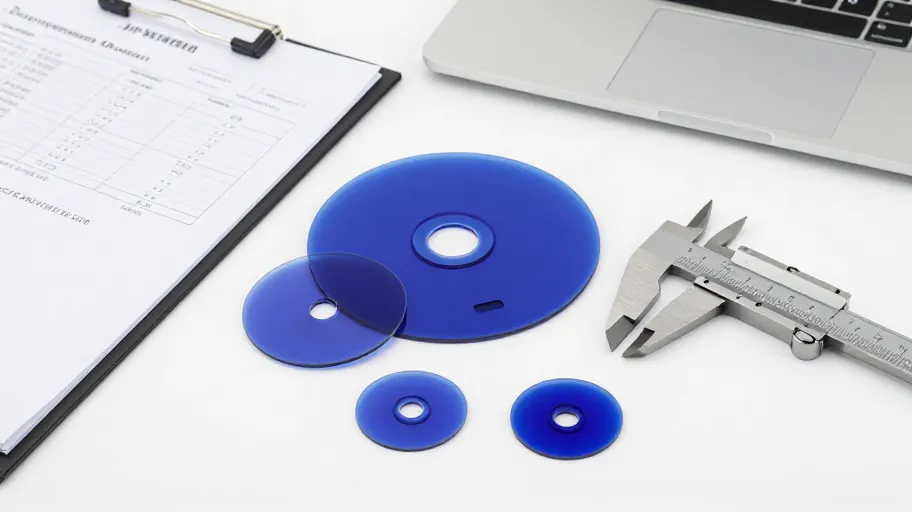
Sapphire crystal glass price is driven by specification, not by a single market rate. Diameter and thickness, dome geometry, edge finishing, hole and date-window features, coating choice, tolerance tightness and approval overhead all shape the quote. A disciplined spec-plus-sample process keeps cost visible and comparable across suppliers before any tooling commitment is made.
That is the short answer. The rest of this guide gives you a working method: a framework you can apply to your next RFQ, a decision table for spec trade-offs, and the approval questions that protect you between sample approval and volume production.
The SPEC–SAMPLE–SIGN-OFF framework
When buyers receive quotes that differ by multiples for what looks like the same drawing, the gap is almost never arbitrary. It sits in specification detail that the drawing did not pin down, and in what each supplier assumes about inspection and approval. The framework below separates those layers so you can compare quotes honestly.
- SPEC. Freeze every variable that defines the part: glass grade, form (flat, domed, double-domed), thickness, edge treatment, decoration, coatings, dimensional expectations and inspection method. Anything left open becomes a pricing assumption — in the supplier's favour or against it.
- SAMPLE. Qualify the frozen spec through physical samples, evaluated against your own case, dial and gasket. A sample is evidence, not a promise: it demonstrates what one production run under one setup can achieve.
- SIGN-OFF. Approve the sample in writing, with revision level, inspection criteria and agreed change-control. This written gate is what makes the eventual unit price meaningful, because it defines exactly what that price buys.
Suppliers such as JadeZone Sapphire — a Shenzhen and Hong Kong based B2B manufacturer of custom sapphire watch crystals and precision sapphire components — work within exactly this kind of process. What the specific terms are for your project is something to confirm directly, drawing by drawing.
What actually drives sapphire crystal glass price
Treat each of the following as a cost lever you control through specification:
Raw boule and orientation. Sapphire is grown and cut from boules, and how a part is oriented relative to the crystal axis affects yield, machining time and optical behaviour. Ask your supplier how they orient watch crystals and how that choice influences both cost and appearance.
Geometry. Flat crystals remove the least material; domed and double-domed forms require more grinding and polishing stages and more complex tooling. Curve radius and consistency expectations are cost variables — request the supplier's process for verifying curvature.
Thickness and dimensional expectations. Tighter dimensional control demands slower machining and tighter inspection sampling. Rather than copying a tolerance from an old drawing, ask what the supplier recommends for your case and movement, and what inspection method verifies it. Do not assume a number; agree one in writing.
Features. Date windows, drilled holes, steps, chamfers and printed or applied indices each add operations and yield risk. Each feature should appear in the drawing with its own inspection method.
Coatings. Anti-reflective coating — single-sided or double-sided — adds process steps. Whether a coating is specified, on which face, and how it is inspected all belong in the SPEC stage. Confirm current coating options and verification methods with the supplier rather than assuming a standard exists.
Finishing and polish. Surface finish expectations drive polishing time. A higher polish spec costs more to reach and to verify. Match the spec to what the wearer will actually see on the wrist.
Approval and change overhead. Undocumented revisions, informal sample approvals and re-quoted changes are quiet cost drivers. A written sign-off gate removes them from the price conversation.
Decision table: spec choices and cost direction
| Decision point | Options to compare | Cost direction | What to confirm with the supplier |
|---|---|---|---|
| Crystal form | Flat / domed / double-domed | Rises with curvature complexity | Tooling implications; curvature verification method |
| Coating | None / single-side AR / double-side AR | Rises with coating scope | Coating process, inspection, rework policy |
| Features | None / date window / holes / steps | Rises per feature | Yield impact; feature inspection method |
| Dimensional expectations | Functional fit / tighter control | Rises with control level | Recommended level for your case; measurement method |
| Surface finish | Standard polish / higher polish | Rises with polish spec | How finish is assessed and documented |
| Sample stage | Informal / documented approval | Documented approval costs time upfront | Sample policy, revision control, approval format |
| Volume approach | One-off / staged ramp | Negotiable per project | MOQ and ramp options — confirm current terms |
This table is a comparison aid, not a price list. Direction of travel is the point: each row is a lever you set before requesting a quote, so the quote reflects your decision rather than the supplier's guess.
Sample and approval questions to ask before sign-off
Before approving any sample — from JadeZone Sapphire or any supplier — put these questions in writing and keep the answers:
- Which drawing revision does this sample represent, and how is that revision identified on the sample or its documentation?
- Which inspection method and equipment were used to verify the dimensions and geometry of this sample?
- How will volume parts be checked against the approved sample, and at what inspection points in production?
- What is the process if a production batch does not conform to the approved sample?
- What changes to the drawing, material source or process will trigger a new sample and re-approval?
- What is the current sample policy — cost, quantities, and logistics — for this project? Confirm all of these directly; no general assumption applies.
- How are coating adhesion and appearance verified for coated parts?
- Who is the named contact for engineering questions during production?
These questions cost nothing to ask and everything to skip. A supplier's willingness to answer them precisely is itself useful qualification evidence.
Approval checklist
- Drawing revision level stated and agreed
- Material grade and crystal orientation confirmed in writing
- Geometry, thickness and features fully dimensioned with inspection methods named
- Coating scope (none / single / double side) specified and verification method agreed
- Surface finish defined and reference sample or standard agreed
- Physical sample evaluated against actual case, dial and gasket
- Sample inspection report received and reviewed
- Written sign-off issued, referencing sample and drawing revision
- Change-control process agreed: what triggers re-sampling
- Commercial terms — sample policy, MOQ, lead time, capacity — confirmed directly and in writing for this project
FAQ
Do all suppliers quote sapphire crystal glass price the same way? No, and that is precisely why the SPEC stage matters. Different suppliers include different scope — tooling, inspection, coating, packaging — in a base quote. Freezing the specification makes quotes comparable.
Should I approve a sample verbally to save time? Avoid it. Verbal approval leaves no reference point when a production batch differs. Written sign-off with revision references is the cheapest insurance in custom crystal sourcing.
How tight should my dimensional expectations be? There is no universal answer; fit to case, gasket and movement determines it. Ask the supplier to recommend a level and the inspection method that verifies it, then document the agreement. Confirm every numeric expectation directly rather than carrying numbers from other projects.
Is anti-reflective coating worth specifying? It depends on the watch's positioning and the wearer-visible benefit you are targeting. Treat it as a decision-table row: confirm the supplier's current coating options, verification methods and any rework implications before deciding.
What makes quotes for identical drawings diverge? Unstated assumptions: orientation, polishing stages, inspection scope, packaging, tooling amortisation and approval overhead. Interrogate each quote against your frozen spec and ask the supplier to itemise anything not covered.
Get the purchase brief
获取采购 Brief — request the procurement brief from JadeZone Sapphire and structure your next sapphire crystal RFQ with spec, sample and approval requirements already documented. Confirm current sample, pricing and production policies directly with the team for your specific project.
Not ready to contact anyone yet? Start smaller: download or copy the approval checklist above into your next supplier evaluation file, and use the decision table to freeze your specification before you request a single quote. When your spec is ready, the procurement brief is the next step.