
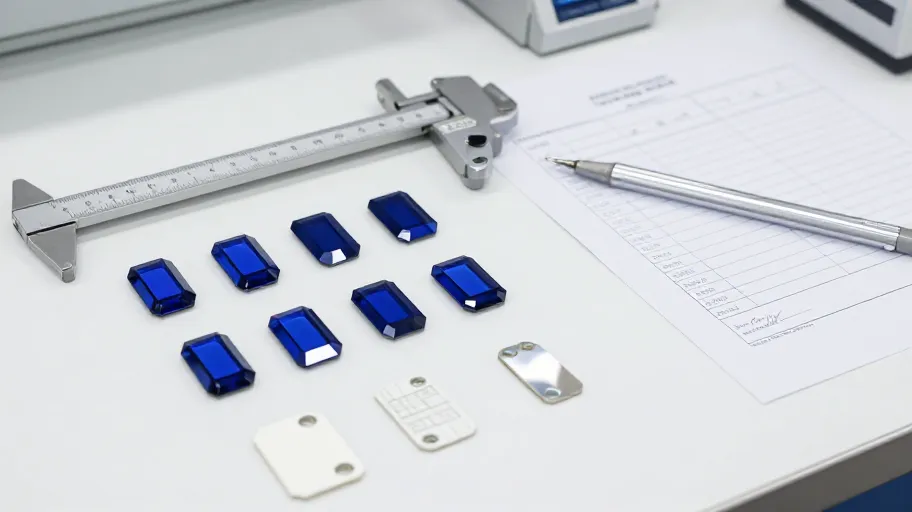
Sapphire crystal replacement cost is driven by specification complexity — geometry, coating, tolerance, finishing and volume — plus the sampling and approval process attached to the order. Buyers who lock a complete spec, run a documented sample loop and sign off against agreed criteria can compare quotes accurately and avoid rework. The SPEC–SAMPLE–SIGN-OFF framework below shows how.
What actually drives sapphire crystal replacement cost
When a quote for a replacement or OEM sapphire crystal arrives, the number reflects decisions made long before the RFQ was sent. A flat crystal with a simple polished edge and no coating is a different project from a domed crystal with anti-reflective coating on one or both faces, a printed logo or index, and a gasket groove machined to match a specific case. Each added feature changes machining time, inspection steps and yield risk.
For sourcing managers, the practical implication is this: two suppliers quoting "the same" crystal may be quoting different products. One may have assumed stock dimensions; the other may have priced full custom tooling. One may have included coating; the other may list it as an option. The cost comparison only becomes meaningful when every input is specified identically.
The cost drivers you control include:
- Geometry — flat, domed, double-domed, or complex profiles requiring multi-axis machining.
- Coating — anti-reflective treatment, and whether it is applied internally, externally or both.
- Surface features — printed elements, bevels, steps, grooves for gaskets.
- Fit requirements — how the crystal interfaces with the case and gasket, and what dimensional agreement the assembly needs.
- Volume and phasing — prototype quantities versus series production, and whether tooling is amortised.
- Approval process — how many sample iterations are needed and what each iteration requires.
Which of these apply to your project, and at what settings, is something to document with the supplier rather than assume. Every item above should appear in your specification package before you ask for a price.
The SPEC–SAMPLE–SIGN-OFF (3S) framework
The 3S framework keeps cost discussions anchored to verifiable inputs:
- SPEC. Write a complete drawing package: geometry, coating, surface features, interface with case and gasket, material grade expectations, and inspection criteria. Anything not written down becomes a variable the supplier must price defensively — or interpret differently than you intended.
- SAMPLE. Request samples against the spec, and agree in writing what the sample loop includes: how many iterations are contemplated, what each iteration is checked against, and what the current sample policy is on cost, shipping and lead time. Confirm the policy directly with the supplier; do not rely on assumptions carried over from other projects.
- SIGN-OFF. Define the approval gate before sampling begins: who inspects, against which criteria, with which measurement methods, and what documentation you receive (dimensional report, inspection record) before series production is authorised.
The framework's value is that each stage produces a document. When a cost question arises later — a re-quote, a dispute, a revision — you can point to the spec, the sample record and the signed approval rather than debating memory.
Spec decision table
| Spec decision | Cost / risk implication | Questions to confirm with the supplier |
|---|---|---|
| Flat vs domed vs double-domed | More complex curvature needs more machining and inspection | What geometries can you produce in-house, and what drawing format do you prefer? |
| AR coating (none / internal / both sides) | Adds process steps and inspection; placement affects visual result | Which coating configurations do you offer, and how is coating quality verified per batch? |
| Printed elements or logo | Requires alignment and adhesion control | What artwork format do you need, and how do you confirm print alignment on samples? |
| Gasket groove or step | Tolerance agreement with your case is critical to sealing | What interface documentation do you need from our case drawing to quote the fit? |
| Prototype vs series volume | Affects tooling approach and unit economics | How do you phase prototype and series production, and what does each phase require from us? |
| Tolerance and inspection criteria | Drives inspection method and acceptance rate | What measurement methods and reports can you provide for the approval gate? |
Samples and the approval gate: questions that protect your budget
Sample-related misunderstandings are one of the most expensive hidden costs in custom crystal sourcing. A quote that looks competitive becomes expensive when the sample loop runs uncontrolled. Before authorising sampling, confirm:
- What does the current sample policy cover — cost, shipping, and how sample charges are handled? Confirm directly; do not assume.
- How many sample iterations are contemplated in the quote, and what triggers additional iterations?
- What will the sample be checked against — the full spec or a defined subset?
- What inspection evidence accompanies the sample (dimensional data, visual inspection criteria)?
- Who signs off on your side, and what form does the written approval take?
- What changes after sign-off — and what happens if a series part is later found to deviate from the approved sample?
- How are revisions to the drawing handled once sampling has started?
These are project-management questions, not accusations. A supplier that answers them precisely is giving you the information you need to plan; a supplier that cannot answer them is telling you where your project risk sits.
Approval checklist
Use this checklist before authorising series production:
- Complete drawing package issued, including geometry, coating, print and interface details
- Sample policy (cost, shipping, iterations) confirmed in writing with the supplier
- Sample received and measured against the agreed criteria
- Fit verified against the actual case and gasket, not just the drawing
- Inspection report or dimensional data received and reviewed
- Deviations documented and dispositioned (accept, rework, revise)
- Written sign-off recorded with date, name and criteria version
- Change-control rule agreed for any post-approval revisions
Frequently asked questions
Why do quotes for the same replacement crystal differ so much between suppliers? Because the quotes are built on different assumptions. Geometry interpretation, coating inclusion, tooling treatment, tolerance choices and sample provisions all enter the price. A like-for-like comparison requires each supplier to quote against an identical written spec — which is the first stage of the 3S framework.
What information should I send to get an accurate sapphire crystal quote? A complete drawing or sketch with geometry, diameter and height, coating preference, any print or logo artwork, the case/gasket interface, expected quantities, and your inspection expectations. The more of the spec you fix, the fewer variables the supplier must price with margin for uncertainty.
How should I evaluate a sapphire crystal sample before approving it? Measure it against the agreed criteria, verify fit with the real case and gasket, review any inspection documentation supplied, and record deviations formally. Approval should be a documented gate, not an informal "looks fine".
Can I order a small batch of replacement crystals for an existing watch model? That depends on the supplier's current policies on minimums, tooling and phased production — all of which must be confirmed directly. Prepare your spec package and ask the supplier how they handle low-volume replacement work within their current terms.
What documentation should I keep for internal supplier approval? The spec package, the sample policy confirmation, sample inspection records, the written sign-off, and the change-control agreement. Together these form the evidence file a sourcing manager needs to justify the supplier choice internally.
Next step: 获取采购 Brief
Before your next RFQ, 获取采购 Brief — a structured specification and approval template built around the SPEC–SAMPLE–SIGN-OFF framework. It standardises what you send to suppliers, what you confirm about sampling terms, and what you document at sign-off, so every quote you receive is comparable.
If you are not ready to request quotes, start smaller: download the approval checklist above and run it against your current crystal specification. Finding the gaps in your own documentation is the cheapest cost-reduction step available to you.