
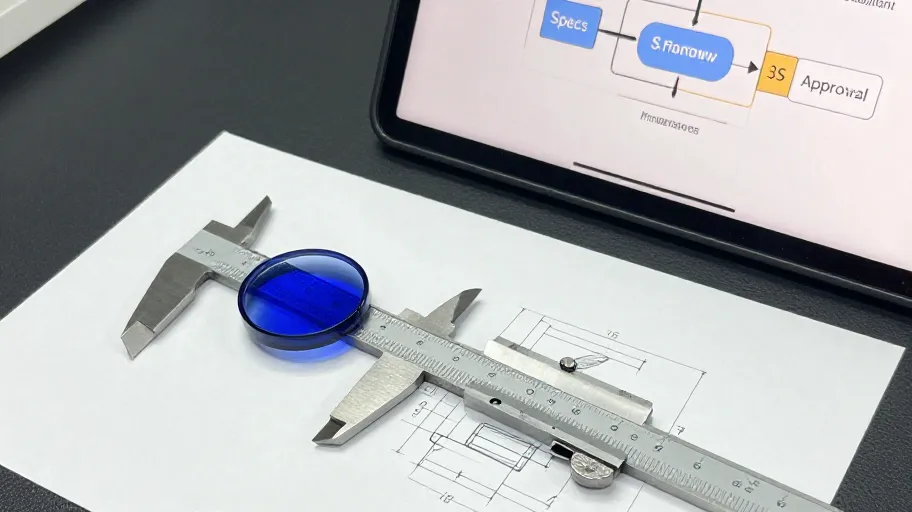
When a brand receives sapphire crystal watch glass that "doesn't fit," the root cause is rarely the sapphire itself. It is a specification that left room for interpretation: an edge profile described in words instead of numbers, a coating expectation never written into the drawing, or an acceptance criterion that existed only in the buyer's head.
The 3S framework exists to remove that ambiguity in three stages:
- Spec — produce a drawing and technical package that a supplier can quote against without assumptions.
- Sample — qualify physical samples against the spec, with documented inspection results.
- Sign-off — approve a golden sample and written acceptance criteria before any production commitment.
Each stage produces a document. Those documents are what protect you if a dispute arises later — and what make re-ordering painless when the collection succeeds.
What to define in your sapphire crystal specification
Your specification package should cover at minimum:
- Geometry: diameter or shape, thickness, edge profile (e.g., bevelled, stepped), dome curvature if applicable, and tolerances stated numerically on the drawing. Ask each supplier what tolerances they can hold and document their confirmed answer — do not rely on assumptions.
- Gasket and case interface: how the crystal seats — tension fit, adhesive, gasket groove — and the mating dimensions you will hold on your side.
- Surface finishing: polish quality expectations on both faces and the edge, described in measurable terms wherever your team can define them.
- Coating: whether an anti-reflective coating is required, on which face(s) or both, and what documentation the supplier can provide about coating performance. Verify any coating claim against documentation rather than verbal assurance.
- Markings: logos, indices or printing, and how they will be referenced and inspected.
- Acceptance criteria: what your team will measure at incoming inspection, and what result counts as a pass.
For every one of these parameters, ask the supplier to confirm in writing what they can achieve for your specific project. Capabilities differ by project, and nothing in this article asserts what any particular supplier — including JadeZone Sapphire — currently guarantees. Confirm the current policy directly.
Decision table: choosing your sourcing and approval path
| Factor | Path A: Catalogue / near-standard crystal | Path B: Fully custom OEM crystal |
|---|---|---|
| Specification ownership | Supplier drawing, you verify fit | Your drawing, supplier confirms manufacturability |
| Sample purpose | Confirm fit and finish against case | Qualify geometry, coating, finishing and markings |
| Documentation burden | Lower — verify existing spec sheet | Higher — full technical package and golden sample |
| Approval risk | Fit mismatch at assembly | Spec drift between sample and production |
| Key question to ask | "Can you confirm dimensions and coating against my case?" | "What will you confirm in writing against my drawing before tooling?" |
| Best suited to | Extensions of existing references, replacement parts | New designs, branded collections, distinctive geometry |
Neither path is inherently safer. Path A risks silent dimensional mismatches; Path B risks under-specified drawings. The 3S framework applies to both.
Sample qualification: questions that surface real answers
When samples arrive, your qualification should be evidence-based. Ask the supplier these questions and record the answers:
- What dimensional report can you provide with the samples, and what does it measure?
- What inspection method do you use for the edge profile and coating, and can you share the results for my samples?
- If I approve this sample, what documentation confirms that production pieces will match it?
- How do you want discrepancies handled if my incoming inspection disagrees with your outgoing report?
- What information do you need from me to quote accurately — and what have I left ambiguous?
Do not accept verbal reassurance on any of these. Ask for documents. A supplier that responds with clear, written answers is demonstrating how the whole relationship will run.
Approval and sign-off checklist
Before releasing any production order, complete this gate:
- Drawing revision number recorded and agreed by both parties
- All numerical dimensions and tolerances confirmed in writing by the supplier for this project
- Coating specification defined (faces, type) with documentation requested
- Edge and surface finishing described in measurable terms
- Golden sample approved, labelled and retained by both parties
- Acceptance criteria for incoming inspection documented
- Discrepancy and re-inspection process agreed in writing
- Contact persons for technical and commercial escalations named
This checklist costs an hour. Skipping it costs weeks if a shipment fails incoming inspection with no agreed reference to arbitrate against.
How JadeZone Sapphire fits this process
As a Shenzhen and Hong Kong based B2B manufacturer of custom sapphire watch crystals and precision sapphire components, JadeZone Sapphire works with watch brands, component buyers and product developers who arrive at different stages of the 3S process — some with complete drawings, some with a case and an idea. Whatever your starting point, bring your questions: what we can confirm for your specific project, in writing, is the basis of a sound approval. Confirm the current policy directly for samples, costs and every project-specific parameter.
Frequently asked questions
What is the difference between sapphire crystal watch glass and mineral glass? Sapphire crystal is synthetic single-crystal alumina, valued for hardness and scratch resistance; mineral glass is a hardened soda-lime glass. For a buyer, the practical difference is in specification and qualification: sapphire involves crystal orientation, growth method and coating decisions that mineral glass does not. Ask each supplier to document the material grade they propose for your project.
Should I specify anti-reflective coating on one side or both? That depends on your dial design, price positioning and how visible coatings are on your reference models. Both options are legitimate. The buyer's job is to specify the choice numerically and request documentation of coating performance from the supplier rather than relying on claims.
How many sample rounds should I plan for? Plan for iteration rather than a fixed number. Lock as much of the drawing as possible before the first sample, inspect thoroughly, and treat each round as producing documentation — not just parts. Ask your supplier how they structure sampling rounds and what they confirm at each stage. Confirm the current policy directly.
What should I check at incoming inspection? Measure exactly what your acceptance criteria say: the dimensions you flagged as critical, coating presence, edge finish, and markings. Compare against the approved golden sample and the supplier's dimensional report. Discrepancies should route through the written process agreed at sign-off.
Can I re-order from the golden sample alone? The golden sample plus the revision-controlled drawing and written acceptance criteria together form your re-order basis. The sample alone is insufficient if the drawing has since changed. Keep all three aligned.
Ready to run this process on your next collection? 获取采购 Brief — download the sourcing brief with the full specification checklist, supplier questions and sign-off gate.
Not ready to talk? Copy the sign-off checklist above into your next project file and use it as your delivery gate. It works with any supplier.