
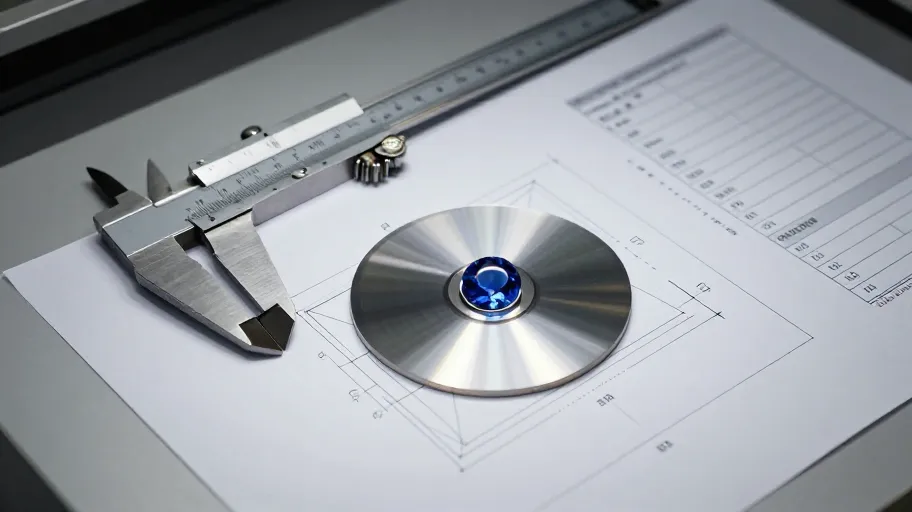
"How expensive is a sapphire crystal?" has no single answer, because a sapphire crystal is not a catalogue item — it is a machined, polished and inspected component priced against your drawing. What you should ask instead is: what does my specification require, what do sampling and revisions cost in time and money, and what evidence will I approve before volume production? Control those three inputs and the price becomes predictable and comparable across suppliers.
Reframe the question: price is an output of your specification
For a watch brand or sourcing team, the useful version of "how expensive is a sapphire crystal?" is "what will this crystal cost given this drawing, this finish, this volume, and this approval process?" The answer arrives as a quotation against a locked specification — not as a market number.
We use a simple framework with buyers we advise, called Spec–Sample–Gate (SSG):
- Spec — lock the geometry, material orientation, finish and coating in a controlled drawing before requesting prices.
- Sample — run a defined sampling loop with measured acceptance criteria, and confirm the supplier's current sample policy directly.
- Gate — release to volume only through a documented approval: first article inspection records, agreed inspection criteria, and a signed-off reference sample.
The framework exists because most cost surprises in sapphire crystal sourcing are not raw-material surprises. They are specification surprises: a coating added after quoting, a tolerance tightened after the first fit test, a revision cycle that restarts tooling. Each of these is avoidable if the spec is locked before the quote and the approval is gated before the volume commitment.
The cost drivers you actually control
Every custom sapphire watch crystal quotation is built from decisions that you, the buyer, make or fail to make. Below are the ones with the clearest cost consequences. Note: the specific pricing effect of each driver is project-specific and must be confirmed with your supplier — treat this table as a checklist of spec decisions, not as a price list.
| Spec decision | Cost impact mechanism | Risk if left ambiguous |
|---|---|---|
| Crystal geometry (flat, domed, double-domed, box, stepped) | More complex curves demand longer machining and polishing cycles per unit | Re-quotes and disputes when the supplier's interpretation differs from your intent |
| Diameter, thickness and wall profile | Material removal volume and yield per boule slice drive unit economics | Fit failures in the case that only appear at assembly |
| Holes, date windows, bevels and edge features | Each added feature multiplies machining and inspection steps | Inspection criteria undefined; parts pass or fail on opinion, not measurement |
| Surface finish (polish quality, chamfer definition) | Finish level determines polishing time and reject handling | Visual inconsistency between sample and volume lots |
| Coating (e.g., anti-reflective treatment, inside/outside) | Coating adds a process step and its own acceptance criteria | Field complaints tied to reflectivity or coating behaviour you never defined |
| Crystal height and side-wall form | Drives fixation method and machining complexity | Gasket or bezel interference discovered after tooling |
| Order volume and batch structure | Setup and polishing economies scale with committed quantity | Comparing quotes made against different volume assumptions |
| Revision and approval discipline | Every unlocked change after quoting restarts cycles | Budget drift that no one can trace to a single decision |
The pattern is simple: every ambiguous line on the drawing becomes a cost variable later. A supplier cannot quote what you have not specified, and a supplier who quotes an unspecified crystal is quoting an assumption.
What to confirm about samples — in writing
Sampling is where a crystal project either becomes controlled or becomes improvised. Because no sample policy was supplied for this article, treat the following as questions to put directly to any supplier, including us at JadeZone Sapphire, in writing before you commit:
- What is your current policy on samples for a new custom crystal — cost, terms, and what is included?
- Who bears shipping for samples, and under which terms?
- What documentation accompanies a sample — dimensional report, material confirmation, finish reference?
- How are revisions handled after the first sample, and what does a revision cycle cost?
- What are your acceptance criteria, and can we agree them before the sample is made?
The key principle: do not approve a sample you cannot measure. A sample that looks right under office lighting is not an approved part. An approved part has agreed measurements, agreed finish references and a record both parties can return to when a volume lot is inspected.
The approval gate: questions to close before volume release
Before you release any sapphire crystal to volume production, run it through an explicit gate. These are the questions worth answering in writing, from any supplier:
- Drawing control — Is there a single revision-controlled drawing, and does the supplier confirm receipt and understanding of the current revision?
- Acceptance criteria — Are dimensional, finish and coating criteria (where applicable) documented and agreed, and what inspection method verifies each one?
- Reference sample — Is there a retained, signed-off reference sample that volume lots will be compared against?
- First article process — Will a first article from production tooling be inspected and documented before the full batch runs?
- Deviation handling — If a lot falls outside criteria, what is the documented path: rework, replacement or another route? Confirm the current policy directly; do not assume it.
- Change notification — If the supplier changes a process input, will you be notified before it affects shipped parts?
- Traceability — Can each shipped lot be traced back to its approval record?
This gate is what makes your earlier price question answerable. A supplier quoting into a locked spec with an agreed gate is quoting a defined part. A supplier quoting into ambiguity is quoting a starting position.
Comparing suppliers fairly
If you are evaluating more than one sapphire crystal supplier, structure the comparison so the quotes mean the same thing:
| Comparison step | Action |
|---|---|
| 1. Single drawing set | Send the identical revision-controlled drawing to every supplier |
| 2. Equal scope | State the same finish, coating and packaging expectations to each |
| 3. Volume basis | Compare quotes at the same committed volume, not different tiers |
| 4. Approval terms | Ask each supplier the same sample and gate questions above |
| 5. Total project view | Compare not just the unit price but sample terms, revision terms and what documentation you receive |
| 6. Decision record | Document why you selected the supplier, against which criteria |
Comparing a quote written against a full drawing with one written against a sketch is not a comparison — it is a decision waiting to become a dispute.
FAQ
Why can't anyone just tell me a price per crystal? Because a custom sapphire crystal is machined to your drawing. Geometry, features, finish, coating, volume and approval loop all change the quotation. A single number without a specification would be an assumption, and assumptions are what make sourcing expensive.
What makes one sapphire crystal design cost more than another? The main levers are geometric complexity, added features such as holes and date windows, finish level, coating, and the volume you commit to. Which lever dominates your project is answerable only against your drawing — confirm each driver's effect with your supplier during quotation.
How many sample rounds should I plan for? There is no fixed number; it depends on how completely the specification is locked before the first sample. A well-locked drawing reduces the loop; an ambiguous one extends it. Ask your supplier how they handle revisions and what each cycle costs, in writing, before you start.
What documents should I keep from the approval process? At minimum: the revision-controlled drawing, the agreed acceptance criteria, the signed-off reference sample record, first-article inspection results, and the supplier's written answers on sample and revision policy. These are your reference points if any question arises during volume production.
How do I know a supplier's sample policy before committing?
Next step: structure your RFQ before you ask for prices
The buyers who get accurate sapphire crystal quotations are the ones who arrive with a locked specification, defined acceptance criteria and a clear approval gate. If you are preparing a custom crystal project, 获取采购 Brief — a structured brief you can complete and send to any supplier, so that every quote you receive answers the same defined part.
Not ready for an RFQ yet? Download the custom crystal approval checklist and use it to audit your current drawing and sampling process first — no project commitment required. Get the checklist