
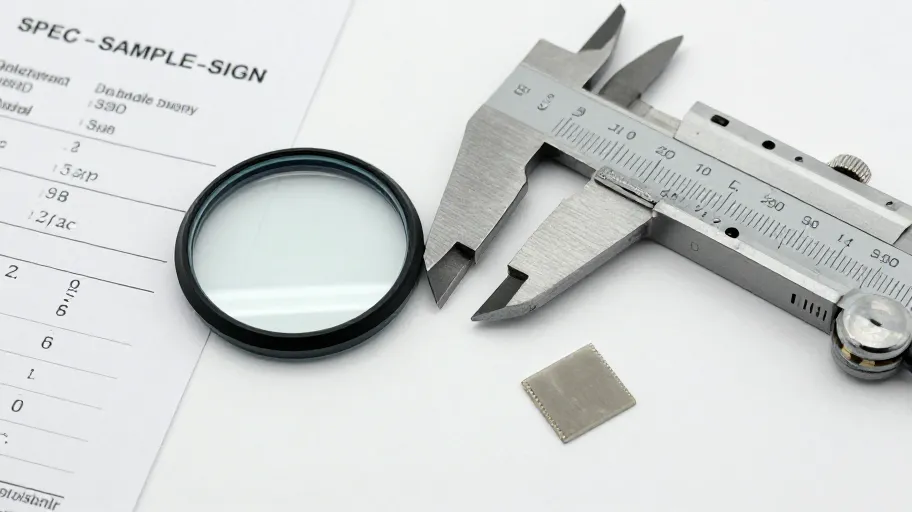
Buying a sapphire crystal for a watch project succeeds or fails on three things: a written specification, a measured sample, and a documented approval. This guide walks through the SPEC–SAMPLE–SIGN framework so component buyers and product developers can compare suppliers on one consistent basis and approve each sapphire crystal with a record they can defend.
Why sapphire crystal sourcing fails at the paperwork
Sapphire as a material is well understood across the watch industry: single-crystal aluminium oxide, grown and cut, polished and sometimes coated. What causes project delays is rarely the material itself. It is the gap between what a buyer assumes a quotation covers and what the supplier's quotation actually commits to.
That gap shows up in three places:
- Specification language. Terms like "AR coated", "polished" or "to drawing" can mean different things unless the drawing, the measurement method and the acceptance criteria are written down.
- Sample approval. When approval is a verbal "looks fine", there is no reference point if production parts differ from samples.
- Policy terms. MOQ, price, lead time, tooling ownership, sample fees and shipping terms are commercial facts that vary by supplier and project. None can be assumed; every one should be confirmed in writing before commitment.
The SPEC–SAMPLE–SIGN framework addresses each of these in sequence.
Stage 1 — SPEC: build the technical package before the RFQ
A specification package for a custom sapphire crystal should let any supplier quote against identical inputs. At minimum, prepare:
- A dimensioned drawing of the crystal — profile, thickness, any curvature or dome geometry — with the features that matter to your case and movement fit flagged as critical.
- Tolerance requirements stated per feature, along with how each will be measured (instrument and method). A tolerance without a measurement method invites interpretation disputes later. Whether your project needs tight or open tolerances — and what is achievable for your geometry — is a question to put to each supplier directly.
- Surface and finish requirements, including the polishing specification for each surface and any edge treatment.
- Coating requirements, if applicable: which side or sides, what performance you expect, and how you want that expectation evidenced. Do not accept a bare claim; agree on what documentation you will receive.
- Marking, printing or Logo requirements, with artwork, placement and method.
- Quantity scenarios, so suppliers quote at the volumes you are genuinely planning — noting that MOQ per supplier must be confirmed, not assumed.
The package becomes your single source of truth. Every question a supplier asks about it is a signal; every question you have to ask after quoting is a gap in your package.
Stage 2 — SAMPLE: inspect, measure, document
When sapphire crystal samples arrive, treat them as engineering evidence, not presentation pieces. An informal approval is the most expensive shortcut in crystal sourcing.
A disciplined sample review covers:
- Dimensional verification against your drawing, using the agreed measurement methods. Record actual readings, not pass/fail impressions.
- Visual inspection under defined lighting, checking for inclusions, scratches, chips and edge quality — with acceptance criteria set before inspection, not after.
- Coating check, if specified: verify the coating is present where required and ask the supplier what test evidence accompanies it. What tests are available, and how results are documented, is a supplier-specific question to ask explicitly.
- Fit check in your actual case, not a reference case, and ideally with your gasket and movement in place.
- Written records of everything, including photographs of each sample and a signed comparison against the drawing.
One practical note on sample terms: whether samples are charged, who covers shipping, and under what conditions fees are treated — all of this varies by supplier and project. Confirm the current policy in writing before requesting samples; do not rely on prior arrangements or assumptions.
Stage 3 — SIGN: approval questions to answer in writing
Before you sign off a sapphire crystal for production, every question below should have a written answer from your supplier. This is the gate that protects both sides.
- Has the supplier confirmed the drawing revision being approved, in writing?
- Which tolerances has the supplier accepted, and which have they revised — with reasons?
- What measurement methods and instruments will be used in production inspection?
- What inspection documentation accompanies each production batch?
- What is the agreed process if a batch does not conform to the approved sample?
- What are the current MOQ, pricing, lead time and tooling terms for this part — confirmed in the quotation, not in conversation?
- If coatings are specified, what evidence of coating conformance will be provided?
- Who holds the tooling, and under what terms?
If any answer is missing, the approval is not complete. An honest "we need to confirm that" is workable; a vague assurance is not.
Decision table: proceed, rework or reject
| Signal from supplier | Read as | Action |
|---|---|---|
| Spec questions answered against your drawing, with revisions documented | Supplier is engineering the part | Proceed to sample approval |
| Samples match drawing within agreed measurement methods, with records kept | Approval basis is solid | Proceed to SIGN stage |
| Policy terms (MOQ, price, lead time, sample terms) confirmed in writing | Commercial basis is clear | Proceed to tooling/order discussion |
| Tolerances agreed verbally but absent from the quotation | Approval basis is weak | Rework — require written confirmation |
| Samples inspected informally, no readings recorded | Dispute risk at production | Rework — repeat inspection with records |
| Coating claims made without agreed evidence method | Unverifiable claim | Ask what documentation is available; compare suppliers' answers |
| Revised terms appear after sample approval | Basis has shifted | Pause; reconfirm full terms before ordering |
| Drawing revision unconfirmed at approval | Wrong-revision production risk | Reject approval until confirmed in writing |
Sample-approval checklist
Use this checklist for every sapphire crystal sample, for every supplier, on every project:
- Drawing revision confirmed in writing before samples were produced
- Tolerances and measurement methods agreed in advance
- Dimensional readings recorded for each sample
- Visual inspection completed against pre-agreed acceptance criteria
- Coating verified, with evidence method agreed or documented
- Fit check completed in the actual case with gasket and movement
- Photographs and records filed against the sample batch
- Deviations listed and dispositioned (accept / rework / reject)
- Sample terms (fees, shipping, conditions) confirmed in writing beforehand
- Signed approval references the drawing revision and sample batch ID
Frequently asked questions
What should I send a supplier to get an accurate sapphire crystal quotation? A dimensioned drawing with flagged critical features, per-feature tolerances with measurement methods, finish and coating requirements, marking artwork if any, and realistic quantity scenarios. The more of this that is explicit, the more comparable quotations from different suppliers will be.
How do I verify coating or hardness claims? Ask what test methods the supplier uses and what documentation accompanies results — before approval. Agree in writing what evidence you will receive with production batches. If a supplier cannot describe their verification method, treat that as a finding to compare, not a disqualifier on its own.
How formal does sample approval need to be? Formal enough that, six months later, both parties can identify which drawing revision, which sample batch and which inspection records the approval covered. A signed record referencing drawing revision and sample batch ID is the practical minimum.
Can I compare suppliers fairly if their quotations cover different things? Yes — by holding all of them to the same spec package and the same written question list. Where a quotation is silent on tolerance, evidence or terms, record the gap rather than filling it with assumptions, and ask directly.
What policy terms must I confirm before committing? MOQ, price, lead time, sample fees and shipping terms, tooling ownership, and the non-conformance process. These vary by supplier and project; confirm each in writing at quotation stage.
Next steps
获取采购 Brief — get the sourcing brief and take the same spec, sample and sign-off structure into every supplier conversation. Confirm all commercial and technical terms directly with your supplier before approving.
Prefer something lighter first? Grab the sample-approval checklist above and run it against your next incoming sapphire crystal batch — it works with any supplier.