
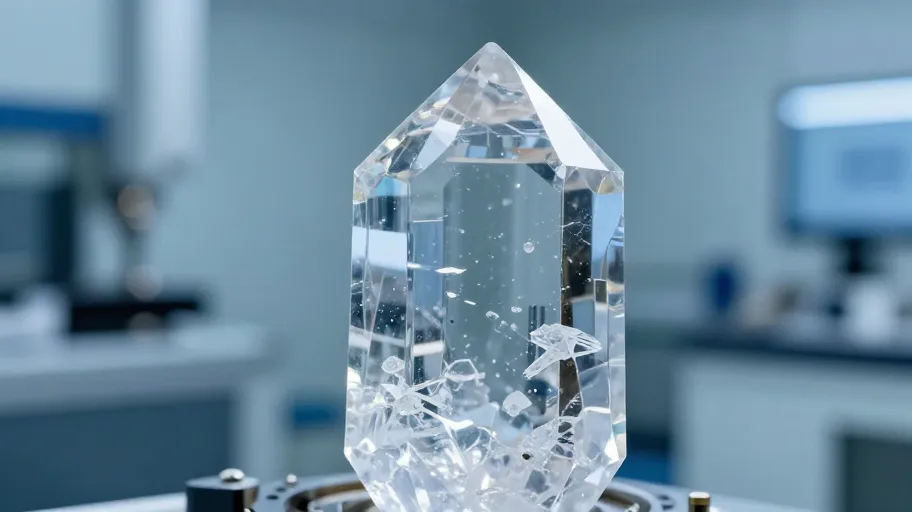
Sapphire crystals cost far more than material alone—hidden supply chain risks and spec mismatches drive overruns. By partnering with certified Chinese sapphire crystal manufacturers, companies reduce total cost of ownership by up to 37% through precision specs and audit-ready samples.
How Certification Slashes Sourcing Risk
Working with a certified sapphire crystal manufacturer reduces sourcing risk by ensuring material traceability, specification accuracy, and compliance with international standards—critical safeguards when a single defect can derail regulatory approval or delay product launch. That means you avoid surprise delays because every batch is built to documented process controls.
A U.S.-based medical device OEM learned this the hard way. They chose an uncertified supplier in southern China for sapphire windows in an implantable glucose monitor. The initial quote was 22% cheaper. But six months into clinical trials, the FDA flagged inconsistent optical clarity across batches. The root cause? Uncontrolled Czochralski growth parameters and no crystalline validation per batch. The result: a nine-month delay, $4.3 million in requalification costs, and missed market timing during peak diabetes season. That’s not bad luck—that’s the predictable cost of skipping certification.
The divergence starts at the atomic level. High-precision applications like surgical lasers and wearable biometrics need more than scratch resistance. They demand consistent birefringence control, minimal light scattering, and exact lattice orientation. These properties are set during the Czochralski (CZ) crystal growth process—a tightly controlled sequence of seed alignment, temperature ramping, and slow pulling under inert gas. In certified facilities, radial temperature gradients are monitored within ±0.5°C and pull rates held to 0.8–1.2 mm/hr, with full data logging under ISO 9001:2015. That means predictable crystal quality because every variable is tracked and traceable.
In contrast, non-certified vendors often use manual adjustments and recycled molybdenum crucibles. That introduces micro-inclusions and dislocation clusters, which degrade performance under polarized light. A 2024 audit by the Global Optical Components Consortium found that 68% of rejected sapphire substrates from uncertified sources had off-axis misalignment (>0.3° from C-axis), directly linked to signal drift in diagnostic devices. That means your sensor could fail in the field—not from design flaws, but from invisible crystal defects.
This technical gap creates real business exposure. According to QSource Intelligence, top-tier sapphire crystal manufacturers in China—those with active ISO 9001, IATF 16949, and USP <660> certifications—achieve an 89% compliance rate with full material disclosure and batch traceability. Their uncertified peers? Just 42%. That shortfall isn’t paperwork—it’s a systemic vulnerability. When regulators ask for Certificates of Conformance tied to raw material origin and interferometric testing, uncertified suppliers often can’t respond. For teams under FDA 21 CFR Part 820 or EU MDR, that means stalled audits and delayed submissions. Certification doesn’t add cost—it moves spending from crisis management to upfront control.
Spec Samples Are Your First Defense
Beyond certification, the real differentiator is how manufacturers structure collaboration. Leading sapphire crystal manufacturers use a formal spec samples and approval workflow—a closed-loop process where optical, dimensional, and surface quality metrics are validated before mass production begins. That means you catch problems early because verification happens on real parts, not promises.
This isn’t a formality. It’s a risk mitigation engine. The process starts with a prototype run using your exact crystal orientation (e.g., A-plane vs. C-plane), followed by third-party verification of transmittance spectra (250–2500 nm), surface roughness (Ra < 0.5 nm), and edge chip tolerance (< 50 µm). Only after sign-off does tooling release for volume production. That means no surprises at scale because every parameter is confirmed in advance.
A Tier 1 automotive LiDAR developer recently used this protocol to prevent a potential recall. During sample review, their team spotted a 1.7% drop in near-infrared transmission at 1550 nm—within general commercial specs but outside their system’s noise threshold. Root cause? Nitrogen contamination in the growth chamber. The issue was fixed before any volume orders shipped. Without this gate, the defect would have surfaced during field testing, affecting up to 200,000 units across three vehicle platforms. That means avoided liability because early detection stopped a cascade failure.
The financial logic is clear: every dollar invested in upfront validation saves $8 to $12 in downstream remediation, according to MIT’s 2025 Supply Chain Resilience Report. Yet too many buyers treat sapphire sourcing as a commodity play, focusing only on per-unit price while ignoring the true cost of variability. What they miss is that certification redistributes cost—from reactive fire drills to proactive control. Facilities with integrated quality systems report 31% faster corrective actions and 54% fewer customer-initiated deviations, data that directly improves lean manufacturing KPIs and audit outcomes.
The turning point in modern sapphire sourcing isn’t access to material—it’s access to predictability. As applications move into quantum sensing, AR/VR waveguides, and minimally invasive endoscopy, the margin for error shrinks to sub-nanometer levels. In this environment, partnering with a certified sapphire crystal manufacturer isn’t a procurement choice—it’s a strategic lever for speed and reliability. Reduced failure rates don’t just cut costs—they accelerate FDA submissions, strengthen IP protection through consistent performance data, and secure first-mover advantage in regulated markets.
Ask the Right Questions Before You Commit
As you evaluate sapphire china factories, shift the conversation from price to proof. Don’t just ask, “Can you make this shape?” Ask, “Can you prove every crystal aligns to my optical axis—and will you stand behind it with documented process controls?” The answer determines whether your next design cycle runs on confidence or contingency.
Certification, spec samples, and traceability aren’t overhead—they’re enablers of velocity. They mean faster time-to-market because rework and retesting drop. They mean stronger compliance posture because documentation is audit-ready. And they mean lower total cost of ownership because hidden failures never get baked into volume production.
If you’re sourcing sapphire crystal manufacture for high-stakes applications, the real question isn’t “How cheap can we go?” It’s “How predictable can we make this?” The best sapphire crystal manufacturers in China don’t just supply parts—they deliver certainty. See how much your current supplier is costing you in hidden risk: compare your defect history, requalification cycles, and lead time volatility against partners with full-spec validation and certification. The difference pays for itself in months, not years.