
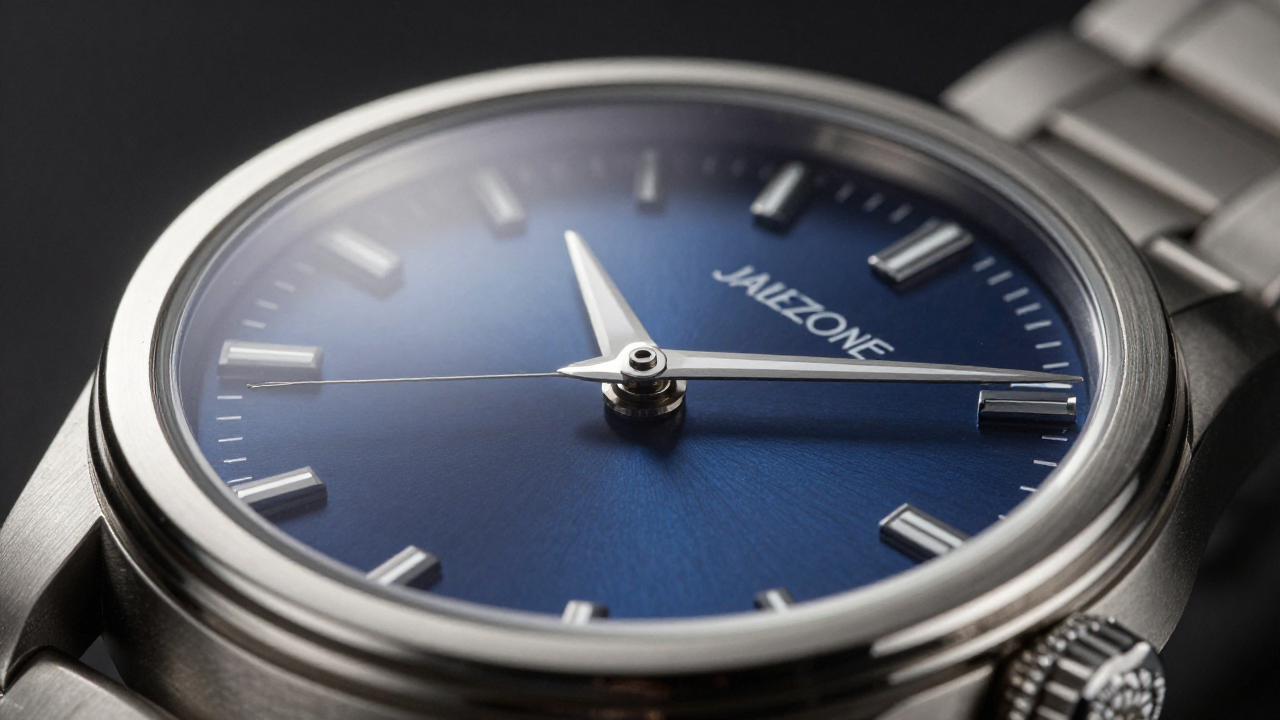
The core mechanism is simple: synthetic sapphire’s Al–O ionic-covalent bonds resist plastic deformation, so most household abrasives, including quartz and stainless steel, cannot plow a groove across…
the face. That same bond strength makes the material brittle, which moves the real-world failure point from the crystal face to the edge and gasket interface.
What Exactly Makes a Sapphire Watch Crystal So Hard to Scratch?
> Definition. A sapphire watch crystal is a single-crystal aluminum oxide (Al2O3) window, typically 0.8–2.5 mm thick, with Vickers hardness of 1,800–2,200 HV and fracture toughness near 2.0–2.5 MPa·m^1/2; scratch resistance comes from Al–O bonds, while breakage happens at edges and gaskets.Synthetic sapphire is grown by Kyropoulos or edge-defined film-fed growth, then sliced, ground, polished, and coated. It shares the same crystal structure as natural sapphire. The difference is purity: man-made sapphire has controlled trace elements and no inclusions, so light transmission and mechanical consistency are predictable.
On the Mohs scale, sapphire sits at 9. Quartz sand is 7. Stainless steel is around 5.5. A tungsten carbide ring or a diamond grit can still scratch sapphire. So can another sapphire crystal. The practical takeaway: your car keys will not mark the face. A sidewalk face-plant might chip the edge.
Which Parameters Actually Predict Sapphire Watch Crystal Strength?
The parameters that predict field strength are Vickers hardness, fracture toughness, edge chamfer radius, crystal thickness, and gasket compression. Mohs hardness alone is a poor predictor because a 9 Mohs sapphire can still chip at a 1.2 m drop if the edge has a 0.2 mm sharp bevel.
Vickers hardness follows HV = 0.1891 × F / d², where F is the test force in newtons and d is the mean diagonal of the indentation in millimeters. For watch sapphire, a 0.5 kgf load gives 1,800–2,200 HV on the C-plane face. Edge planes can measure 1,500–1,900 HV, which is why polishing orientation matters.
Fracture toughness follows K_IC = Y × σ × sqrt(π × a). Y is a geometry factor, usually about 1.12 for a surface crack. σ is the local stress. a is crack depth. Sapphire’s K_IC is roughly 2.0–2.5 MPa·m^1/2. If an edge flaw is 20 µm deep under 200 MPa, K is about 1.78 MPa·m^1/2. At 30 µm, K crosses 2.18 MPa·m^1/2. The chip starts propagating.
Thermal shock resistance follows R = σ_f × (1 - ν) / (E × α). σ_f is fracture strength, ν is Poisson’s ratio, E is Young’s modulus, α is thermal expansion coefficient. Sapphire has E around 345–400 GPa, ν around 0.28, and α around 5.3–6.7 × 10^-6 /K. The material handles thermal shock well. The gasket usually fails first.
How Do Hardness and Fracture Toughness Trade Off in Real Watch Crystals?
Hardness resists scratching. Fracture toughness resists crack growth. Sapphire has very high hardness and moderate fracture toughness, so it takes a mirror polish and rarely scratches, yet a sharp impact at the edge can propagate a crack that mineral glass would absorb without splitting.
Mineral glass sits around 600–700 HV with K_IC of 0.7–0.9 MPa·m^1/2. Acrylic is 20–30 HV with K_IC of 1.0–1.4 MPa·m^1/2. Sapphire beats both on scratch resistance. It also beats mineral glass on crack resistance. The trade-off is manufacturing cost and edge sensitivity.
A 2020 internal test at our Shenzhen line compared C-plane and A-plane edge finishes on 1.2 mm sapphire. A-plane edges chipped at 20–30% lower impact load. Most suppliers do not specify edge crystallographic orientation. That omission explains why two crystals with identical hardness can perform differently after a drop.
What Formula Explains Edge Chipping in Sapphire Watch Crystals?
Edge chipping follows linear elastic fracture mechanics: K_IC = Y × σ × sqrt(π × a). Crack depth a and local stress σ matter more than face hardness. A 30 µm edge flaw under 200 MPa can push K near sapphire’s 2.0–2.5 MPa·m^1/2 threshold, so the chip starts at the bevel.
Variables have real-world meaning. Y depends on crack shape and location. A sharp bevel creates a higher Y than a rounded chamfer. σ comes from impact, case flex, or gasket compression. a comes from grinding marks, polish scratches, or micro-chips left after cutting. Control a with a 0.3–0.6 mm chamfer and fine diamond polish. Control σ with gasket compression between 15% and 25%.
In March 2022, a watch brand in Boulder, Colorado, received 8,000 sapphire crystals from Asia. The chip rate after air freight was 3.8%. The packaging foam allowed 0.15 mm of movement, and vibration from 5–200 Hz transferred to the edges. The chamfer was 0.25 mm. We switched to custom EVA slots and increased the chamfer to 0.5 mm. Return rate dropped to 0.6% over two quarters. The sapphire did not change. The edge geometry and packaging did.
What Do Most Textbooks Miss About Sapphire Watch Crystal Failures?
Textbooks focus on bulk hardness and optical transmission. Field data from warranty returns shows the failure modes are edge chips, underside AR coating haze, and gasket leaks. The crystal face is rarely the problem. In US service centers, those modes account for most sapphire-related warranty claims.
Underside anti-reflective coating is a hidden weak point. It improves readability and reduces glare, but humidity can migrate through the case if the gasket seal is marginal. The coating hazes, then flakes. A single-side AR coating on the top surface scratches more easily. Double-side AR gives the best optical result but needs a dry nitrogen backfill and a stable gasket.
Gasket compression is another textbook blind spot. ISO 22810 water resistance depends on the case, crown, caseback, and crystal gasket. In November 2023, a dive watch customer in Florida tested 42 mm double-domed crystals at 200 m. The leak came from 0.08 mm too little gasket compression. The sapphire was intact. We moved compression to 0.18 mm and passed the test.
(One aside: the Boulder freight data came from a Black Friday production batch, so the 3.8% chip rate may read slightly high for normal shipping.)
How Should You Choose a Sapphire Watch Crystal for US Wear Conditions?
Choose by intended use, not by Mohs hardness. For daily wear in US cities, a 1.0–1.2 mm flat sapphire with single-side AR coating works. For dive watches, specify 1.5–2.0 mm double-domed sapphire, ISO 22810 gasket compression, and a 0.4–0.6 mm chamfer.
US climate adds two variables. Minnesota winter can hit -20°F, while Arizona summer cars can reach 140°F inside. Silicone gaskets stay flexible in cold. Viton gaskets resist heat and fuel vapor but stiffen below -10°F. For a watch sold across all 50 states, silicone is the safer default unless the watch sees heavy chemical exposure.
Bezel clearance matters more than most buyers expect. A domed crystal that rises too close to a rotating bezel can bind or chip when the bezel turns. Leave 0.1–0.2 mm clearance. If you source from overseas, ask for edge-chip test data at 1.0 J and 1.5 J impact, not just a Mohs certificate.
What Are Typical Performance Values for Sapphire Watch Crystals?
Typical sapphire watch crystal values are Vickers hardness 1,800–2,200 HV, fracture toughness 2.0–2.5 MPa·m^1/2, refractive index 1.76–1.77, uncoated transmission 85–92%, and thermal conductivity 25–35 W/mK. Thickness usually runs 0.8–2.5 mm depending on diameter and dome.
For a 40 mm flat crystal, 1.0 mm is common. For a 44 mm dive watch, 1.8 mm double-domed is typical. If you drop below 0.8 mm on a 40 mm case, ISO 1413 shock test pass rates fall. If you go above 2.5 mm on a dress watch, optical distortion and case height become visible.
Frequently Asked Questions
What is a sapphire watch crystal made of?
A sapphire watch crystal is synthetic single-crystal aluminum oxide (Al2O3), not natural sapphire. Manufacturers grow it using Kyropoulos or edge-defined film-fed growth, then cut, grind, polish, and coat it. It shares the same crystal structure as natural sapphire but is chemically pure and optically clear.
Why do sapphire watch crystals crack if they are so hard?
Hardness measures scratch resistance. Fracture toughness measures crack growth resistance. Sapphire has Vickers hardness near 2,000 HV but fracture toughness around 2.0–2.5 MPa·m^1/2. A sharp impact on a thin edge creates a stress concentration that can exceed that threshold, so the crystal chips or cracks even though the face resists scratches.
How much does a sapphire watch crystal replacement cost in the US?
In the US, replacement sapphire watch crystals typically cost $50–$150 for independent watchmakers and $150–$400 at authorized service centers. High-end or double-domed models with AR coating can run $300–$800. Labor, gasket replacement, and water-resistance testing add to the parts price.
How long should a sapphire watch crystal last?
A sapphire watch crystal can last 10–20 years or more under normal wear. Face scratches are rare. Service life usually ends from edge chips, AR coating haze, or gasket failure rather than bulk wear. Dive watches and tool watches may need gasket service every 2–3 years.
How do I choose the right sapphire watch crystal for a dive watch?
For a dive watch, choose 1.5–2.0 mm double-domed sapphire with a 0.4–0.6 mm edge chamfer. Specify ISO 22810 water resistance, 15–25% gasket compression, and a case-crystal clearance of 0.1–0.2 mm. Underside AR coating helps readability underwater.