
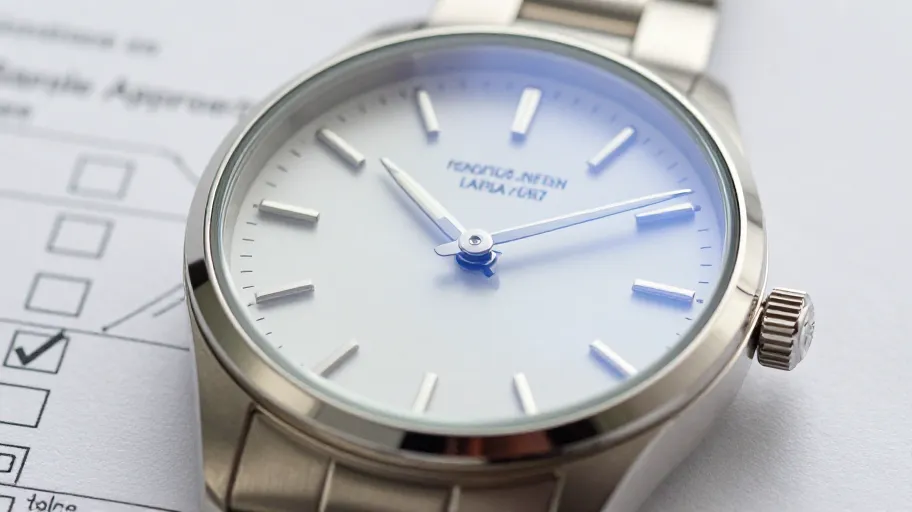
Sourcing a sapphire lens for a watch comes down to three controllable stages: a complete specification, a disciplined sample loop, and a documented sign-off. Define every dimensional, optical and coating callout before quoting. Approve samples only against written acceptance criteria. This guide gives you the spec checklist, comparison table and approval questions to run the process properly.
Why a sapphire lens watch project fails at paperwork, not at the crystal
Most sourcing problems in watch component projects are not material problems. They are definition problems. Two suppliers can quote "the same" sapphire lens watch crystal and mean materially different things, because the drawing omitted coating callouts, edge finishing, plinth geometry, or inspection criteria. The buyer discovers the gap when parts arrive.
The way to prevent this is not to trust a supplier's summary. It is to control the document chain: specification, sample acceptance criteria, and final approval record. The framework below gives that structure a name your team can use internally.
The SPEC–SAMPLE–SIGN-OFF (3S) framework
| Stage | Buyer's job | Output you keep |
|---|---|---|
| SPEC | Freeze the drawing and written spec: material grade description, geometry, coatings, markings, inspection and packaging requirements | Approved spec pack issued with every RFQ |
| SAMPLE | Request samples against the frozen spec; define in advance what "acceptable" means for fit, optics and finish | Sample evaluation record with pass/fail per criterion |
| SIGN-OFF | Approve in writing; link approval to the exact spec revision and sample reference; define the change process | Golden sample plus signed approval note referenced in the purchase order |
The framework's value is that nothing moves forward on a verbal "it looks fine". Every stage produces a document you can point to when questions arise during production.
Stage 1: SPEC — what belongs in the spec pack
A complete sapphire lens watch specification should force the supplier to answer, in writing, at least the following. Where a value is project-specific, state your target and ask the supplier to confirm capability — do not accept silence as agreement.
Geometry and fit
- Diameter, thickness and any step or plinth geometry, with the measurement method named on the drawing.
- Where dimensions interact with the case, gasket or bezel, state the functional requirement (e.g., seal compression) and ask the supplier how they will verify it.
- Which dimensional tolerance class applies to your project — ask the supplier what they can hold and how it is measured, rather than assuming a number.
- Edge treatment: shape, polish zones and any chamfer definitions.
Optical and surface
- Coating definition: which side(s), what function (anti-reflective behaviour), and how it will be verified.
- Surface quality criteria: which inspection standard or method you will use, and the acceptance level you require.
- Transparency/appearance criteria under agreed lighting.
Marking and identification
- Any logo, index or print: artwork reference, location, method and durability expectation, stated as a requirement for the supplier to confirm.
Logistics of the document
- Spec revision number on every page.
- Statement that quotations must quote against the stated revision and flag any deviation in writing.
This last point is what makes supplier quotations comparable. If the spec pack is incomplete, you are comparing prices for different products.
Decision table: comparing sapphire lens quotations
Use this table across every supplier you contact, including JadeZone Sapphire. Its purpose is to surface gaps before pricing, not after tooling.
| Evaluation question | What a strong response looks like | Red flag |
|---|---|---|
| Is the quotation referenced to a spec revision? | Quotation cites the revision and lists any deviation | Quote based on a "similar" part or a verbal summary |
| Are coating and marking included as line items? | Each feature priced and described | "Includes everything" with no breakdown |
| What dimensional tolerance can be held, and how is it measured? | A stated capability tied to a named measurement method | Vague assurances with no measurement basis |
| What inspection evidence accompanies each lot? | Defined inspection documents or reports per agreed criteria | "We check quality" with no defined output |
| What is the sample process and its terms? | A written statement of sample policy, cost terms and timing — confirmed directly | No written sample policy; terms change mid-conversation |
| How are deviations and changes handled? | A written change-control process | Changes absorbed silently into production |
| What is the approval mechanism? | Written sign-off tied to a golden sample | Production starts from an email saying "OK" |
Note the deliberate gap: nothing above tells you what JadeZone Sapphire's current sample policy, pricing structure, lead time or tolerance capability is. That is intentional. Those facts are project-specific and must be confirmed directly with the supplier at the time of enquiry — the table exists so you ask precisely, and compare answers.
Stage 2: SAMPLE — running a disciplined sample loop
Before requesting samples, write the acceptance criteria. This is the single highest-leverage step in the process, because "the sample looks good" is not an acceptance criterion.
A sample evaluation record should cover:
- Fit — installation into your case or fixture, and interaction with gasket or bezel, judged against your functional requirement.
- Optics — visual clarity and coating behaviour under the lighting conditions you agreed in the spec.
- Surface and edge — inspected against the stated method and acceptance level.
- Marking — artwork position, definition and any durability check you defined.
- Documentation — does the sample arrive with the dimensional and inspection evidence you asked for?
For each item: pass, fail, or conditional with a required correction. Send the completed record to the supplier, not just the failures. Suppliers correct what is documented; ambiguous feedback creates the next round of ambiguity.
On sample terms — cost, shipping, timing, and what happens if the sample fails — no policy details can be stated here. Confirm the current sample policy in writing directly with the supplier before issuing the request, and record it in your project file.
Stage 3: SIGN-OFF — approval questions to answer before production
Approval should be a gate, not a mood. Before authorising production of any sapphire lens watch component, your team should be able to answer yes to every question below, in writing:
- Does the approved sample carry a unique identifier, and is it physically retained as the golden sample?
- Is the approval referenced to a spec revision number, and is that revision the one the production order uses?
- Are all sample evaluation records complete, with every conditional item closed in a documented correction?
- Has the supplier confirmed in writing the dimensional tolerances, inspection method and lot documentation for production?
- Are coating and marking acceptance criteria restated in the purchase documents, not just the drawing?
- Is there an agreed written process for handling any deviation discovered during production?
- Do you have the supplier's current written statements on sample policy, pricing terms and delivery arrangements for this project, confirmed directly?
If any answer is "no", the honest status is "not yet approved". Proceeding past an open item transfers risk to your assembly line, where it costs more to discover.
FAQ
Is a sapphire lens the same thing as a sapphire crystal for a watch? In practice, buyers and suppliers use overlapping terms — sapphire crystal, sapphire glass, sapphire lens — for the transparent synthetic sapphire cover over a watch dial. What matters commercially is not the label but the spec: geometry, coating, surface criteria and inspection method. Define those, and terminology disputes disappear.
What should I send a supplier to get an accurate quotation? A frozen spec pack: dimensioned drawing with revision number, coating definition, marking artwork, inspection criteria, and a clear statement that quotations must reference the revision and flag deviations. This is precisely what the 3S framework's SPEC stage produces.
How many sample rounds should I plan for? There is no universal correct number, and none should be asserted here. What you can control is making each round productive: written acceptance criteria before sampling, a structured evaluation record after, and closure of every conditional item. Disciplined loops are shorter than improvised ones.
Can I approve a sapphire lens based on the supplier's own inspection report? A supplier report is evidence, not approval. Your approval should rest on your own evaluation of the sample against your functional requirements, supplemented by the supplier's documentation. Keep both in the project file.
What if the supplier's terms differ between the sample stage and production? Document everything at each stage and reconcile before sign-off. If sample-stage terms and production-stage terms diverge, resolve it in writing before the purchase order is issued — the sign-off gate in the 3S framework exists for exactly this situation.
Get the working documents before your next RFQ
If this structure matches how you want to run your next sapphire lens watch project, 获取采购 Brief — the condensed procurement brief you can hand to any supplier, including JadeZone Sapphire, to force complete, comparable quotations from the first email.
Not ready to talk to suppliers yet? Start small: take the seven approval questions above into your next internal sourcing review as your readiness checklist. When every box is ticked, you are ready to request a quotation with confidence.