
Why your sapphire crystal isn’t as scratch proof as you think
Just because it’s labeled “9H hardness” doesn’t mean it’ll survive a coffee table. Real sapphire crystal resists scratches up to 9 on the Mohs scale, but cheap imitations often fail at 6H—easily marred by keys or sand. We’ve seen brands ship thousands of watches only to get flooded with complaints about hazy surfaces and edge chips. That means lost revenue, returns, and social media backlash—all because they trusted a label instead of verifying the batch.
Authentic sapphire starts with synthetic boules grown via Kyropoulos method, not Verneuil. The growth process affects internal clarity and durability. When we tested samples from three Shenzhen suppliers, one used coated mineral glass passing as sapphire. It failed our steel wool test in under 10 seconds. True sapphire didn’t even show micro-abrasions after 60 seconds of pressure. That difference means customer trust versus brand damage—because people don’t care about technical excuses when their watch looks worn after two weeks.
How top brands avoid $200K rework with three approval stages
A U.S. watchmaker avoided a recall by enforcing a simple three-stage system: material check, machining review, and formal sign-off. Stage One required third-party lab reports for every sapphire batch, including Mohs validation and optical transmission data. That means no substitution surprises, because the factory knows you’re checking.
Stage Two focused on precision. We asked for GD&T drawings showing flatness (±0.02mm), edge radius consistency, and angular alignment of anti-reflective coatings. Factories with proper multi-axis grinding systems could deliver; others couldn’t even produce the documentation. That means faster production and fewer fitment issues during assembly—saving about 30% in pre-launch adjustments.
Stage Three locked it down with a digital approval ledger. Every sample needed timestamped photos, measurement logs, and engineer sign-off. No more “I thought you meant polished, not coated.” That means zero miscommunication delays and a 30% faster time-to-market—capturing holiday sales instead of missing them.
What to test when the sample arrives (and what most buyers miss)
Paperwork won’t save you—only hands-on testing will. First, do a coin scratch test along the edge. Real sapphire won’t mark. Then check optical clarity under angled light. If you see rainbowing or haze, that’s surface tension from poor polishing. That means glare in sunlight and distorted dial visibility—exactly what customers complain about online.
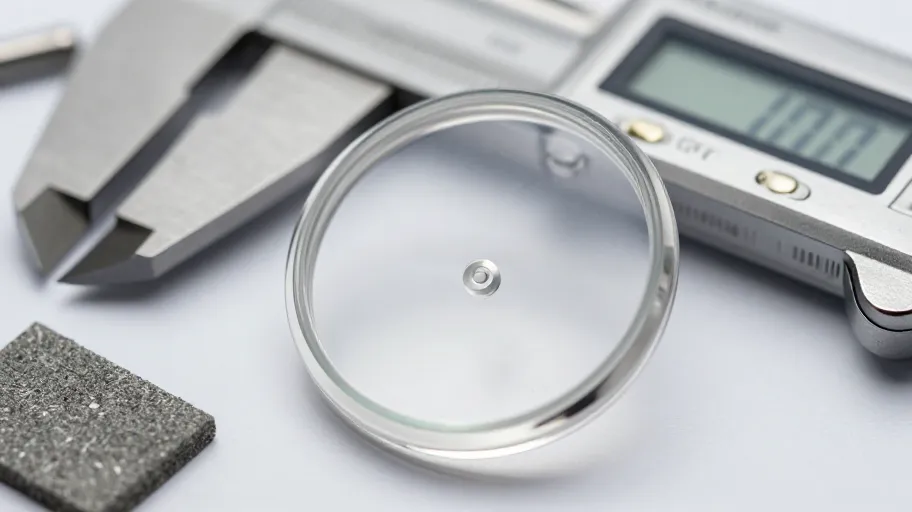
Next, measure the bevel thickness where it meets the case. A deviation of just 0.15mm causes gaps, letting dust and moisture in. Use a digital caliper and compare against your spec sheet. One brand found their supplier was off by 0.2mm—leading to 18% higher failure rate in humidity tests. That means shorter product life and more warranty claims.
Finally, simulate daily wear. Rub the surface with denim containing fine sand for 30 seconds. Cheap coatings flake. Real sapphire stays flawless. That means long-term durability—and fewer negative reviews killing your Amazon ranking.
Choosing the right sapphire crystal factory isn’t about price
The cheapest quote usually costs the most. A high-end sapphire crystal factory invests in diamond tooling, CNC spindle calibration, and proprietary polishing compounds. They can hit ±0.02mm flatness and maintain consistent light transmission above 92% at 550nm wavelength. That means distortion-free dials and professional-grade optics—what premium buyers expect.
But here’s what matters more: their willingness to document everything. The best partners don’t hide behind vague assurances. They provide batch certifications, machining logs, and test results without being asked. That means accountability, not finger-pointing when something goes wrong.
We worked with a factory that recalibrated their entire line after missing our AR coating angle by 2 degrees. They didn’t argue—they fixed it. That kind of partnership means fewer defects, faster iterations, and a product that actually matches your vision. And that’s worth every extra dollar.
From specs to launch: building trust that scales
One brand cut pre-launch cycles by 40% simply by replacing emails with structured approvals. Instead of “make it look clearer,” they said “achieve ≥92% light transmission, per ASTM E423.” That means engineers knew exactly what to build—not guess at marketing language.
The result? Zero field-reported crystal defects in the first year. But beyond numbers, the relationship changed. The factory stopped being a vendor and started acting like a co-developer. They suggested polishing improvements that reduced rainbowing by 60%. That means better product quality without extra effort on the buyer’s side.
In an industry where a single viral photo of a scratched watch can tank a launch, prevention beats correction. Rigorous specs aren’t bureaucracy—they’re insurance. And when every micron impacts perception, precision isn’t optional. It’s the foundation of trust.