
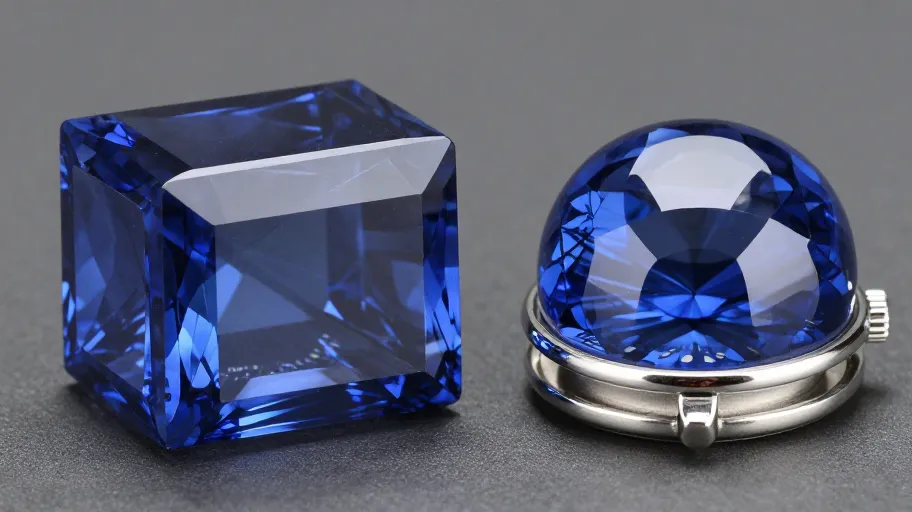
When comparing a box sapphire crystal versus a domed sapphire crystal, the decision comes down to how each form interacts with your case geometry, dial visibility targets, height budget and finishing requirements — not to which is objectively better. A box crystal rises from a defined base with distinct side walls and a flatter upper plateau; a domed crystal curves continuously from edge to crown. Use the FORM–DRAW–APPROVE framework: fix the form factor against the design intent, lock every drawing input before requesting a quotation, and run sample approval against pre-agreed criteria.
The two forms in specification language
A box sapphire crystal is defined by its straight or near-straight side profile, a measurable wall height, and a broad, flatter viewing surface. It suits designs that want a more architectural silhouette, a distinct bezel-to-crystal transition, or a larger flat viewing area over the dial.
A domed sapphire crystal is defined by a continuous convex curve from the edge toward the centre. The curve radius, apex height and edge thickness all become controlled dimensions. It suits designs seeking a curved light path, a vintage-leaning profile, or a specific optical character over the dial.
Neither form is a quality grade. Both are machined from sapphire and both can be produced to tight specifications. The buyer's job is to translate design intent into a form definition the supplier can quote and inspect against.
The FORM–DRAW–APPROVE framework
FORM — fix the form factor. Decide from the case design, not from preference alone. Ask: what case height budget exists? How should the crystal meet the bezel? Is the priority a flat viewing plane or a curved profile? Document the answer as a profile sketch with key dimensions before contacting suppliers.
DRAW — lock the drawing inputs. A box crystal drawing must define base dimensions, wall angle, wall height, top surface flatness intent, and edge break requirements. A domed crystal drawing must define the base diameter, dome radius or profile curve, apex height, and edge thickness. Coating intent, finishing and any printed or applied markings must also be specified. Leave any of these open and the quotation you receive will carry assumptions you did not author.
APPROVE — run the approval gates. Approve samples against the drawing, not against a photograph or a general impression. Confirm with the supplier in writing what inspection methods, measurement reports and re-submission rules apply before samples are ordered, and confirm the current sample and tooling policy directly, since none is stated here.
Decision table: box vs domed across buyer criteria
| Criterion | Box sapphire crystal | Domed sapphire crystal | What the buyer must confirm |
|---|---|---|---|
| Profile definition | Side walls plus flat or near-flat top | Continuous convex curve | Profile drawing with radii and heights |
| Viewing surface | Broad flat plane over the dial | Curved surface; reflections follow the curve | Whether reflections suit the dial and hands design |
| Height envelope | Controlled by wall height | Controlled by apex height and radius | Fit with hands, dial and case headroom |
| Edge treatment | Wall-to-top edge break must be defined | Edge thickness at the seat must be defined | Gasket or seat interface dimensions |
| Optical character | Flat light path | Curved light path; magnification perception varies with curve | Visual evaluation on real samples against the dial |
| Drawing complexity | Wall angle, wall height, top flatness | Dome radius or spline profile, apex height | Which dimensional set your team can specify precisely |
| Inspection focus | Wall geometry, top surface, edge break | Curve profile conformity, apex height, edge thickness | Measurement methods and reports offered by the supplier |
| Design fit | Architectural, industrial, modern-leaning cases | Vintage-leaning, curved, cushion or round cases | Alignment with the brand's design language |
This table is a comparison aid, not a specification substitute. Every cell in the final column becomes a project-specific question for your supplier.
Before you request a quotation
A structured quote request reduces re-quote loops. Prepare:
- A profile drawing for the chosen form, with all key dimensions and their intended tolerances stated as your targets for the supplier to confirm feasibility against.
- Case and gasket interface information, so the supplier can flag fit risks rather than guess.
- Finishing intent: polished surfaces, edge treatment, any coating requirement — and confirm with the supplier what coatings they currently offer and how coating performance is verified, since no performance claims are made here.
- Any printing, marking or date-magnifier features.
- Expected annual volume range, so the supplier can propose an appropriate production approach — confirm MOQ and capacity questions directly.
Sample approval: questions that protect the project
Ask these before and during sampling, and document the answers:
- "Which dimensions on my drawing will you measure, with which methods, and what report format will accompany the samples?"
- "What is your current sample policy — cost, tooling, and re-submission terms? Please confirm in writing." (Confirm directly; no policy is stated in this article.)
- "If a sample deviates from the drawing, what is the correction process before production approval?"
- "How do you handle the dome profile conformity or the box wall geometry, and how will I see that in the inspection data?"
- "What should I inspect on my side — fit into the case, gasket compression, visual quality over the actual dial — and what evidence do you need back from me to close approval?"
Close approval only when samples match the drawing, the measurement report is consistent with your own checks, and both parties have signed off in writing.
Pre-quote and approval checklist
- Crystal form chosen and documented with a profile sketch.
- All key dimensions and target tolerances stated in the drawing.
- Case, gasket and dial interface information shared.
- Finishing, coating and marking requirements specified as requirements, with supplier confirmation pending.
- Sample policy, tooling terms and re-submission rules confirmed in writing.
- Inspection methods and report format agreed before samples ship.
- Approval criteria defined on both sides and documented.
- Written production release only after sample sign-off.
FAQs
Which is more expensive, box or domed sapphire? No pricing is stated here, and cost depends on dimensions, finishing, coatings and volume. Submit both profiles for quotation and compare like for like. Confirm current pricing directly with JadeZone Sapphire.
Can a box crystal and a domed crystal share the same case? Only if the seat and gasket interface accommodate both profiles. Ask your case supplier and crystal supplier to review the interface dimensions together before finalising either drawing.
How do I specify the dome curvature precisely? Define the dome as a radius or a profile curve with an apex height and edge thickness, and confirm with the supplier which definition they can measure and report against. Do not rely on reference samples alone.
Should I approve samples from a drawing or from a reference crystal? Approve against the drawing, using the reference crystal only as a visual aid. Drawing-based approval creates a documented basis for production; reference-only approval leaves acceptance open to interpretation.
What if I cannot decide between the two forms? Request quotations and, if the supplier agrees, samples of both forms against your case. Evaluate fit, optics over your actual dial, and height budget side by side, then document the decision.
Next step
If you are preparing a sourcing decision between a box sapphire crystal and a domed sapphire crystal, 获取采购 Brief from JadeZone Sapphire to structure your specification, questions and approval criteria before you commit tooling.
Prefer to start smaller? Copy the checklist above into your next supplier email and use it as your pre-quote self-audit — it costs nothing and closes the most frequent gaps before they reach a sample run.