
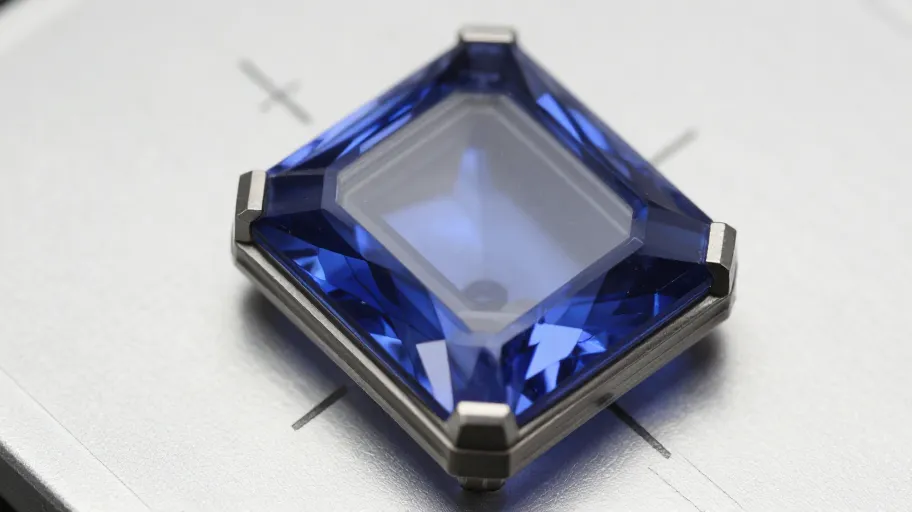
A box sapphire crystal watch project succeeds or fails before the first crystal is cut. Buyers who lock the geometry, coating, gasket interface and dimensional references in a written specification, then validate with samples against a documented sign-off gate, avoid the rework cycles that erode margins. This guide walks through the SPEC–SAMPLE–SIGN-OFF chain: specify precisely, sample deliberately, approve formally — with concrete questions to close every ambiguity.
Why “box” changes the sourcing conversation
A box crystal — a crystal with a raised, curved central portion rising above a flatter perimeter — is not just a flat sapphire disc with a dome added. The box geometry affects:
- Total height and profile, which determine whether hands, rehaut and case bezel clear the crystal.
- Curvature continuity, where an abrupt transition can distort dial visibility or create stress points.
- Gasket and seating interface, because the perimeter flat must still seal against the case construction you have chosen.
- Coating behaviour, since a curved surface reflects light differently from a flat one, and coating application on a box form is its own process decision.
Every one of these is a point where an imprecise drawing becomes an expensive misunderstanding. That is why the sourcing process matters as much as the material itself.
The SPEC–SAMPLE–SIGN-OFF framework
JadeZone Sapphire approaches custom sapphire work as a three-gate chain, and we recommend buyers run the same discipline regardless of supplier:
- SPEC — Convert every intention into a written, dimensioned specification with tolerances you have chosen deliberately, plus referenced test and inspection methods. No verbal agreements on geometry.
- SAMPLE — Commission samples against that frozen specification, and evaluate them with a written method, not an impression.
- SIGN-OFF — Approve formally against pre-agreed criteria, record the approval in writing, and link the production order to the approved sample and drawing revision.
Skipping a gate is where drift begins. A sample approved without a frozen spec proves nothing about repeatability; a PO issued without a recorded sign-off has no reference point when a dispute arises.
Building the specification pack
Before requesting a quotation for a box sapphire crystal watch component, prepare:
- A dimensioned drawing with the box profile defined (a cross-section is more useful than a 3D render alone).
- Your chosen dimensional tolerances, stated per feature rather than as a blanket note — and justified against how the part actually functions in your case.
- Material and orientation references, surface finish requirements per face, and any coating requirements with the coating defined (which surfaces, which side, what acceptance criteria).
- The gasket interface drawing, showing how the crystal perimeter seats in your case.
- Marking, packaging and handling requirements — sapphire edges are unforgiving, and transit damage disputes start with unstated packing assumptions.
What you should not do is assume the supplier will infer tolerances or standards. Ask them to confirm in writing which dimensions they hold to which limits, and where they see manufacturability risk in your drawing. Their response is itself useful sourcing intelligence.
Evaluating samples defensibly
When samples arrive, evaluate them the way you will inspect production. That means:
- Measuring against the frozen drawing, with the same instruments and methods each time.
- Checking the box profile at multiple points, not just overall height, to verify curvature consistency.
- Assessing optical quality — clarity, distortion, coating appearance — under lighting conditions that match real-world use, and documenting observations.
- Trial-fitting with your actual case and gasket components, not a proxy.
- Recording every deviation, however small, and classifying it as acceptable, conditional or reject.
The output should be a written evaluation report shared with the supplier. This creates a shared reference document and sets the tone for production inspection.
Decision table: attribute, verification, approval evidence
| Attribute | Verification method | Approval evidence to record |
|---|---|---|
| Box geometry and profile | Dimensional measurement against frozen cross-section drawing at defined points | Signed measurement report per sample; drawing revision referenced |
| Diameter and perimeter flat | Measurement with stated instruments; trial-fit in case | Fit-test record with case/gasket lot identified |
| Surface finish and clarity | Visual and instrumental inspection under defined lighting | Inspection notes with acceptance decision |
| Coating (if specified) | Defined appearance and adhesion checks per agreed method | Test method reference and result record |
| Edge quality and seating surfaces | Edge inspection and gasket trial-assembly | Assembly record; photographs archived |
| Marking/branding (if any) | Comparison against approved artwork at defined magnification | Approved artwork revision on file |
Approval questions to put to your supplier in writing
These questions are supplier-neutral — use them with any manufacturer, including us:
- Which dimensions on our drawing do you hold to which limits, and which do you consider high-risk?
- What is your current sample policy — including any fees, shipping responsibilities, and whether terms differ between first samples and revised samples? (Confirm current terms directly; do not rely on prior arrangements.)
- What inspection methods and reports will accompany samples and production lots?
- How do you control drawing revisions between sample approval and production, and how will we be notified of any process change?
- What is your current MOQ, lead time and capacity position for this part? (These are project-specific; confirm current figures in writing.)
- What documentation can you provide on material origin, coatings, and any certifications relevant to our markets? (Verify currency and scope of any certificate offered.)
- How are packing and transit protection specified, and how are damage claims handled? (Confirm current policy directly.)
- Who is the named engineering contact for technical queries through the project?
If a supplier resists answering these in writing, treat that as decision-relevant information in itself.
Sample approval checklist
Before signing off, confirm every line:
- Frozen drawing revision is referenced on the approval record
- All dimensions measured with stated instruments and methods
- Box profile verified at multiple points, not only overall height
- Optical and coating checks completed under defined conditions
- Trial-fit completed with actual case and gasket components
- All deviations classified and dispositioned in writing
- Supplier has acknowledged the evaluation report
- Production order explicitly references the approved sample and drawing revision
- All commercial terms (MOQ, pricing, lead time, sample policy, claims) confirmed in writing and current
FAQs
Is a box sapphire crystal harder to specify than a flat crystal? The geometry adds variables — profile height, curvature, and how the perimeter seats — so the specification must be more explicit. A precise cross-section drawing plus per-feature tolerances closes most of the gap.
What should I check first when samples arrive? Start with the box profile and the gasket interface, because those drive both function and fit. Then move to optical quality and coating, then edge condition. Record everything against the frozen drawing.
How do I prevent sample-to-production drift? Gate everything: freeze the spec, approve samples in writing, and make the production order reference the approved sample and drawing revision. Ask the supplier to commit to change notification in writing.
Should I request test reports with samples? Yes — agree in advance which reports accompany samples and which accompany production lots, and which methods they follow. Confirm current documentation practice directly with the supplier rather than assuming it.
How many sample rounds should I plan for? Treat this as project-specific: it depends on design maturity and how completely the first specification is defined. A thorough spec pack reduces iterations, but budget for at least one revision cycle and confirm the supplier's current sample terms for each round.
Next step
获取采购 Brief — request the sourcing brief and use it to build your specification pack, sample evaluation record and approval gate before your next production commitment.
Or start lighter: download the sample approval checklist above and run it against your current project this week. If any box is unticked, you have found your next sourcing task.